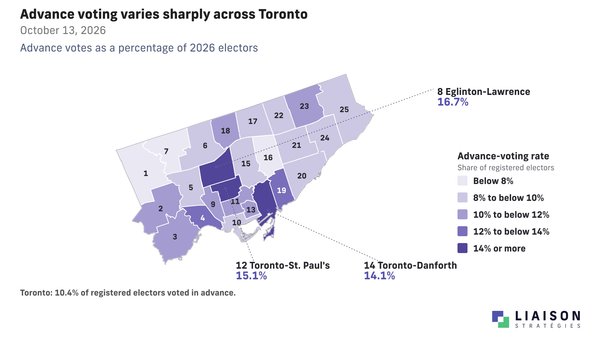
Toronto's Early Voters Are Not Spread Evenly
Downtown accounts for 40.1% of Toronto's advance votes but 35.2% of electors. The ward-level figures show where early participation is strongest, and what remains unknown before October 26.
A collection of 8 posts
Downtown accounts for 40.1% of Toronto's advance votes but 35.2% of electors. The ward-level figures show where early participation is strongest, and what remains unknown before October 26.
Bradford's coverage share reaches roughly 45% after Alexander's withdrawal, while Parrish and Crombie are nearly tied in Mississauga.
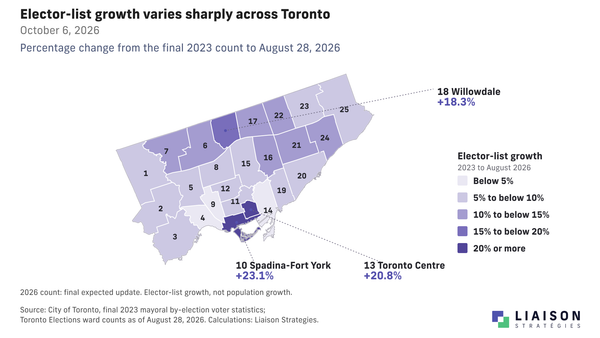
Toronto has added 194,442 electors since the 2023 mayoral by-election. Where the list has grown, what has barely changed, and why it matters for campaigns.
Chow draws almost half of Toronto coverage, Alexander is gaining attention, and Crombie outdraws the sitting mayor. What earned media tells us about Ontario's mayoral races.

A new Liaison Strategies national survey finds households with children are more open to classroom technology, while Canadians remain cautious about AI doing student work or grading.
Quebec City leads Canada on net perceived safety, while Winnipeg has the weakest net safety score.

A new Liaison Strategies Canada Day survey finds 80% are proud to be Canadian, but 44% say they are proud but worried.

Nearly half have used an AI chatbot for medical advice, but 68% would wait for a human doctor.