Safe and Unsafe Cities: Quebec City Best on Net Safety; Winnipeg Worst
Quebec City leads Canada on net perceived safety, while Winnipeg has the weakest net safety score.

September 3, 2026 (Toronto, ON) - A new Liaison Strategies national public safety perception study updates a previous version of this study, conducted nearly a decade ago, and finds Quebec City now has the strongest net perceived safety score in Canada, while Winnipeg has the weakest.
Net safety is the share who say a city is very or somewhat safe minus the share who say it is somewhat or very unsafe. Quebec City leads the 15 cities tested at +57, followed by Ottawa at +56, Charlottetown at +51, Moncton at +41, St. John’s at +39, Victoria at +34, Halifax at +29, Calgary at +24, Montreal at +12, and Regina at +9.
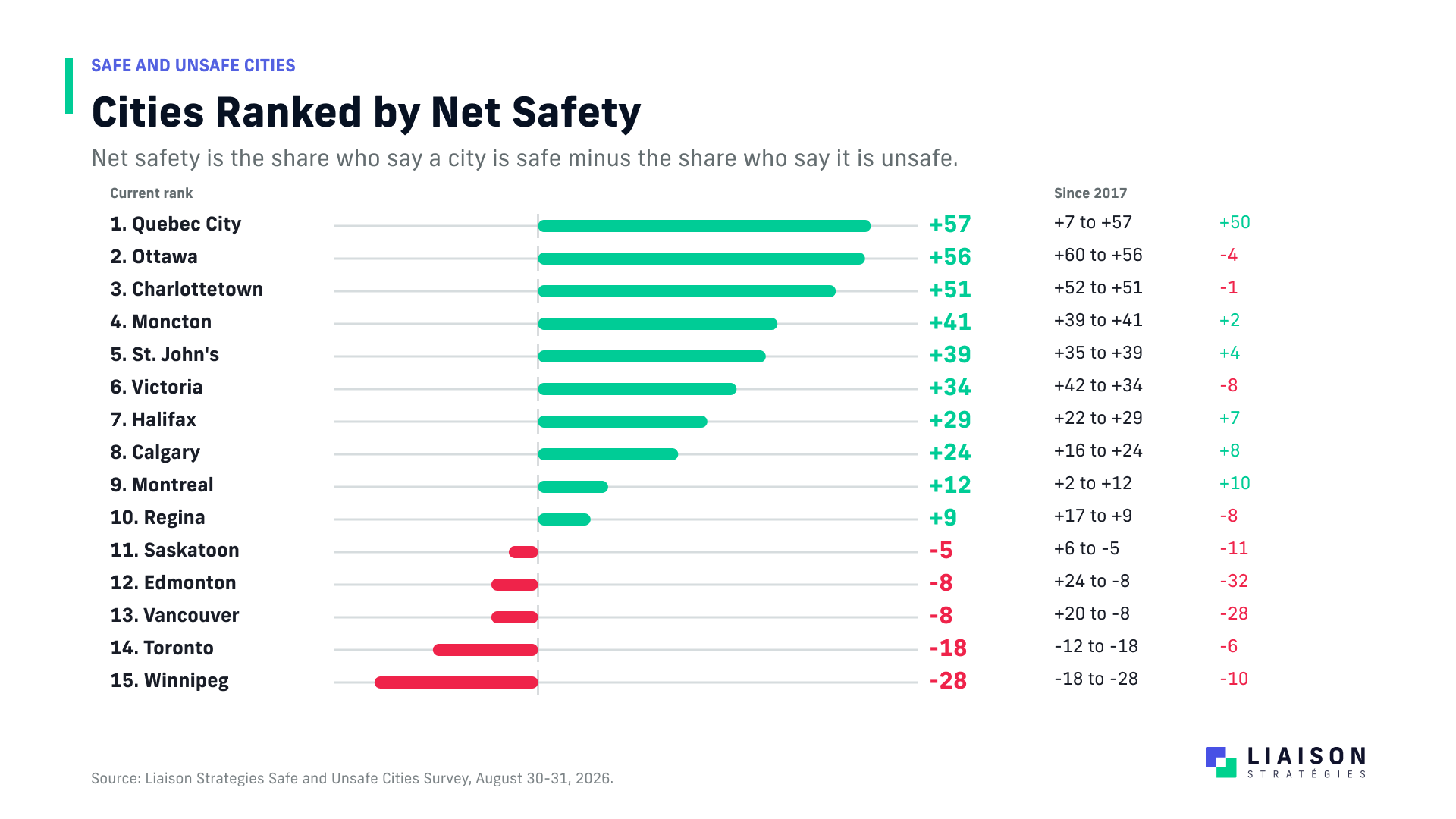
Five cities have negative net safety scores: Saskatoon at -5, Edmonton and Vancouver at -8, Toronto at -18, and Winnipeg at -28. Winnipeg and Toronto remain at the bottom of the ranking, with Winnipeg worsening from -18 in 2017 and Toronto moving from -12 to -18.
The study asked Canadians whether they consider 15 Canadian cities very safe, somewhat safe, somewhat unsafe, very unsafe, or whether they do not know enough to say.
The same ranking also shows which safety reputations have moved most. Quebec City has changed the most since 2017, rising from +7 to +57. Edmonton and Vancouver have moved sharply in the other direction, each falling from positive net scores in 2017 to -8 today.
Liaison surveyed a random sample of 1,500 Canadian adults from August 30 to August 31, 2026, using Interactive Voice Recording (IVR) technology and random digit dialling (RDD). Results were weighted to demographic and geographic targets. The margin of error is +/- 2.53 percentage points, 19 times out of 20.
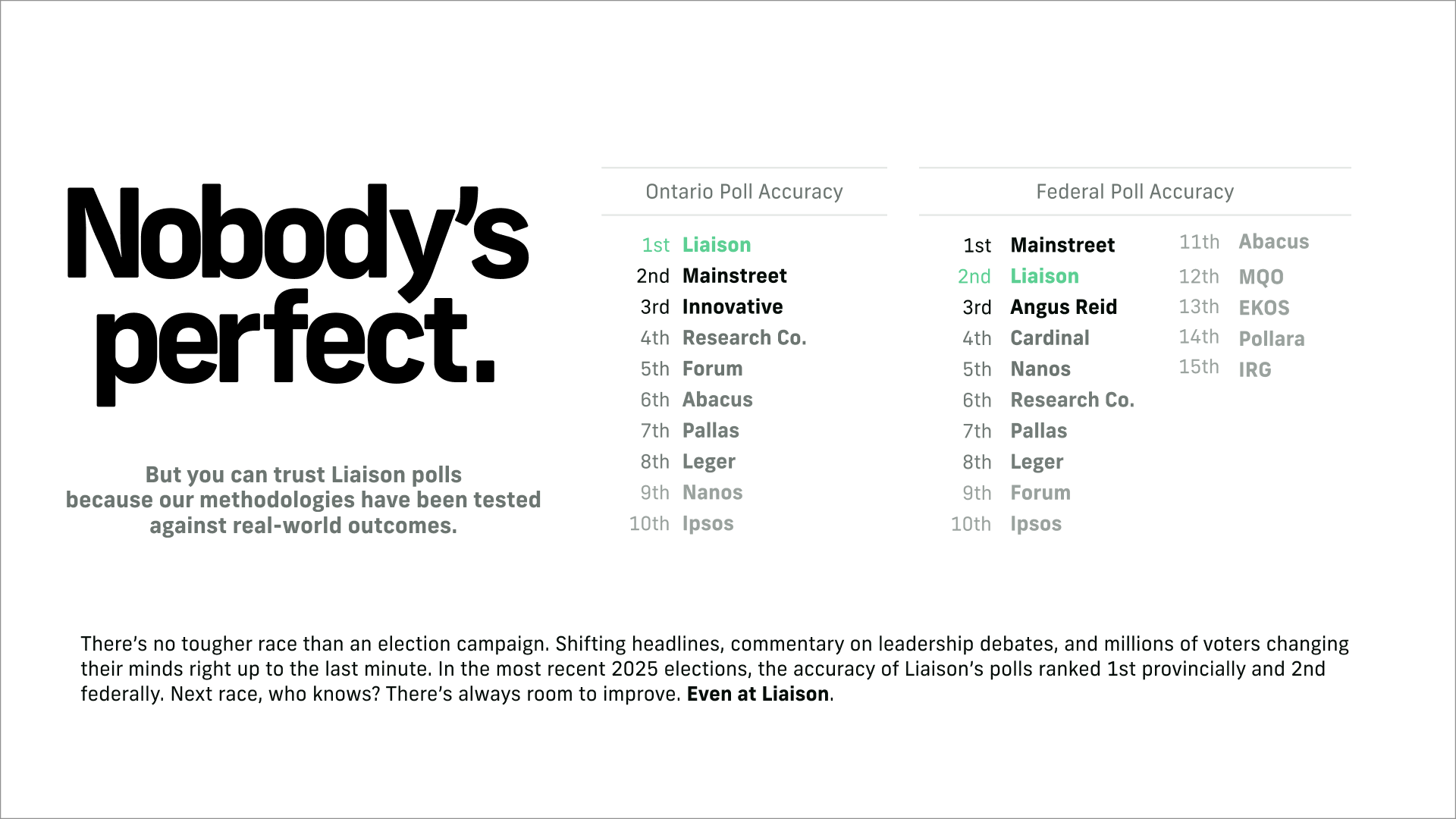
Liaison Strategies is one of the most accurate polling firms in Canada. It ranked #1 in accuracy in the 2025 Ontario election and #2 nationally in the 2025 federal election. Liaison is a member of the Canadian Research Insights Council.
David Valentin, Principal at Liaison Strategies, said:
"We brought this study back because city safety has a long memory. Quebec City now leads on net safety, Ottawa remains very strong, and Winnipeg and Toronto remain at the bottom."
"At the top, this is a two-city story. Quebec City is first on net safety at +57, while Ottawa is just behind at +56. That is a very narrow gap, but if we are ranking cities by net safety, Quebec City is first."
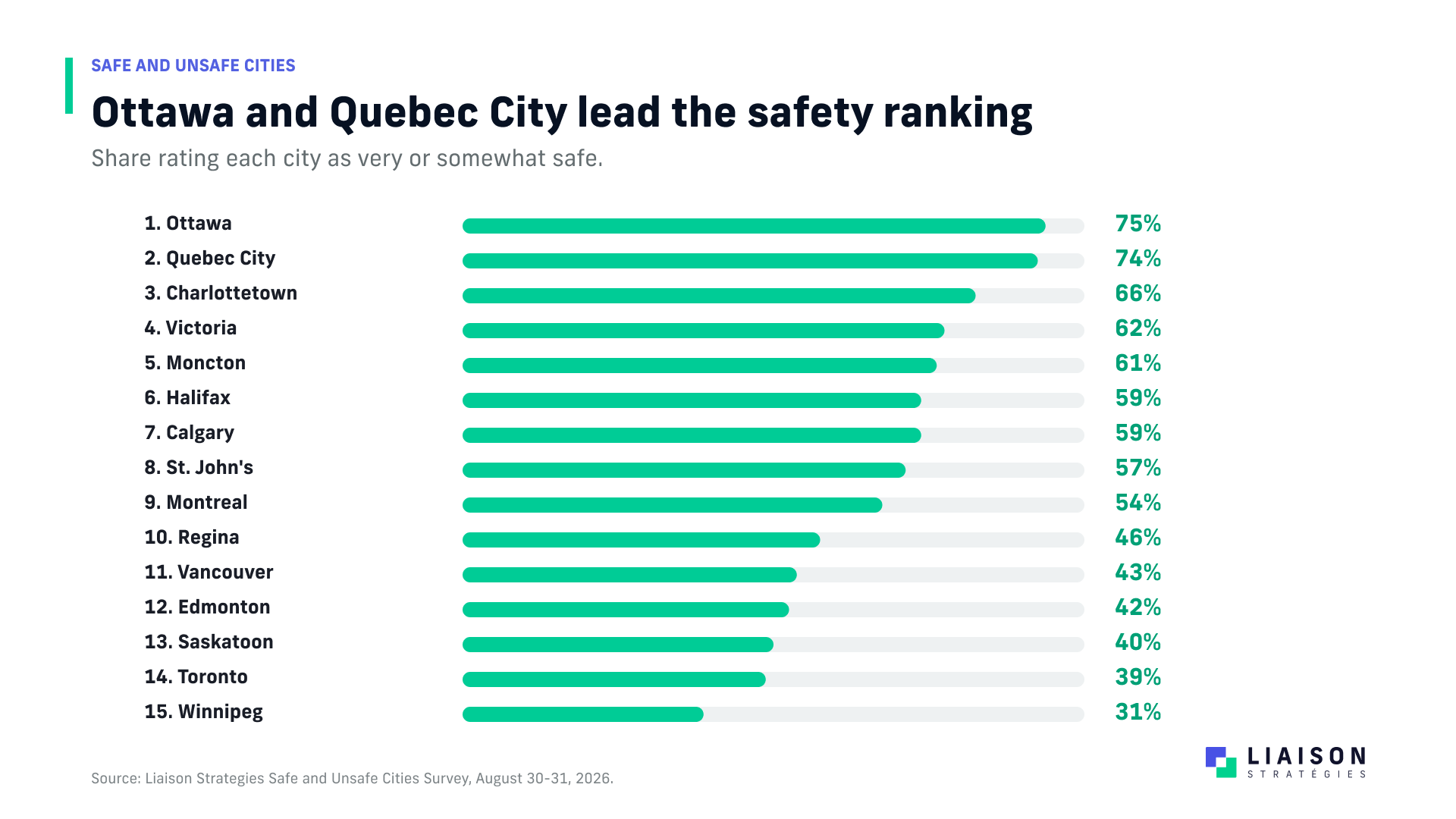
"Winnipeg is the clearest safety concern. It ranks last on perceived safety, with only 31% saying it is safe and 59% saying it is unsafe. It also has the highest official Crime Severity Index among the cities tested, so in Winnipeg the perception problem and the official data are pointing in the same direction."
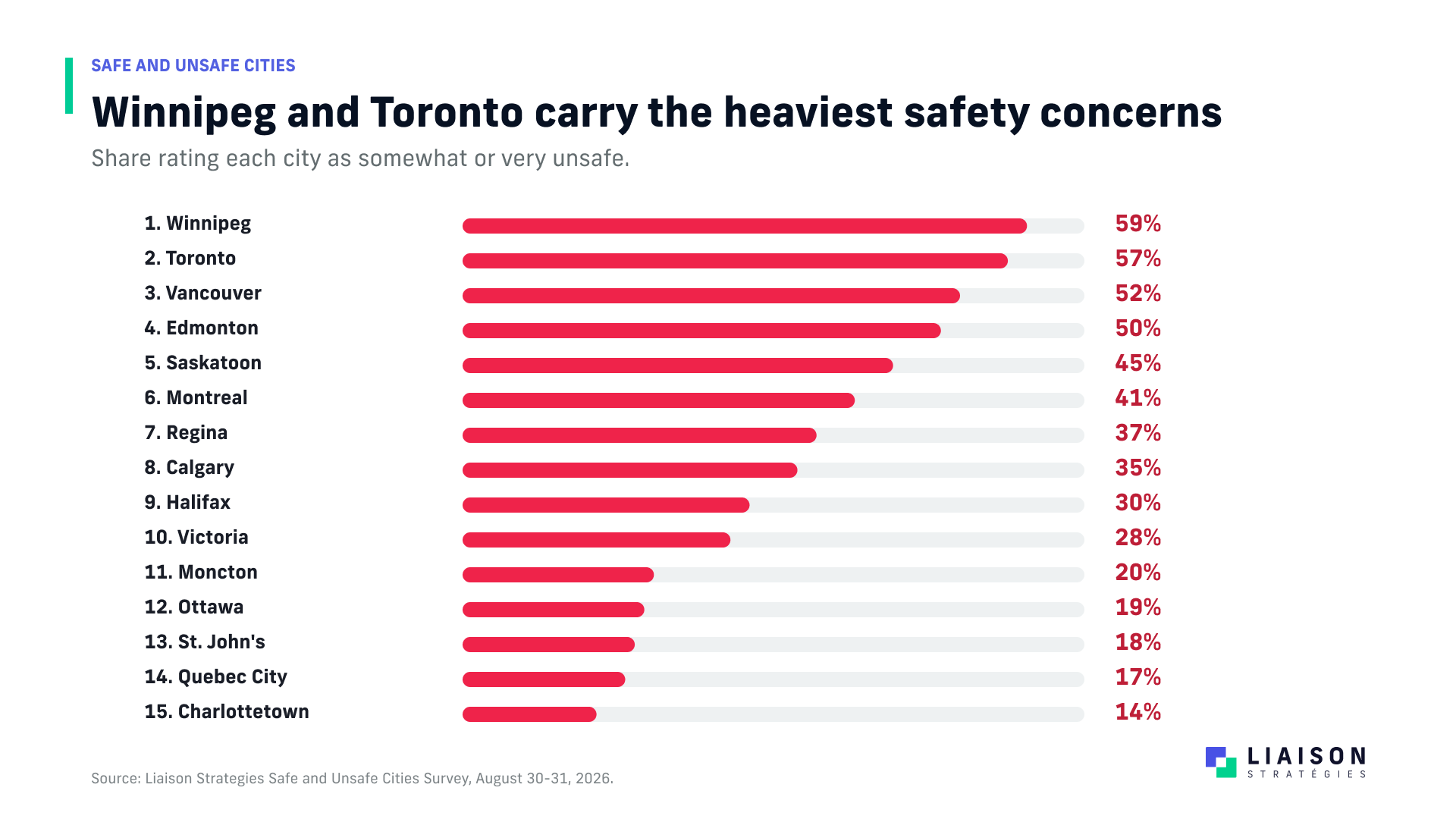
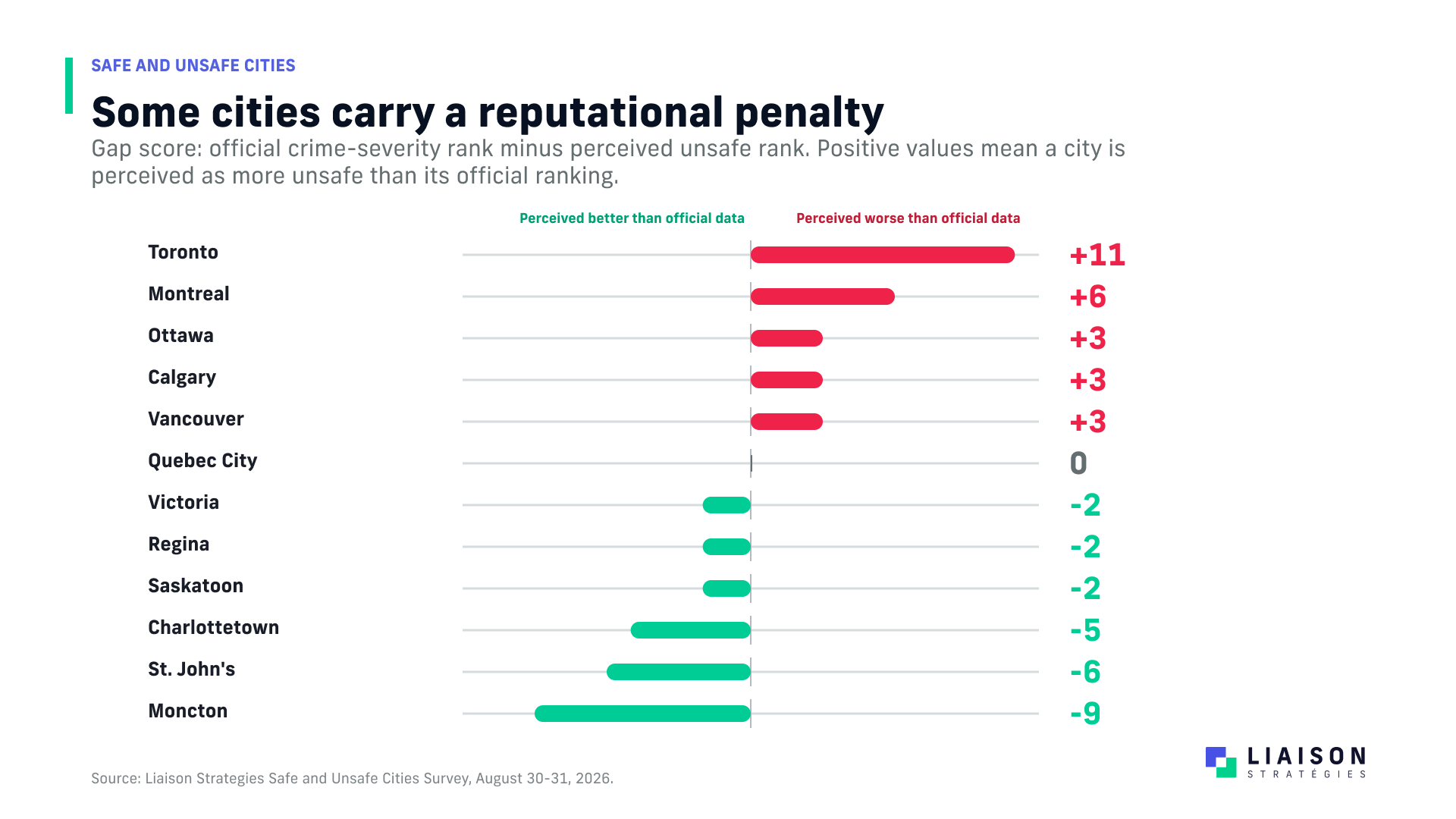
"Toronto is different. Toronto is perceived as almost as unsafe as Winnipeg, but the official crime-severity data does not put Toronto in the same category. That is why Toronto stands out as the clearest reputational penalty in the report."
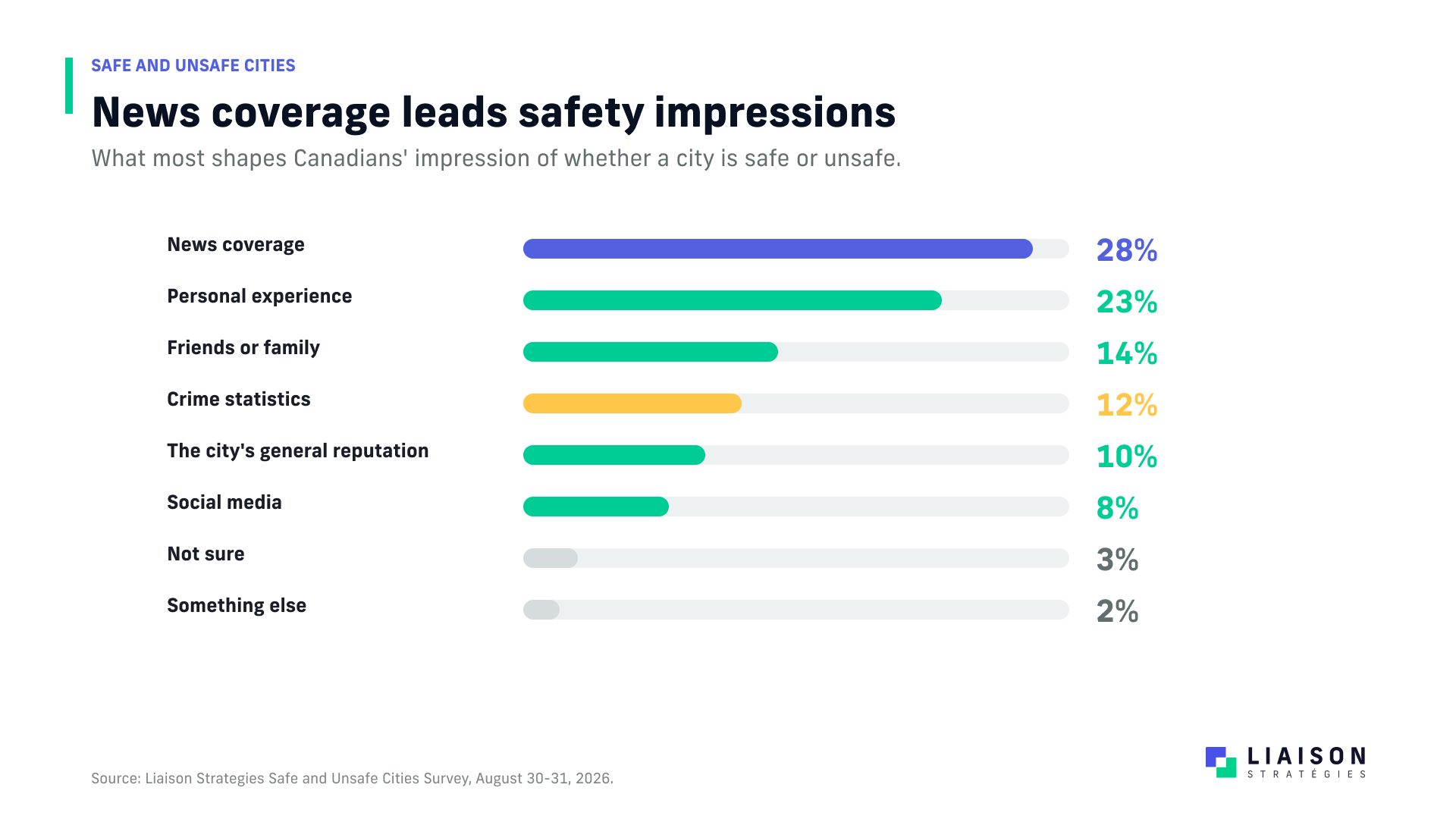
"Only 12% say crime statistics are the main thing shaping their impression of city safety. That matters. If people are mostly relying on news coverage, personal experience, and word of mouth, then city safety is not just a policing issue. It is also a reputation issue."
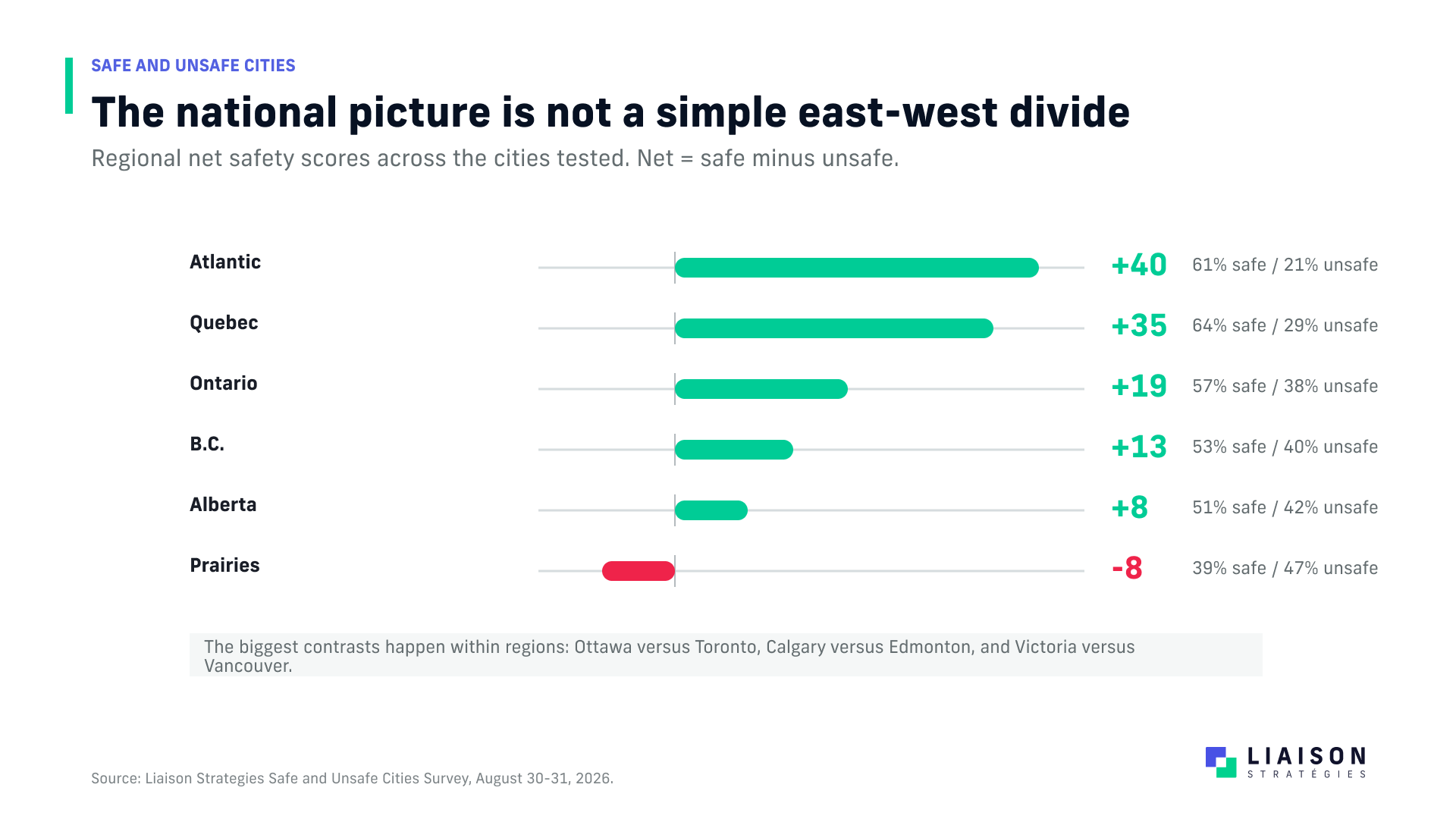
"The regional numbers show that familiarity is not neutral. Some cities look better when judged closer to home, while others look worse. Moncton and Calgary benefit from local and regional familiarity, while Vancouver, Winnipeg, and Saskatoon do not."
"There is also a clear gender gap. Women see a sharper safety problem in several major cities, including Winnipeg, Vancouver, Edmonton, and Toronto. A city can have one national number, but the lived meaning of safety is not the same for every audience."
"For public leaders, the lesson is that perception has consequences. Residents, visitors, and investors react not only to police-reported crime, but to the reputation a city carries. That reputation can take years to build, and years to repair."
-30-
Detailed Poll Report:
Detailed Tables:
About Liaison Strategies
Liaison Strategies is a national public opinion research firm. With 13 years of experience in Canadian polling, David Valentin, principal, has fielded hundreds of projects at the municipal, provincial and federal levels and appeared across Canadian media to discuss insights. Liaison is a member of the Canadian Research Insights Council (CRIC), Canada's voice of the research, analytics, and insights profession both domestically and globally.