The Week in Media: Bradford Gains, Parrish and Crombie Nearly Tied
Bradford's coverage share reaches roughly 45% after Alexander's withdrawal, while Parrish and Crombie are nearly tied in Mississauga.
Happy Thanksgiving. I hope you’re enjoying the day off! If you have a little time between the turkey and the pie, take a look at which mayoral candidates are winning the race for media coverage.
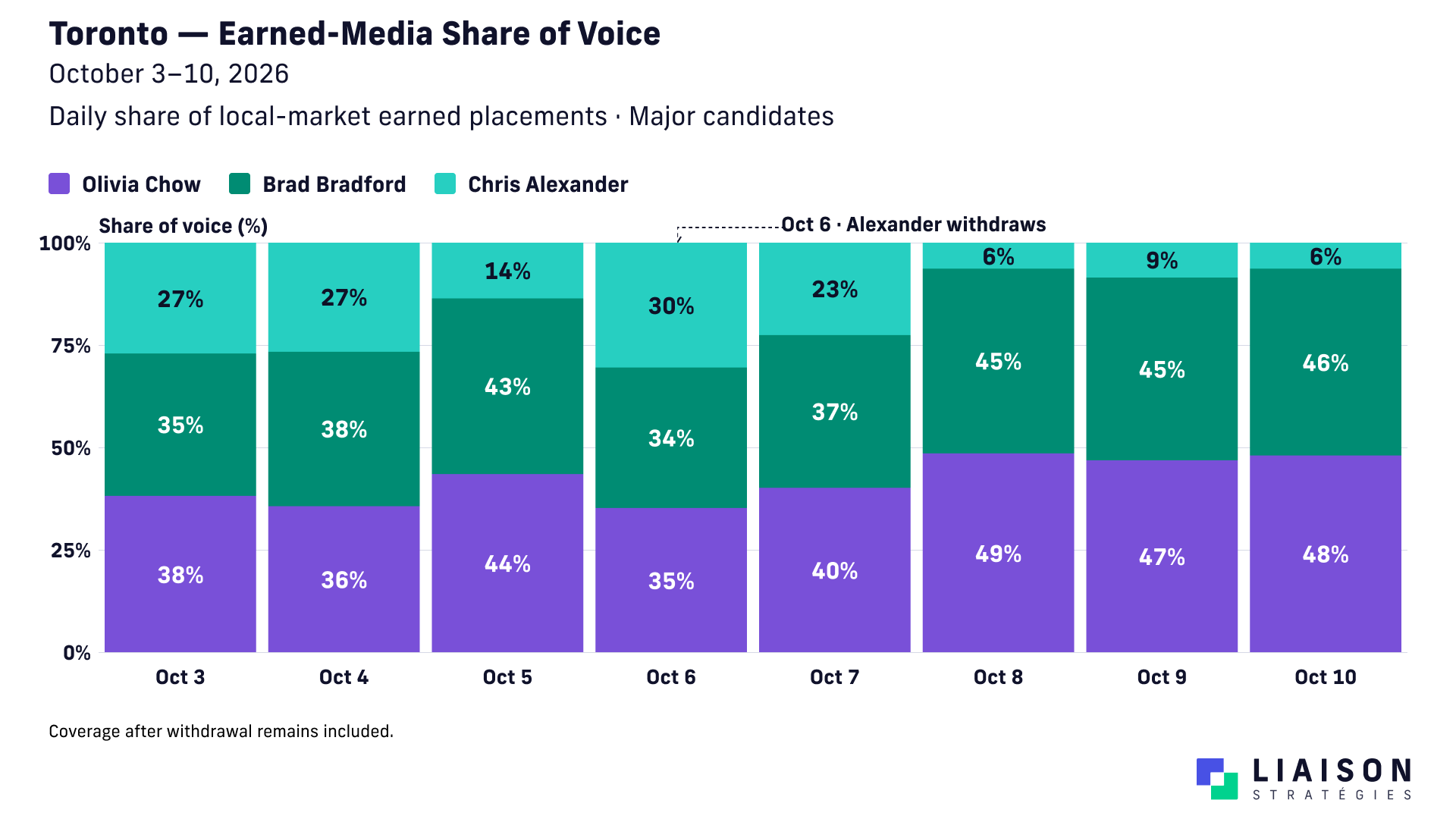
Brad Bradford's share of earned media coverage was higher in the days following Chris Alexander's withdrawal from Toronto's mayoral race, reaching roughly 45% on October 8, 9 and 10. In Mississauga, Carolyn Parrish and Bonnie Crombie were almost tied in the latest week, while Alvin Tedjo received about a quarter of appearances.
For Bradford, there is now more room to make his case directly against Chow. For Tedjo, the opportunity is to get voters considering someone other than the current mayor or the former mayor. Both have to do more than get their names into a story. They need voters to hear what would be different if they won.
With Ontario's municipal election on October 26, the campaigns have two weeks left to turn those introductions into something voters remember when they cast a ballot. Getting covered does not guarantee anyone likes what they hear but it does give a candidate a chance to make an impression.
The main comparison here is October 3-9 against September 26-October 2: two seven-day periods covering Saturday through Friday. These are shares of earned appearances among the major candidates we tracked, not polling numbers.
Toronto: more attention for Bradford after Alexander's exit
Alexander withdrew on October 6. On that day, Bradford received 34.3% of earned appearances. By October 8, his share was 45.1%, followed by 44.6% on October 9 and 45.6% on October 10. Alexander's share fell from 30.5% on October 6 to between 6% and 9% on those later days.
The timing is useful. Coverage of Alexander's departure initially kept him in the news, but by the end of the period Chow and Bradford accounted for most of the appearances. The two remaining major candidates were within four percentage points of one another on October 8, 9 and 10.
That gives Bradford a larger part of the conversation in which to explain why voters should make a change. He is still competing with a mayor whose job provides plenty of reasons to be in the news, but he no longer has another major challenger making his own case against her.
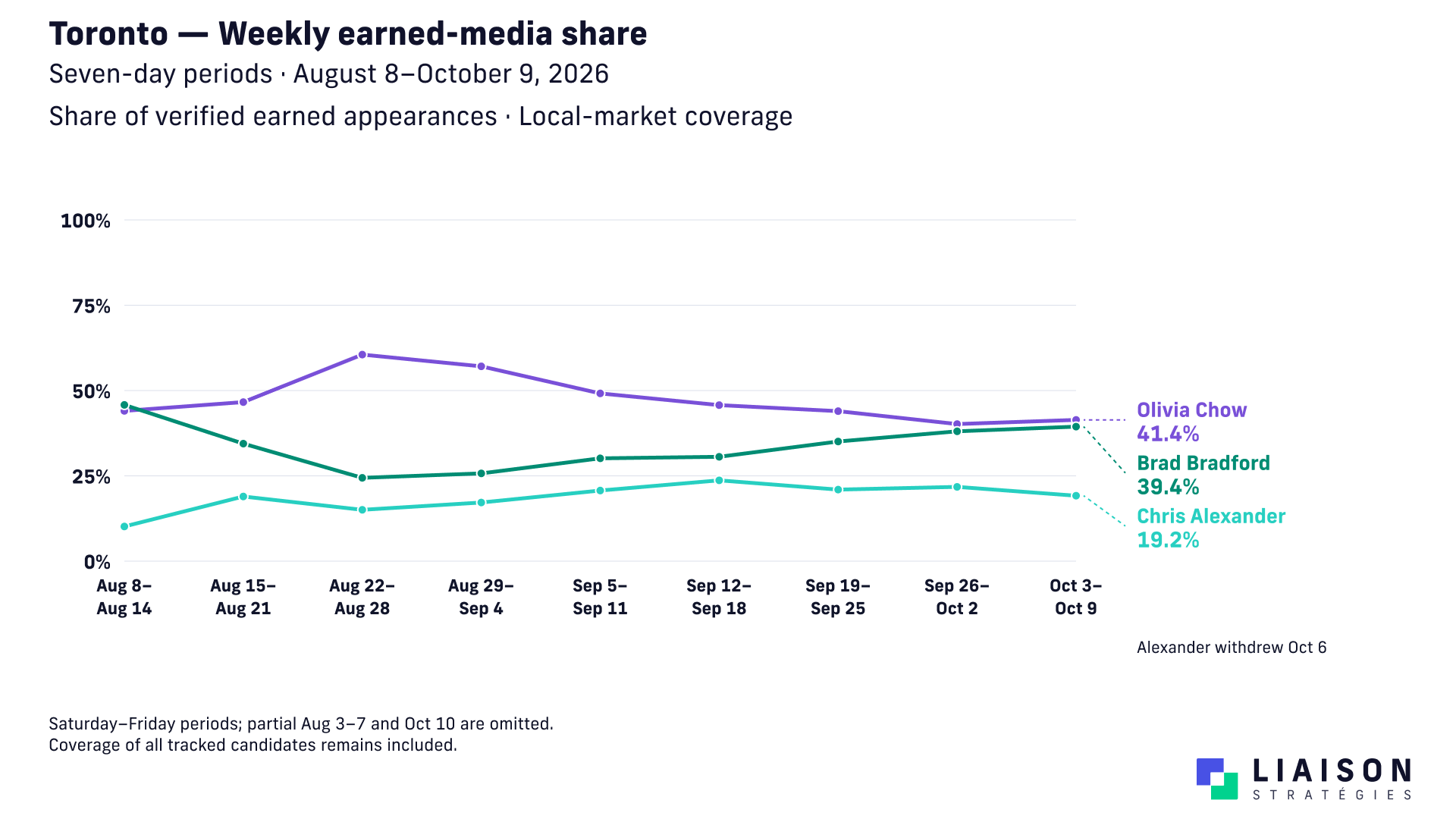
Across the October 3-9 week, Chow received 41.4% of earned appearances, Bradford 39.4% and Alexander 19.2%. Bradford's weekly share was up from 38.1% the previous week. The whole-week figure includes the days before Alexander withdrew and the coverage of his departure; it does not show the late-week balance as clearly as the daily figures do.
In the earlier post, I was interested in Alexander's ability to compete with Bradford for attention. Now the more important question is what Bradford does with the additional attention. Getting nearly as much coverage as Chow gives him a chance to be considered. It does not tell us whether voters liked what they heard, or whether anyone changed their vote.
Ottawa: Lawson gets a larger share
Lawson received 25.5% of earned appearances in October 3-9, compared with 18.3% the previous week. Sutcliffe received 32.1%, compared with 40.2%. Jeff Leiper's share was 23.2%, compared with 23.8%, while Neil Saravanamuttoo's was 19.3%, compared with 17.7%.
That leaves Sutcliffe ahead, but with a much smaller gap over Lawson in the verified coverage. Lawson also moved ahead of Leiper, who had received the larger share the previous week.
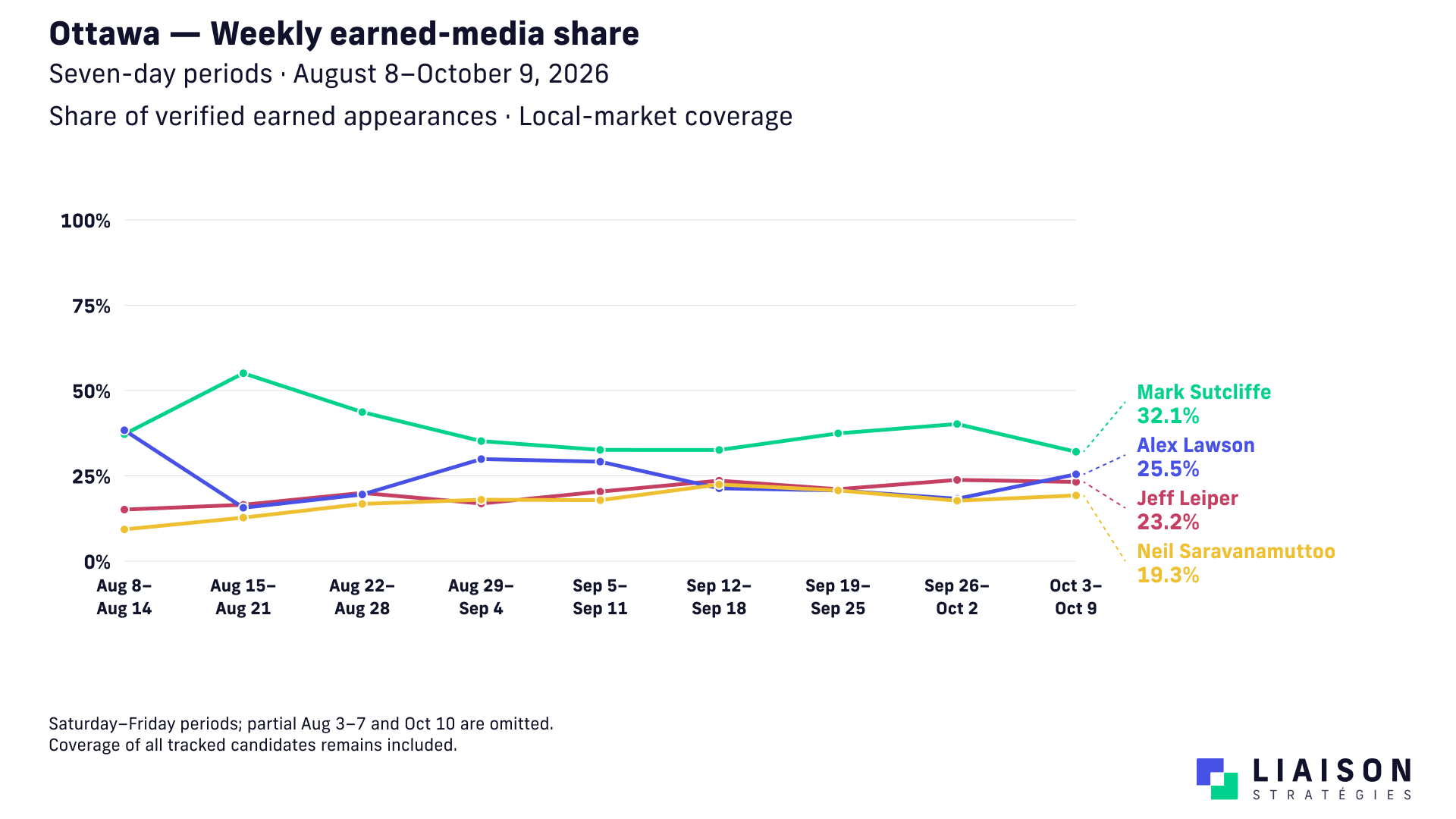
I would not describe that as Lawson steadily taking over the challenger coverage. There have been substantial differences between weeks. The latest result gives him more opportunities to make his case, not proof that the other challengers have been pushed aside.
Leiper's share was much steadier over the last two weeks. Saravanamuttoo was also receiving a meaningful share of coverage. For voters hearing about alternatives to Sutcliffe, there were still three people competing to explain why the city needs a different mayor.
The radio and television comparison adds something useful. Over October 3-10, Saravanamuttoo received roughly 20% of radio appearances but 14% of television appearances. Sutcliffe received about 32% on radio and 36% on television. Lawson was at roughly 26% in both.
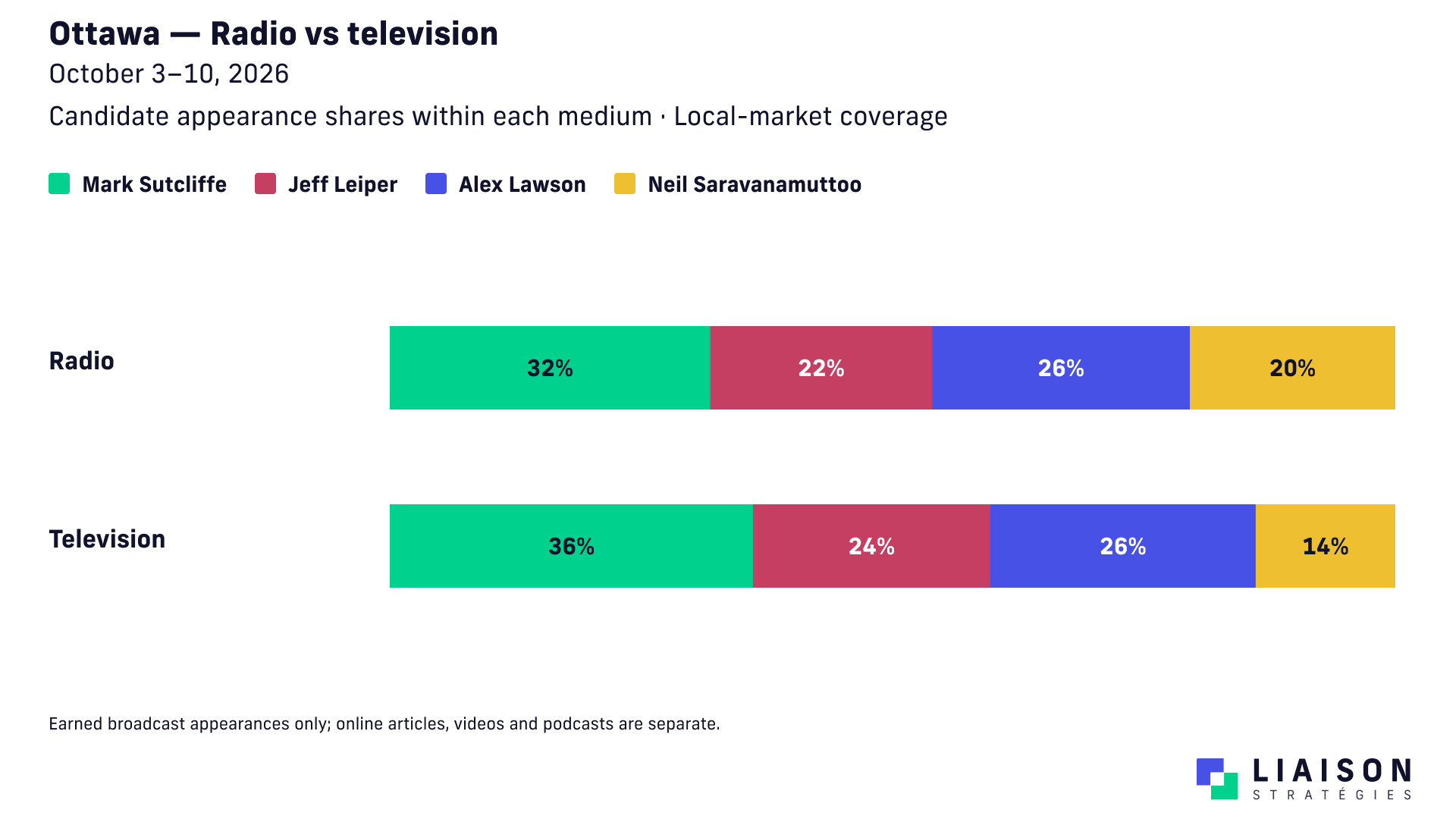
A voter following the race on television could therefore encounter a somewhat different balance of candidates from someone listening to the radio. That does not tell us which candidate got the better interview or the more favourable story. It does tell us that the combined total can conceal important differences in coverage.
Mississauga: Crombie and Parrish are almost tied
Parrish received 30.5% of earned appearances in October 3-9, Crombie 29.9%, Alvin Tedjo 24.7% and Dipika Damerla 14.8%. The previous week's shares were 29.5%, 33.4%, 23.0% and 14.1%, respectively.
The latest comparison is close. Parrish was slightly ahead of Crombie, Tedjo was receiving about a quarter of appearances, and Damerla remained behind the other three.
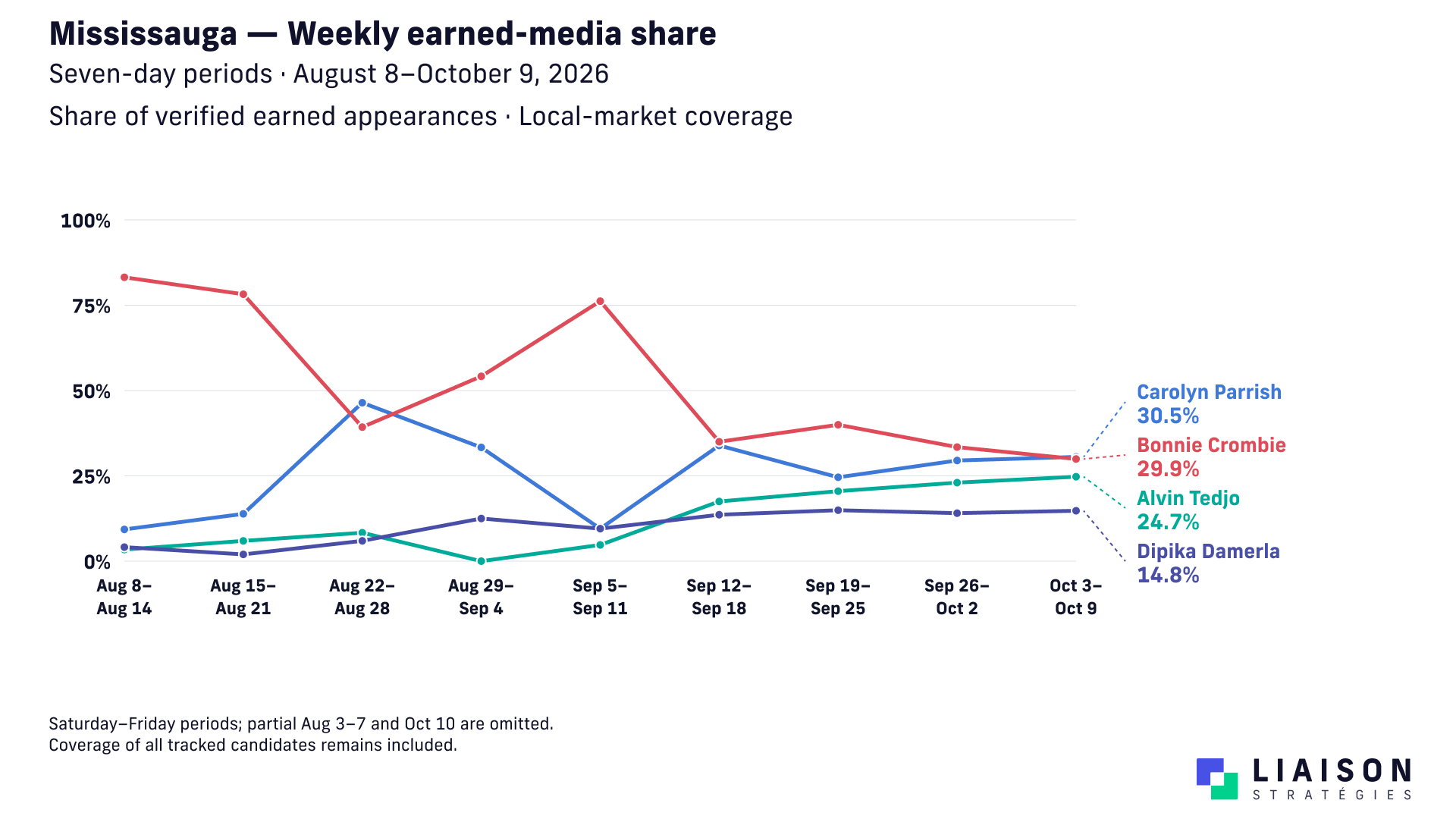
ICrombie's previous jobs still matter. A former mayor and provincial party leader does not have to begin by explaining who she is. But Parrish has the visibility of the mayor's office, and Tedjo was getting repeated opportunities to explain why voters should consider someone who has not already had the job.
Damerla's radio and television shares are particularly interesting. In the separate October 3-10 broadcast comparison, she received roughly 11% of radio appearances and 19% of television appearances. Crombie received about 33% on radio and 27% on television. Parrish was at approximately 32% and 29%, while Tedjo was at 23% and 25%.
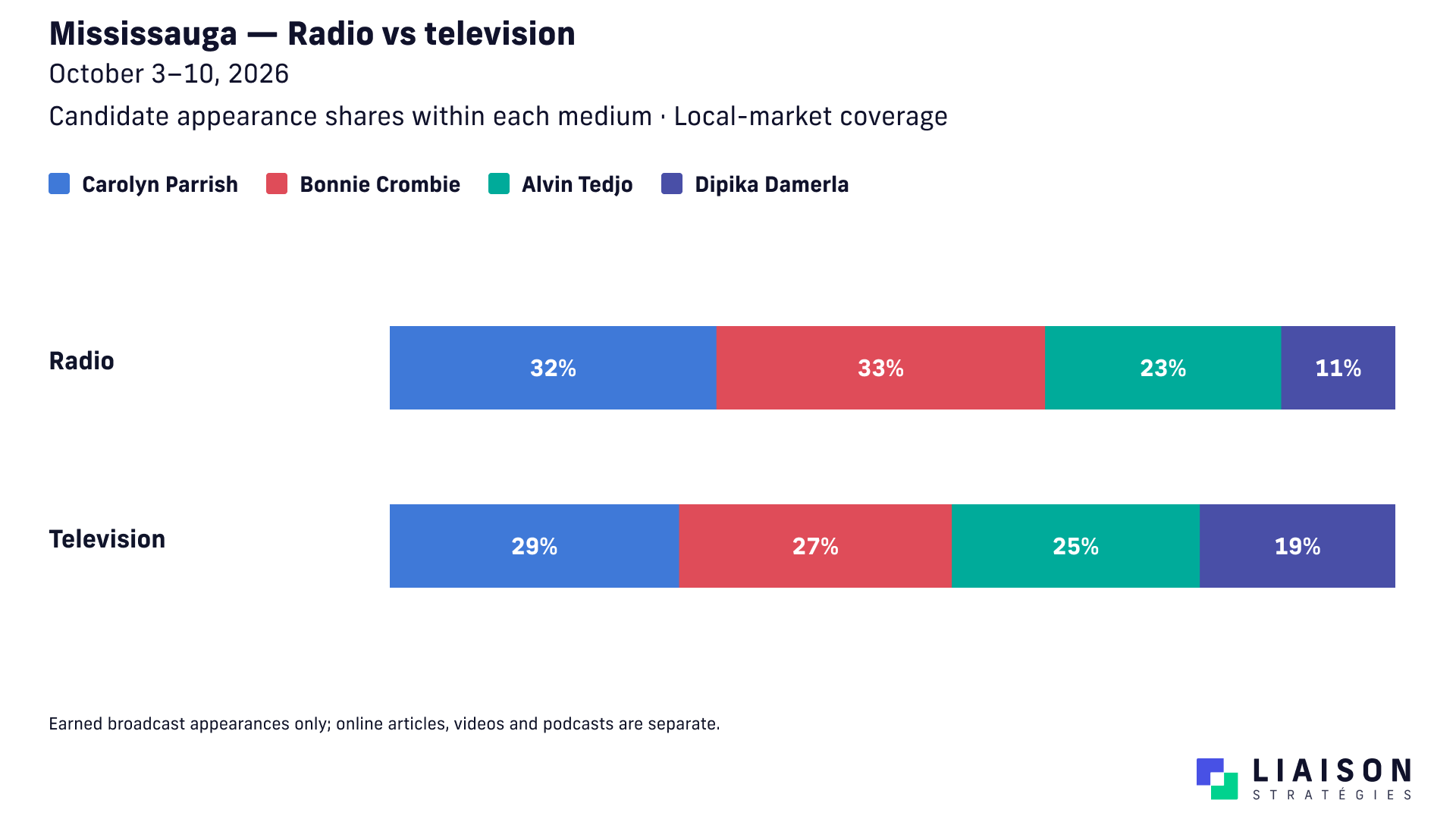
For Damerla, the combined share understates her relative presence on television. For Crombie, radio provides the stronger share. Neither comparison tells us how many voters were persuaded, but it is more useful than assuming every candidate is getting the same introduction across the broadcast outlets.
Hamilton: Horwath still gets most of the coverage
Horwath received 54.0% of earned appearances in October 3-9, compared with 66.8% the previous week. Rob Cooper received 22.3%, compared with 18.5%; Keanin Loomis received 17.3%, compared with 12.0%; and Scarlett Gillespie received 6.5%, compared with 2.7%.
The challengers had larger shares in the latest reviewed week. But Horwath still accounted for more than half the appearances, and Cooper was again ahead of Loomis.
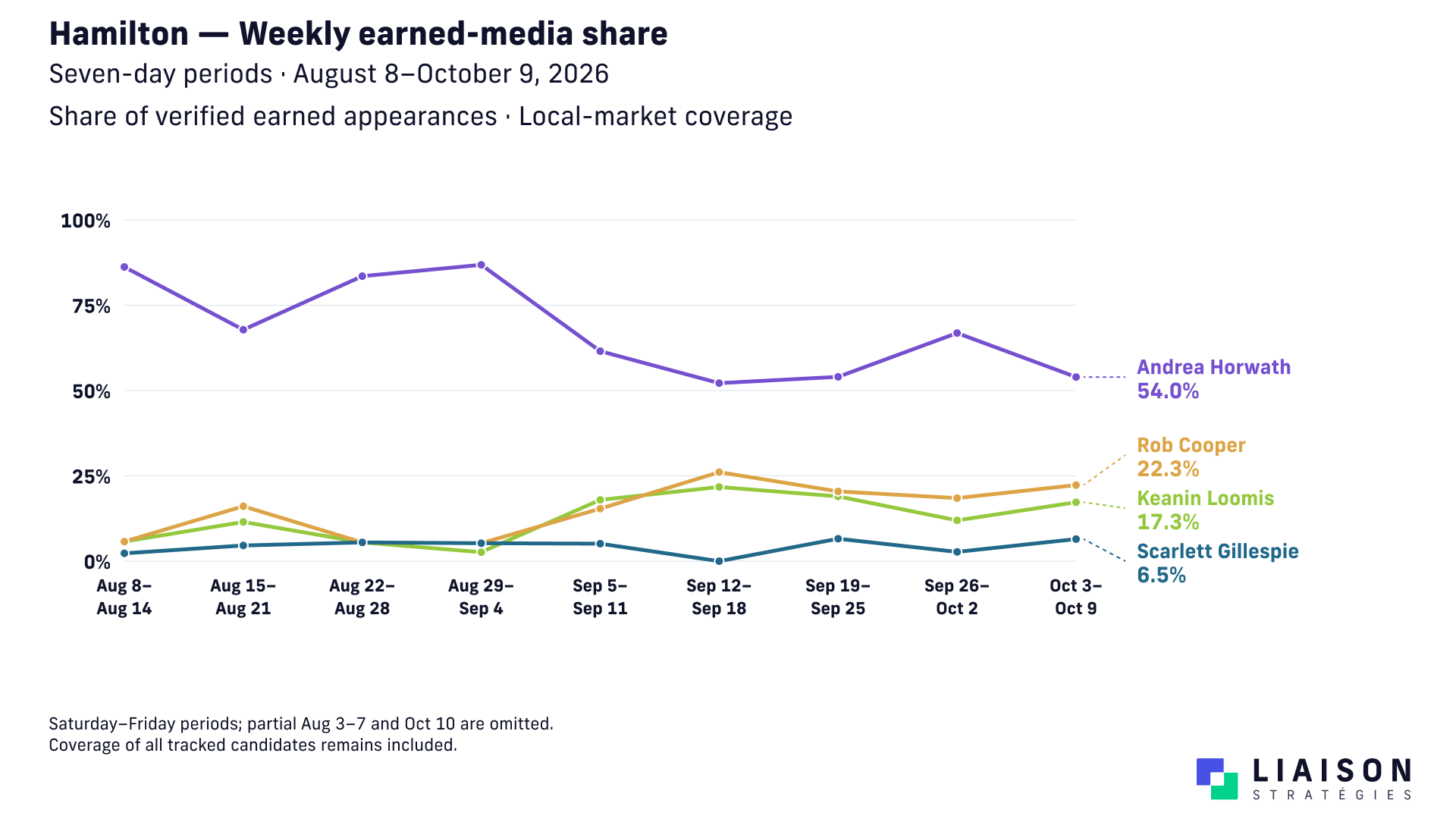
Horwath remains prominent when we look beyond appearances. In the separate October 3-10 comparison, she accounted for roughly 75% of the available estimated potential exposure. The challengers' share of mentions gives them more room than that exposure comparison does. Simply saying they are catching up would leave out an important part of the picture.
Oshawa: still very little coverage
Oshawa remains the race where I would be least inclined to make a story out of changing percentages. The reviewed coverage was sparse, and the latest appearances were concentrated on October 8 and 9.
That leaves very little opportunity for the candidates to be introduced to voters through the news we captured. It also means an additional story can produce a large change in someone's share without establishing a sustained change in attention.
The campaigns may be doing plenty of work elsewhere. Social media, door knocking, community events and campaign literature all matter. But residents have to do more of the work to find out about their choices when the race is not regularly appearing in the news.
Getting heard before October 26
These are opportunities, not endorsements. Bradford had a larger share of appearances in the days after Alexander withdrew. Parrish and Crombie were nearly tied in Mississauga, with Tedjo receiving about a quarter of coverage. Lawson had a larger share in Ottawa's latest week, while Horwath still received most of Hamilton's appearances.
For newsrooms, the fair-coverage question applies everywhere: are voters hearing enough about the alternatives to make a choice? Equal shares are not automatically fair. Mayors still have cities to run, and candidates need to give reporters something substantive to cover. A smaller share alone does not establish unfair treatment.
For campaigns, the question is what they do with the attention. Criticizing the mayor can get someone into a story. Explaining what they would do differently gives voters something to consider when they see the name on the ballot. With two weeks left, I would rather hear more of the latter. We are probably all reasonably familiar with the complaints by now.
David Valentin is a Principal at Liaison Strategies
How we tracked coverage
Liaison Strategies reviewed vendor material for nineteen selected mayoral candidates in Toronto, Ottawa, Hamilton, Mississauga and Oshawa. Weekly shares use non-overlapping Saturday-Friday periods. The principal comparison is October 3-9 against September 26-October 2; the radio/television and estimated exposure comparisons cover October 3-10, including an additional Saturday.
Searches included candidate names, spelling and transcript variants, and city/election searches. Candidate identities and substantive mentions were checked against available original material. Official-duty coverage was included alongside campaign coverage. Paid advertisements and candidates' own social media, door knocking and other direct communications are outside the earned-media shares.
Each candidate counted once per distinct verified placement. A story mentioning two candidates could count for both. Duplicate vendor records, same-day article versions and continuous broadcast fragments were consolidated. Each weekly share uses summed appearances divided by all tracked candidate appearances in that city and week, not an average of daily percentages.
Radio and television shares use verified station identities, with online articles, videos and podcasts classified separately. Repeated bulletins and distinct airings can count separately, so station schedules affect the mix. Estimated exposure uses available positive vendor audience estimates, includes repeated potential exposure and does not measure unique viewers or local voters reached. None of the appearance shares measures airtime, sentiment, persuasion or voting intention.