AI in Health Care: Canadians Using AI, But Draw the Line at Autonomous Diagnosis
Nearly half have used an AI chatbot for medical advice, but 68% would wait for a human doctor.

Canadians are already experimenting with AI for medical advice, but most still want human accountability for diagnosis, prescribing, records, and care.
May 27, 2026 (Toronto, ON) - A new Liaison Strategies survey on AI in health care finds Canadians are already using AI for medical advice, but remain deeply cautious about giving AI authority over diagnosis, prescribing, health records, and the doctor-patient relationship.
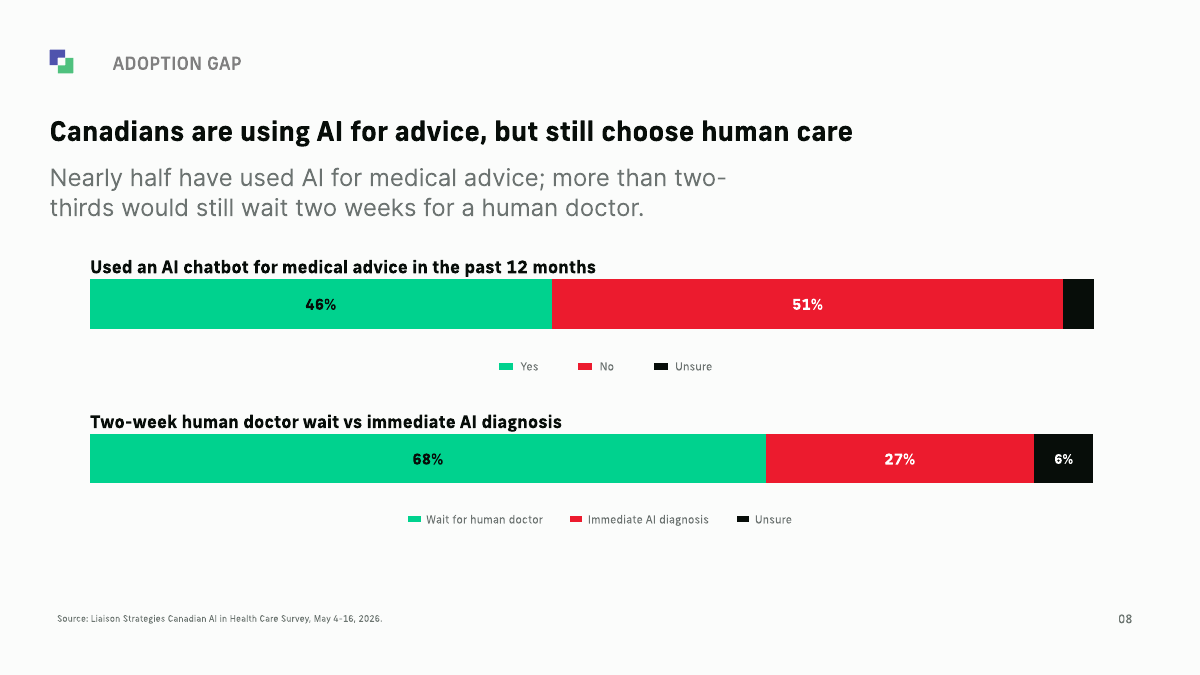
Nearly half of Canadians, 46%, say they have used an AI chatbot for medical advice in the past 12 months. At the same time, 68% would rather wait two weeks for a human doctor than receive an immediate AI diagnosis, and just 13% are comfortable with AI diagnosing them and prescribing medication without any doctor involved.
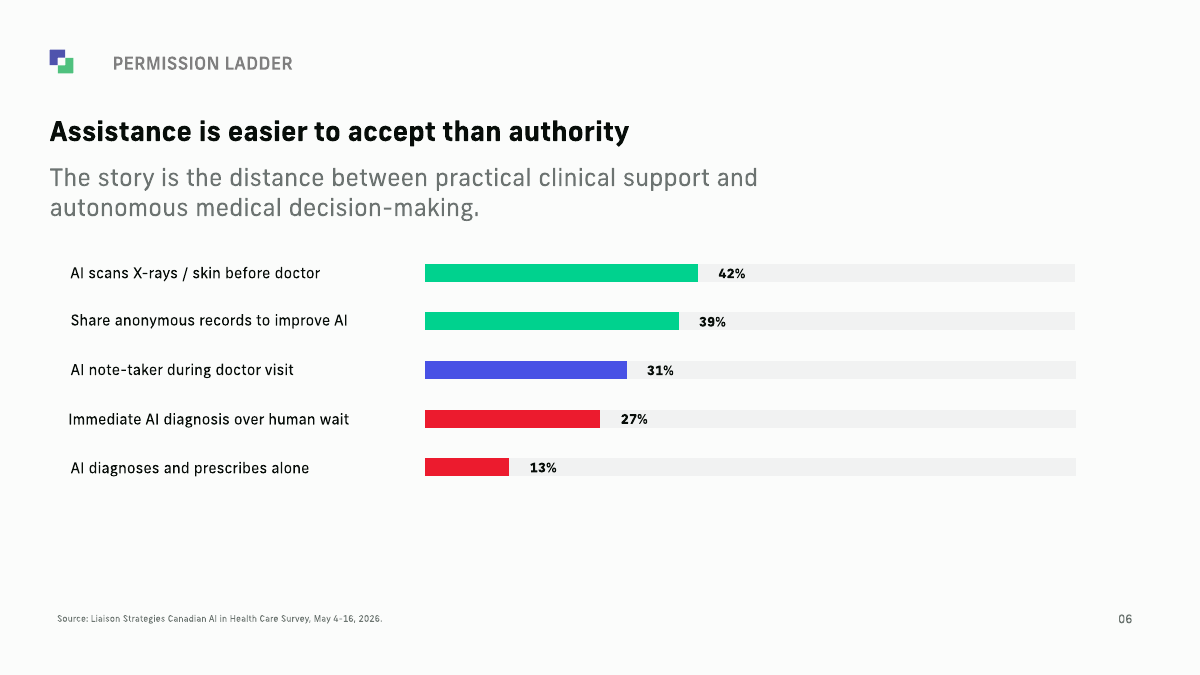
The survey also finds 47% rate their current access to a family doctor or clinic as poor, creating pressure for new models of care. However, public permission remains conditional: 42% are comfortable with AI scanning X-rays or skin for cancer before a doctor, 31% are comfortable with an AI note-taker during a doctor’s visit, and 39% support sharing anonymous health records with researchers to improve AI tools.
Liaison surveyed a random sample of n=1,526 Canadian adults from May 4 to 16, 2026, using Interactive Voice Recording (IVR) technology. To ensure a representative sample, participants were reached through random digit dialling across both landline and cellular phone networks. The sample was weighted to ensure a representative national sample, with a dedicated Quebec oversample included. For the total sample, the margin of error is +/-2.51 percentage points, 19 times out of 20.
Liaison Strategies is one of the most accurate polling firms in Canada. It ranked #1 in accuracy in the 2025 Ontario election and #2 nationally in the 2025 federal election. Liaison is a member of the Canadian Research Insights Council (CRIC).
David Valentin, Principal at Liaison Strategies, said:
“Health care shows the AI market in miniature. Canadians are not rejecting AI outright, but they are drawing very clear lines around what AI should be allowed to do.”
“Nearly half of Canadians have already used an AI chatbot for medical advice, so this is no longer a hypothetical technology. The adoption is here. The question is whether institutions can earn permission for higher-risk uses.”
“The strongest opening is clinical assistance, not clinical authority. Canadians are much more open to AI screening an X-ray or skin scan before a doctor than they are to AI diagnosing and prescribing on its own. That distinction matters.”
“The access problem is real. Nearly half of Canadians say access to a family doctor or clinic is poor, and that creates demand for alternatives. But poor access does not mean unconditional consent. Even when people are frustrated with the system, most still choose a human doctor over an immediate AI diagnosis.”
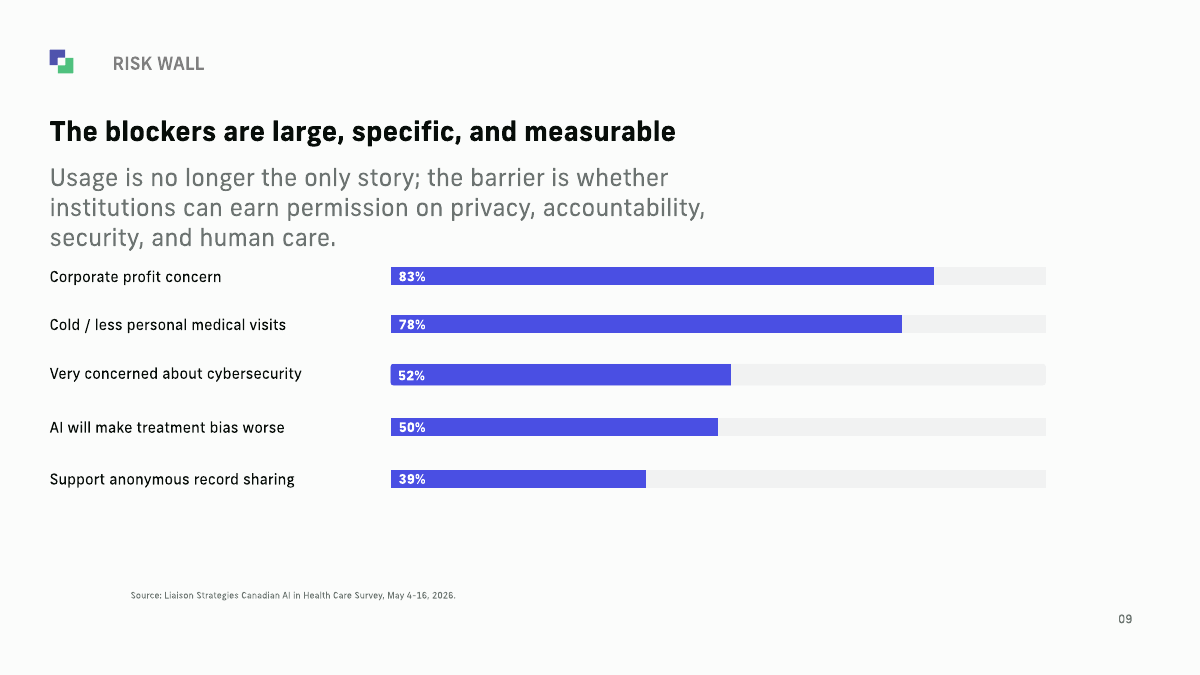
“Where the public gets especially cautious is around trust. Seventy-eight per cent are concerned AI will make medical visits feel cold or less personal, 52% are very concerned about hospital AI making records more vulnerable to hackers, and 83% are concerned private tech corporations will profit too much from the public system.”
“Accountability is another major signal. If AI causes a medical error, Canadians are most likely to hold the AI company responsible. That creates a very different risk environment for hospitals, governments, and vendors than a simple adoption number would suggest.”
“Younger Canadians are already experimenting. Sixty-five per cent of 18- to 34-year-olds say they have used AI for medical advice, compared to 26% of Canadians aged 65 and older. But even among younger Canadians, comfort with fully autonomous diagnosis remains limited.”
“The story is not one AI market. The same person may accept AI screening, reject AI diagnosis, worry about data sharing, and still use ChatGPT for advice. That is why tracking permission by use case, institution, and audience segment is going to matter.”
Liaison Strategies will launch the Canadian AI Trust & Adoption Monitor in fall 2026 to track where Canadians permit AI to act, and under what conditions.
-30-
Detailed Poll Report:
AI in Health Care: Trust, Use, and Public Permission
Detailed Tables:
Canadian AI in Health Care Survey - Detailed Tables
About Liaison Strategies
Liaison Strategies is a national public opinion research firm. With 13 years of experience in Canadian polling, David Valentin, principal, has fielded hundreds of projects at the municipal, provincial and federal levels and appeared across Canadian media to discuss insights. Liaison is a member of the Canadian Research Insights Council (CRIC), Canada’s voice of the research, analytics, and insights profession both domestically and globally.