Who Owns the News? The Media Race Behind Ontario's Mayoral Campaigns
Chow draws almost half of Toronto coverage, Alexander is gaining attention, and Crombie outdraws the sitting mayor. What earned media tells us about Ontario's mayoral races.
Olivia Chow is getting almost half the earned media coverage in a Toronto mayoral race with three major candidates. In Hamilton, Andrea Horwath is getting more than two-thirds. And in Mississauga, Bonnie Crombie is getting considerably more coverage than the person who actually has the mayor's job.
We looked at coverage of the major mayoral candidates in Toronto, Ottawa, Hamilton, Mississauga and Oshawa from August 3 to October 2. The differences tell us quite a bit about the advantages of incumbency, the work challengers have to do to get noticed, and the people the media are introducing to voters ahead of October 26.
It is hard for voters to form an opinion about someone they do not know exists. A candidate can have a terrific platform, an experienced campaign team and very strong opinions about traffic. None of that helps much if voters have never heard their name.
Most of the coverage in our tracking comes from television and radio, which are particularly useful for that introduction. Someone can encounter a candidate while watching the evening news or listening in the car without having decided to follow the election. They hear the name, get some sense of what the candidate wants to do, and perhaps hear how the mayor responds. Over time, those appearances can help a challenger become familiar enough to consider.
Earned media is far from the only thing that matters in a campaign. Candidates still need an organization, a message and people prepared to vote for them. But coverage helps determine whose message voters get a chance to hear.
This project tracks earned media: the coverage candidates receive in news reporting, interviews and other editorial material. Candidates also communicate directly through their own social media accounts, videos, email lists, door knocking, community events and campaign literature. Those activities can reach voters who barely follow the news, and they are not captured by these earned media shares. A campaign with less news coverage may still be doing a great deal of work to introduce itself.
We also compared appearances with the available estimates of potential reach. Being mentioned more often and appearing in coverage associated with a larger audience can produce different results. The reach figures help us explore that difference, although they include repeat exposure and are not a count of unique voters who saw or heard a candidate.
Toronto: Alexander is getting noticed
Across the full period, Chow received 46.6% of earned appearances among the three Toronto candidates we studied. Brad Bradford received 32.9% and Chris Alexander 20.5%.
Almost half the coverage is a very good result for Chow in a three-person contest. She gets covered as a candidate, but she also gets covered because she is the mayor. Transit, housing, budgets and council business give her reasons to be in the news regardless of what is on the campaign calendar.
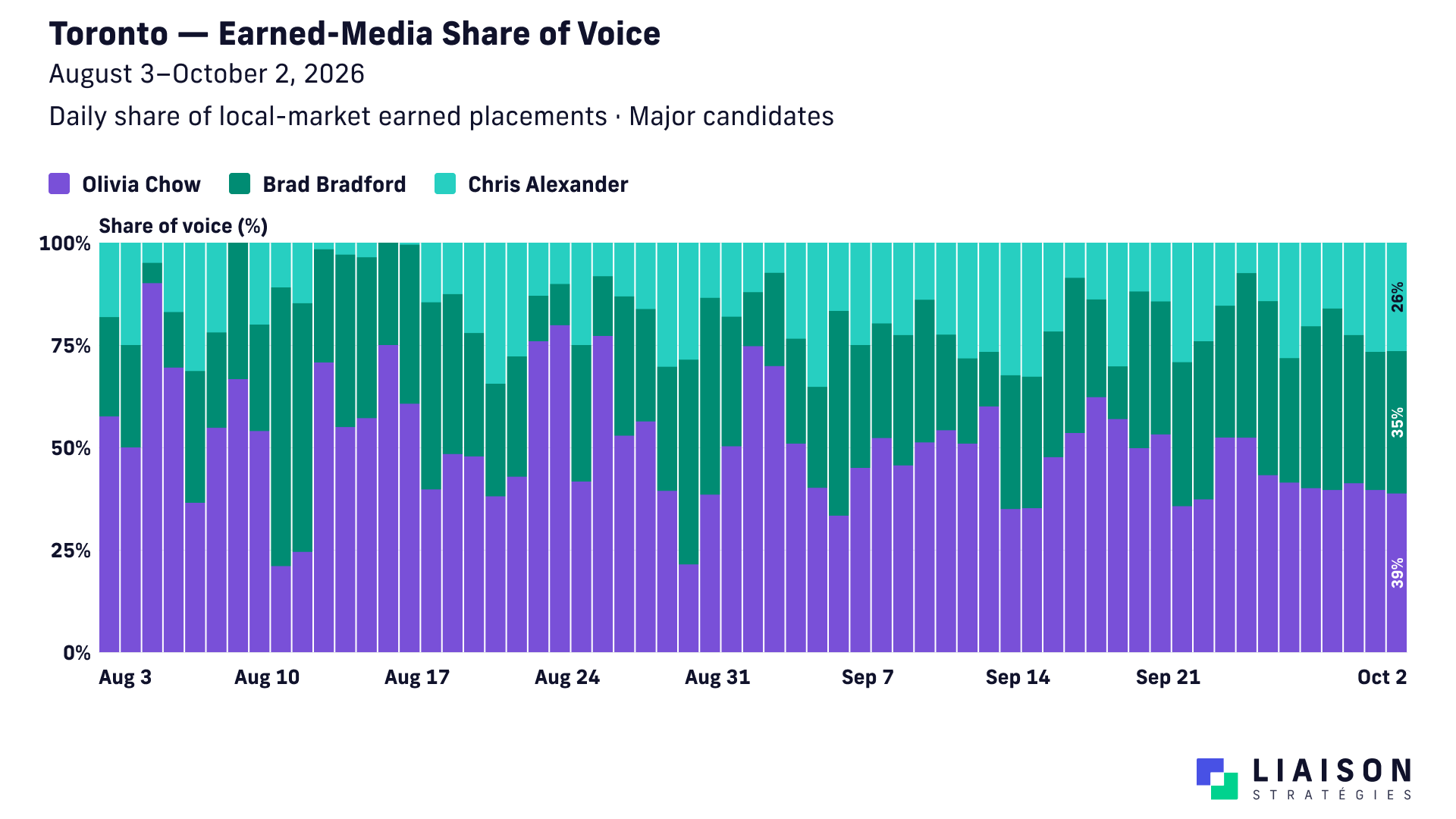
Alexander is the more interesting development in the chart. His share was 17.1% in the August portion of our tracking, rising to 21.1% in September. Over the full period, his share of estimated potential reach was 21.2%, compared with Bradford at 34.0% and Chow at 44.8%. The two measures give us a broadly similar picture of Toronto.
People have asked whether Alexander could be a spoiler. In terms of the attention economy, his presence is already being felt. Bradford would presumably prefer the coverage to centre on a choice between himself and Chow. Alexander is making sure there is another challenger in that conversation.
That does not establish that Alexander is taking Bradford voters, or even that every additional Alexander story would otherwise have been a Bradford story. Bradford's own share edged up between August and September. But Alexander is competing for the interviews, the candidate comparisons and the space available to someone offering an alternative to the mayor.
Bradford's radio advertising helps him supplement his earned coverage and gives him control over what voters hear. There is no interviewer waiting to ask a follow-up question. That is useful, especially when two challengers are competing to become better known. Chow, meanwhile, continues to receive the largest share of the coverage without having to purchase those particular appearances.
For Bradford, the question is how much of the attention he can turn into a clearer impression of who he is and what he would do as mayor. For Alexander, it is whether the additional attention produces more voters willing to consider him. The coverage shows that he is getting a larger opportunity to make that case.
Ottawa: challengers share the attention
Mark Sutcliffe received 38.2% of earned appearances in Ottawa. Alex Lawson received 22.0%, Jeff Leiper 21.8% and Neil Saravanamuttoo 17.9%. Lawson and Leiper were effectively tied.
The mayor is doing well, while the remaining attention is divided among three challengers. All three are getting coverage, but none is getting close to Sutcliffe's share over the full period.
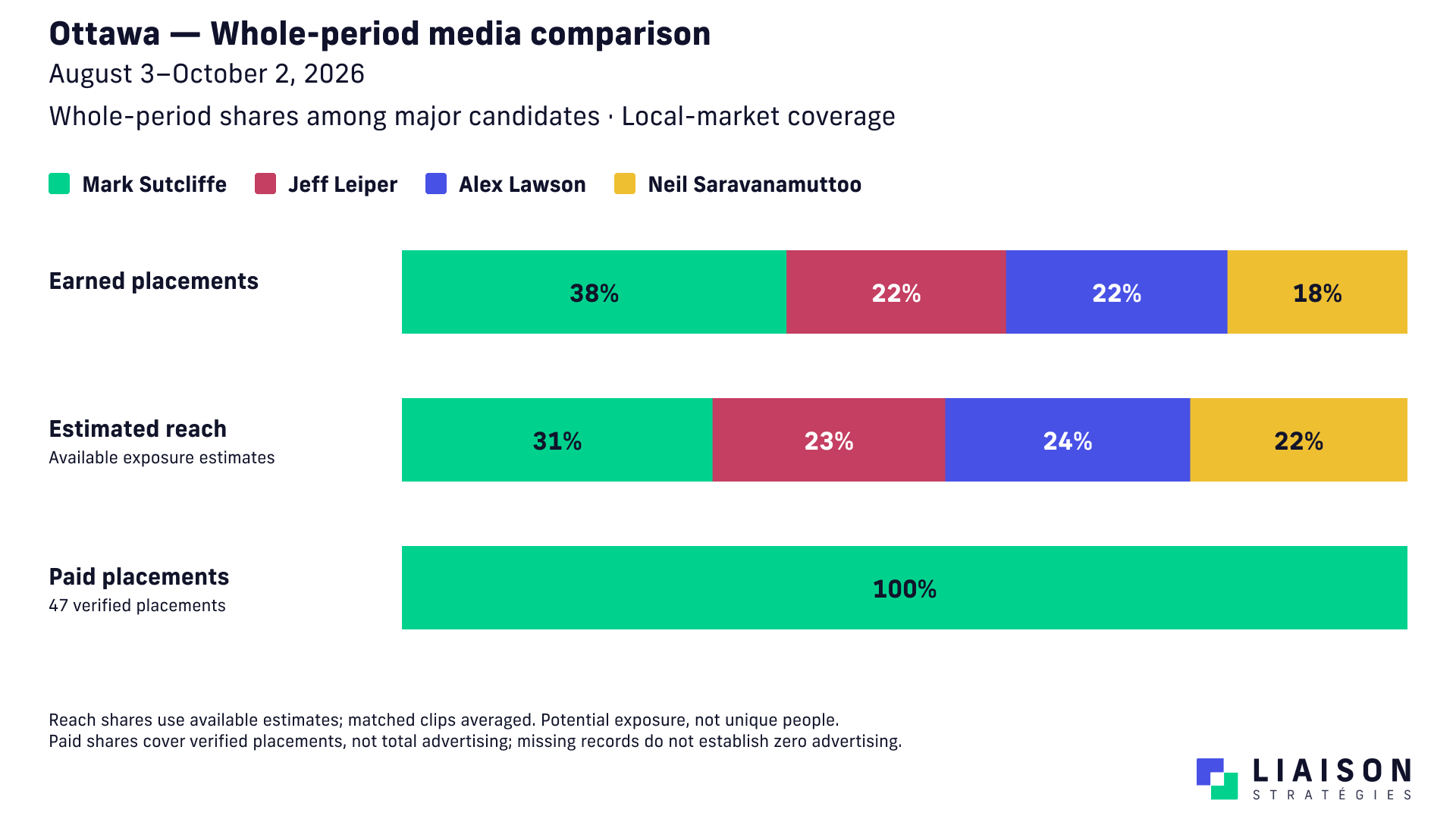
The estimated reach comparison is closer. Sutcliffe receives 30.9%, Lawson 24.4%, Leiper 23.1% and Saravanamuttoo 21.6%. Sutcliffe remains ahead, but his lead over Lawson falls from roughly 16 points on appearances to roughly seven points on estimated reach.
That matters when we describe how much attention the challengers are receiving. Their share of appearances suggests a larger disadvantage than the reach estimates do. Saravanamuttoo, in particular, moves from 17.9% of appearances to 21.6% of estimated reach.
Sutcliffe has the advantages of office and an identified paid broadcast presence as well. His challengers are competing with the mayor and with each other for attention. Whether any one of them can become the main alternative is a question worth watching over the remaining weeks.
Hamilton: incumbency in full swing
Andrea Horwath received 69.1% of earned appearances in Hamilton. Rob Cooper received 15.1%, Keanin Loomis 11.6% and Scarlett Gillespie 4.2%.
This is where the incumbency effect is most obvious. Horwath is the mayor, she has a long provincial profile, and she is receiving more than two-thirds of appearances among the candidates we tracked.
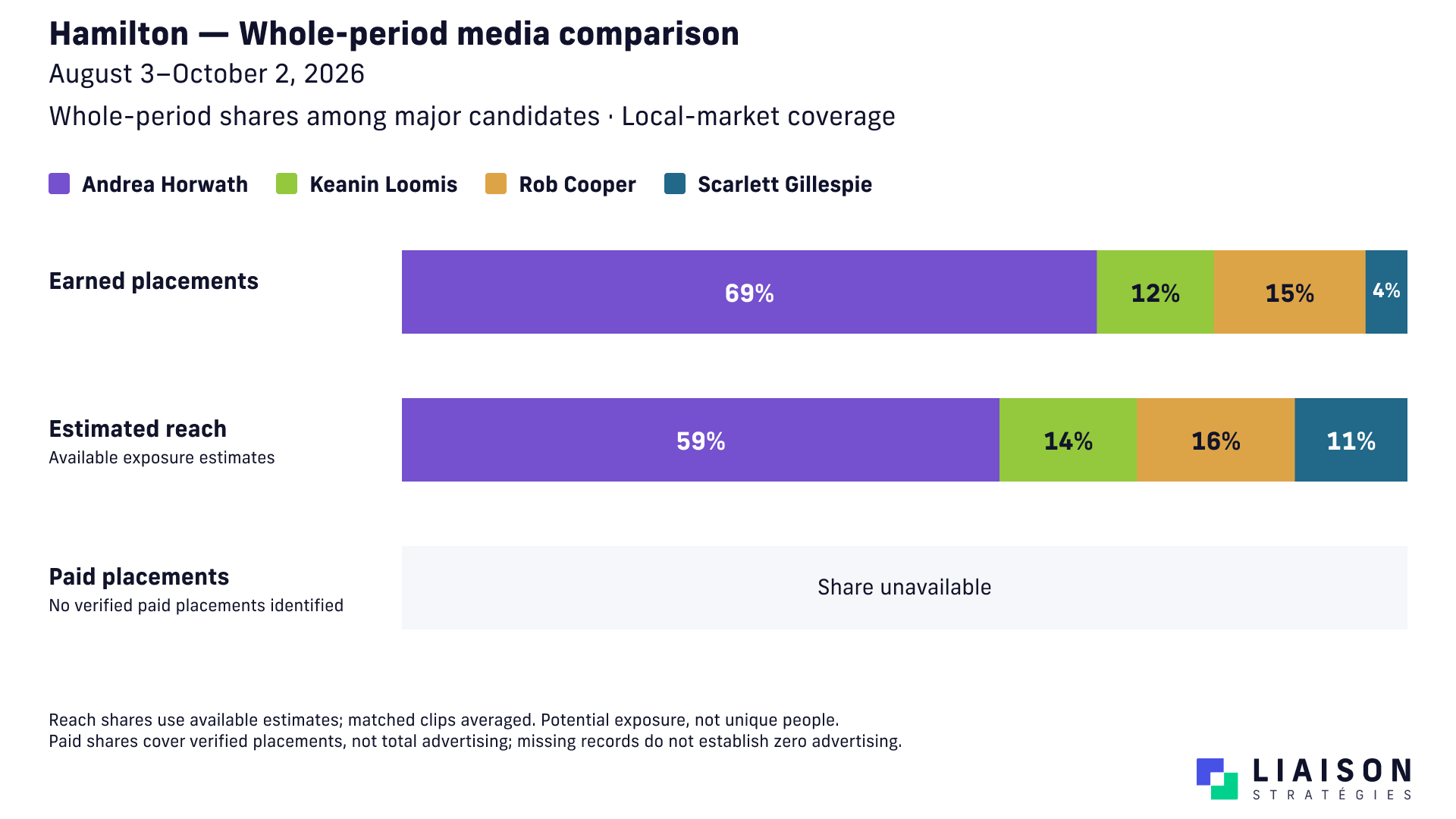
Cooper and Loomis are both getting attention, but the gap with Horwath is substantial.
We did additional searches and checked name variants against the original material, including references that broadcast transcripts can get wrong. The difference between Cooper and Loomis survived that review.
But the estimated reach comparison gives the challengers more room. Horwath receives 59.4%, Cooper 15.7%, Loomis 13.7% and Gillespie 11.2%. Horwath still has a large lead, although it is smaller than the appearance count alone suggests. Cooper remains ahead of Loomis on both measures.
Gillespie is particularly interesting here. She receives only 4.2% of appearances, but 11.2% of estimated reach. Her relatively few appearances account for a larger share when weighted by the available reach estimates. It is a reason to look beyond frequency before concluding how little opportunity a candidate has had to be noticed.
For the challengers, the task is to give voters enough information to develop an opinion of them while Horwath is already a familiar figure.
Horwath's coverage will include criticism and scrutiny as well as announcements. We have not scored its tone. But even an unfavourable story can leave the mayor as the person voters hear about most often. Her challengers have considerably fewer opportunities to explain themselves in the coverage we reviewed.
Mississauga: Crombie commands attention
Bonnie Crombie received 45.4% of earned appearances in Mississauga, ahead of Mayor Carolyn Parrish at 26.1%, Alvin Tedjo at 16.7% and Dipika Damerla at 11.8%.
The challenger is the biggest topic of conversation here. Crombie received 77.5% of appearances in the August portion of our tracking. September was much more balanced, with Crombie at 37.0% and Parrish at 29.7%, followed by Tedjo at 18.5% and Damerla at 14.8%.
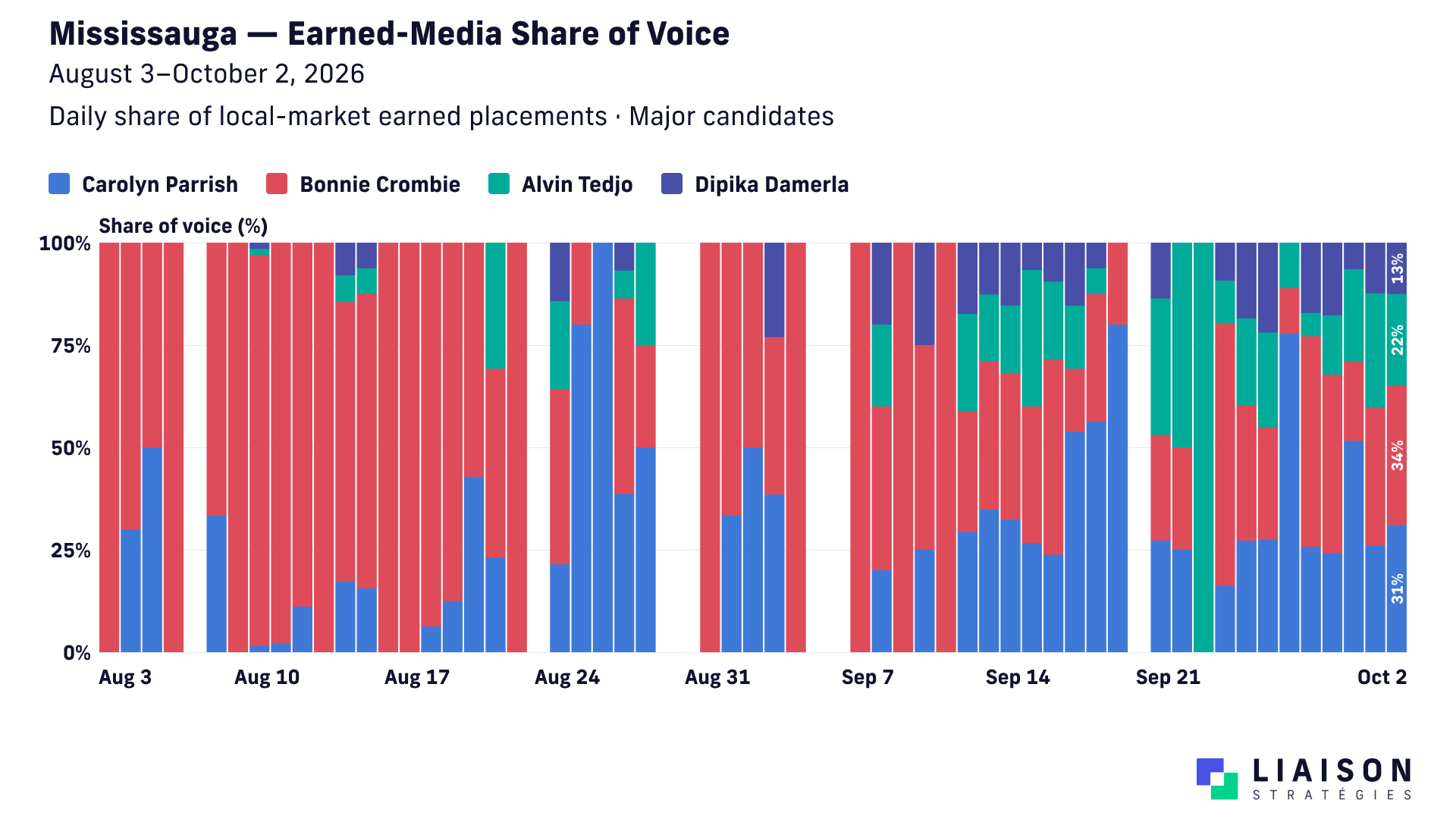
Crombie's August coverage gives her a considerable advantage in the full-period comparison, but she also remained ahead in September. The early attention did not simply disappear once the other campaigns started getting more coverage.
Her previous jobs matter. She was mayor of Mississauga and then leader of the Ontario Liberal Party. Voters and reporters already know who she is, and her return to municipal politics gives the race a story that extends beyond the usual campaign announcements.
Crombie can draw attention without currently occupying the mayor's office. Parrish has the responsibilities and visibility of the job, but she is competing against a former mayor with a substantial public profile of her own. Tedjo and Damerla have to find room alongside both of them.
Damerla deserves attention in that comparison too. Her September share of appearances is much larger than her August share, and over the full period she receives 14.2% of estimated reach, compared with 11.8% of appearances. Crombie leads both measures, with 44.4% of estimated reach, followed by Parrish at 24.0% and Tedjo at 17.5%. The race became more balanced over the period, even while Crombie remained the most covered candidate.
Parrish also had paid broadcast advertising in the material we reviewed. It gives her another way to reach voters while Crombie leads earned coverage. That is a useful reminder that a campaign can supplement the news rather than wait for it to provide the introduction it wants.
Oshawa: very little coverage to go around
In our tracking, Oshawa looks much more like a media desert. We found very little earned coverage of the four candidates studied: Derek Giberson, Tito-Dante Marimpietri, Jim Lee and Henry Onwuachu.
Dividing that coverage into percentages would suggest a level of competition that the volume does not support. When there is barely any coverage, one appearance can make a candidate look as though they dominated an entire day.
The more useful finding is how little opportunity these candidates had to introduce themselves through the news we reviewed. Candidates in Toronto are competing for space in a busy conversation. In Oshawa, there is much less of a conversation to begin with.
That places more of the work on campaigns themselves: knocking on doors, appearing at community events and finding other ways to reach residents. It also places more of the work on voters, who have to seek out information that people in a heavily covered race might encounter without trying.
Recent Canadian research by Martin Horak and Zack Taylor describes the difficulty challengers face in municipal elections where coverage is sparse and party labels provide little guidance. Their work examines how experience, money and local networks help candidates assemble the resources needed to get their names and messages in front of residents. Oshawa makes that problem quite concrete.
What does fair coverage look like?
These results raise a question for newsrooms in every race we studied: what should fair coverage look like? Equal time for everyone? Coverage in proportion to their support? More attention for the people making the most substantive announcements?
Equal shares would be easy to calculate, but much harder to justify as an editorial rule. Sitting mayors remain responsible for running their cities during the campaign. Their decisions are newsworthy, and reporters cannot stop covering them because their opponents would like more airtime. Former office-holders can also attract coverage because their return is itself a story, as we see with Crombie.
At the same time, voters need enough information about the alternatives to make a choice. If the mayor is repeatedly on the news and a challenger is only occasionally introduced, the difference matters even when every individual editorial decision is perfectly reasonable. And, as Ottawa and Hamilton show, the frequency of appearances and the potential reach associated with them can give different impressions of that balance.
The candidates have a responsibility here too. A newsroom needs something to cover: an announcement, a proposal, an event or a response that advances the story. Registering for an election does not come with a standing reservation on the six o'clock news.
A lower share of coverage by itself does not establish unfair treatment. It gives us something to examine alongside the substance of the campaigns, the public responsibilities of the candidates and the information voters need. Those questions apply in Toronto, Ottawa, Hamilton and Mississauga, and in a race like Oshawa where the lack of coverage is the larger concern.
Getting known before October 26
These comparisons help explain why incumbency is so valuable. The mayor has reasons to appear in the news throughout the term and throughout the campaign. A challenger has to build that familiarity in a much shorter period, often while several other candidates are trying to do the same thing.
Canadian research on municipal incumbency and the personal vote finds that the familiarity and reputation developed in office contribute to an incumbent's advantage, although they do not explain all of it. Our coverage analysis offers a way to see how often voters are given opportunities to hear about the candidates. It does not measure how much any particular appearance changes their minds.
Broadcast coverage is valuable because it can introduce candidates to people beyond those already following their campaigns. Paid advertising can supplement that exposure and let candidates explain themselves on their own terms. Both matter when a campaign is trying to persuade residents who have other things to do than keep track of every mayoral announcement.
With just over three weeks until election day, I would be watching whether Alexander continues to gain attention in Toronto and whether one Ottawa or Hamilton challenger pulls ahead of the others in coverage. In Mississauga, the question is whether the more balanced September coverage continues or Crombie again draws a much larger share.
Those changes would tell us who is getting a chance to introduce themselves, explain their proposals and respond to their opponents. Candidates still have to do something useful with that chance. But first, voters have to know they exist.
How we tracked the coverage
Liaison Strategies tracked broadcast and media records for major mayoral candidates in Toronto, Ottawa, Hamilton, Oshawa and Mississauga from August 3 through October 2, 2026. Searches included candidate names, alternate spellings, shortened names, transcript variants and searches combining city names with election terms. Unrelated namesakes and unconfirmed matches were excluded.
Coverage was included when the outlet or verified local production served the municipality concerned. Reports about a candidate's official duties as mayor or councillor were included alongside campaign coverage. The collection includes television, radio, print, online news, podcasts and editorial online video.
Each candidate was counted once per distinct placement. A report mentioning two candidates counted once for each. Duplicate records of the same placement across the two services were consolidated, along with overlapping fragments of continuous coverage.
Appearance percentages represent each candidate's share among the selected candidates in that city over the stated period. Full-period shares use totals across the period rather than an average of daily percentages. The Toronto and Mississauga charts show daily appearance shares; the Ottawa and Hamilton charts compare full-period appearance, estimated reach and identified paid placement shares. August comparisons begin on August 3, and figures may not sum to 100% because of rounding.
Estimated reach shares use the positive vendor estimates available for each verified placement.
David Valentin is a Principal at Liaison Strategies