Toronto: Chow 47%, Bradford 40%; Cost of Living Tops Concerns
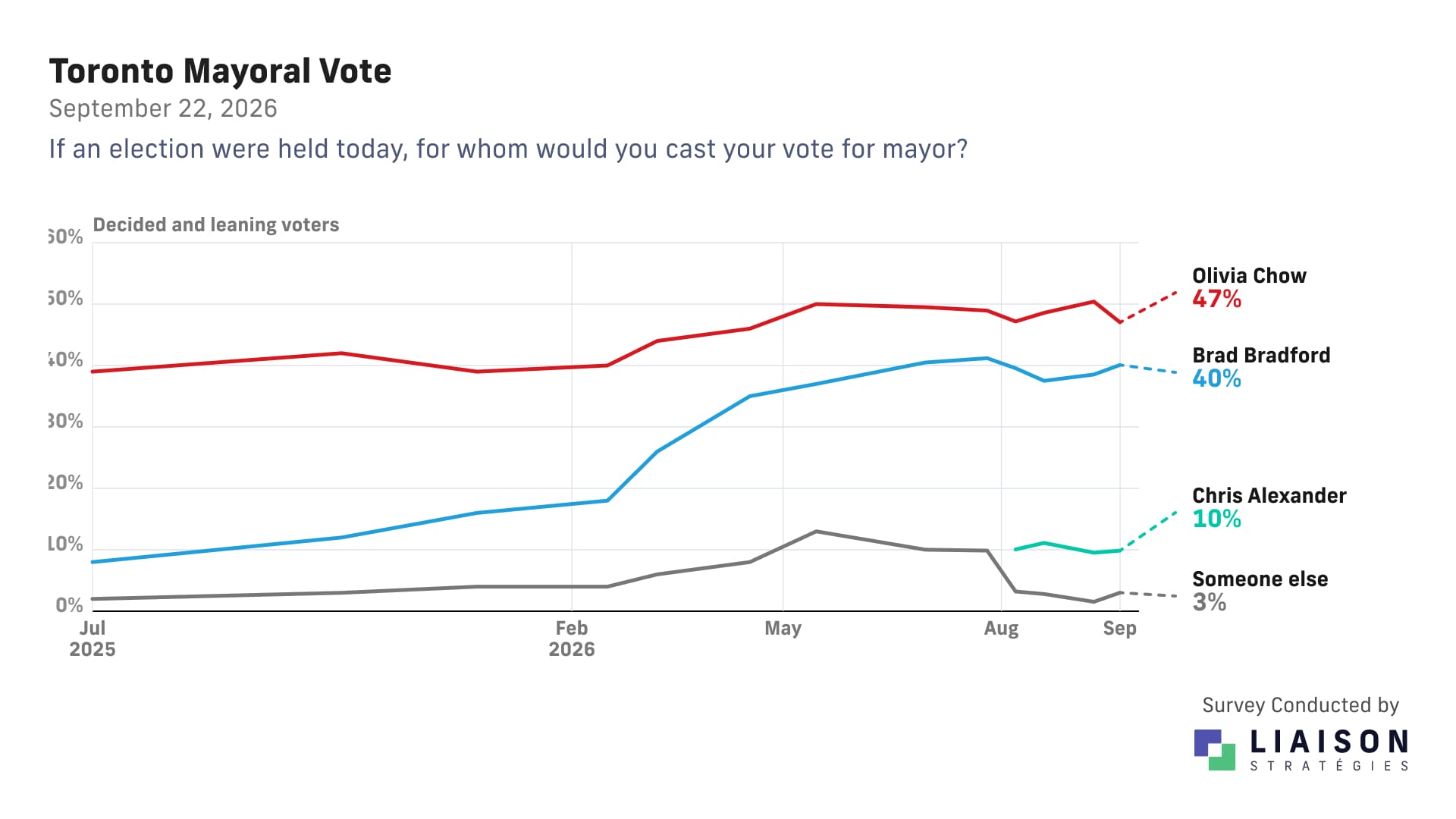
Chow leads Bradford 47% to 40% among decided and leaning voters, while cost of living tops Torontonians' unprompted mayoral priorities.

September 22, 2026 (Toronto, ON) - A new Liaison Strategies Toronto Pulse survey shows Mayor Olivia Chow leading Councillor Brad Bradford by seven points among decided and leaning voters, while cost of living is the most frequently named top issue in the mayoral race.
Chow receives 47%, Bradford 40%, Chris Alexander 10%, and someone else 3%. In Liaison's September 9 release, Chow stood at 50%, Bradford at 39%, Alexander at 10%, and someone else at 2%.
Liaison surveyed a random sample of 1,000 Toronto residents from September 19 to September 20, 2026, using Interactive Voice Recording (IVR) technology. Participants were reached through random digit dialling (RDD) across both landline and cellular phone networks. The resulting data was weighted to match targets based on the 2021 Census. For the total sample, the margin of error is +/- 3.1 percentage points, 19 times out of 20. The margin is higher for subsamples. Totals may not add up to 100% due to rounding.
Liaison Strategies is one of the most accurate polling firms in Canada. It ranked #1 in accuracy in the 2025 Ontario election and #2 nationally in the 2025 federal election. Liaison is a member of the Canadian Research Insights Council.
David Valentin, Principal at Liaison Strategies, said:
"Chow's cushion is smaller. Her lead has gone from 11 points to seven, with Chow down three points and Bradford up one. It's a closer result, but not enough to establish a new trend. Bradford has gained some ground without overtaking the mayor."
"The most competitive parts of the city are North York and Scarborough. Chow leads Bradford 46% to 41% in North York and 46% to 43% in Scarborough. Those are much closer results than Downtown, where Chow leads 60% to 27%, or Etobicoke, where Bradford leads 54% to 33%. The regional samples are smaller, but the contrast is striking."
"There is also a sharp age divide. Bradford has 47% among decided and leaning voters aged 18 to 34, compared with 41% for Chow. Among those aged 35 to 49, Chow leads 57% to 33%. Talking about younger voters as one bloc would miss two very different races."
"We asked residents to name the issue that would matter most to their mayoral vote in their own words, without reading them a list. Cost of living came first at 23%, followed by housing affordability at 19%, crime and public safety at 17%, and traffic and congestion at 13%. Together, cost of living and housing account for 42% of first responses."
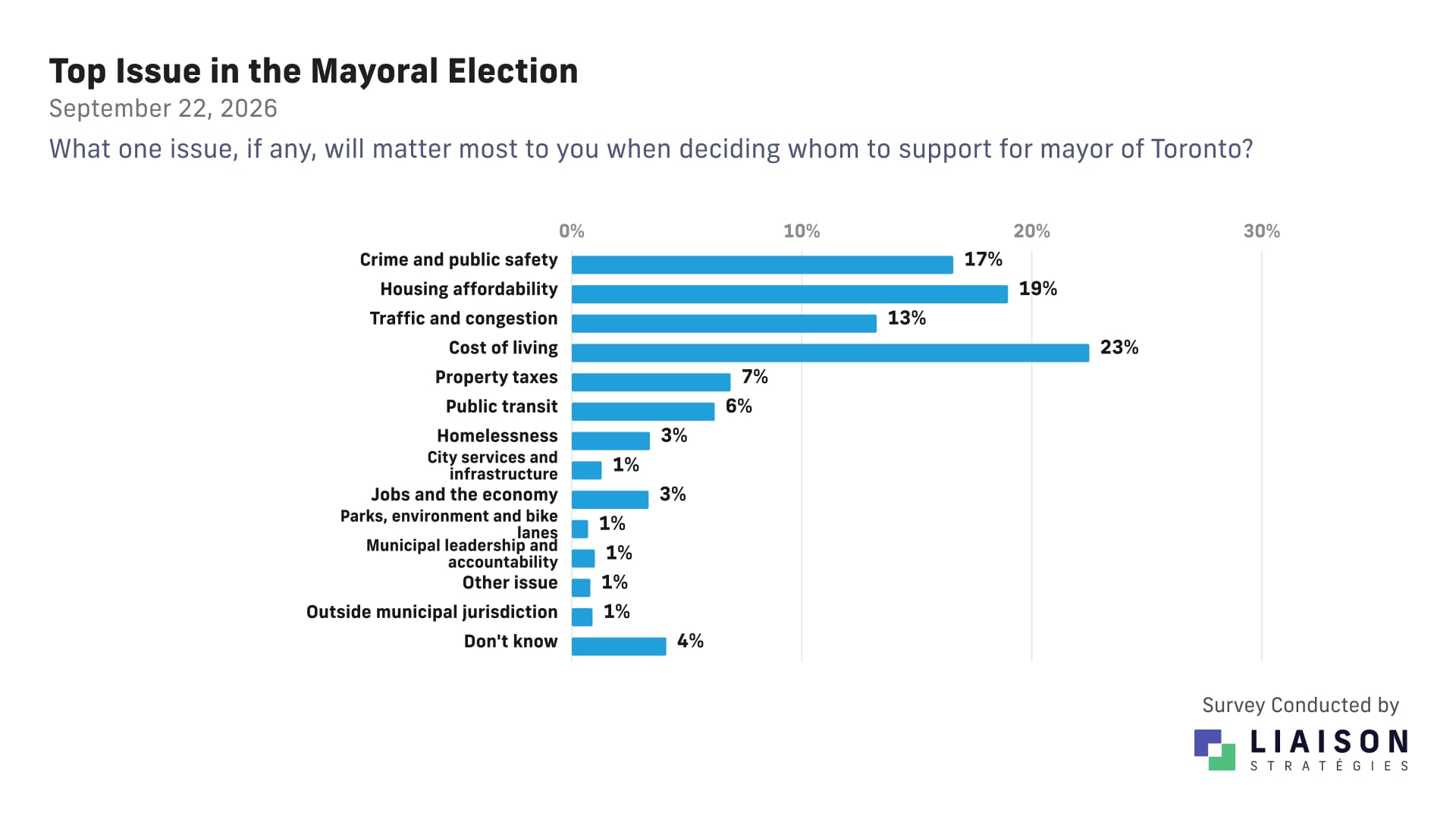
"That is an affordability agenda broader than property taxes. Seven per cent name property taxes as their first issue, compared with 23% for cost of living and 19% for housing. Voters are describing the cost of living in Toronto, not just the cost of city government."
"The priorities also vary across the city. Housing leads Downtown at 25%. In North York, cost of living leads at 27%. Etobicoke is more evenly divided among cost of living at 22%, traffic at 21%, and public safety at 20%. A citywide campaign has to speak to more than one version of Toronto's problems."
"Safety and housing are not just first-choice concerns. Crime and public safety is the most common second issue at 16%, followed by housing at 15%. They are tied at 11% when residents name a third issue. These are separate rankings, but both subjects recur beyond the first answer."
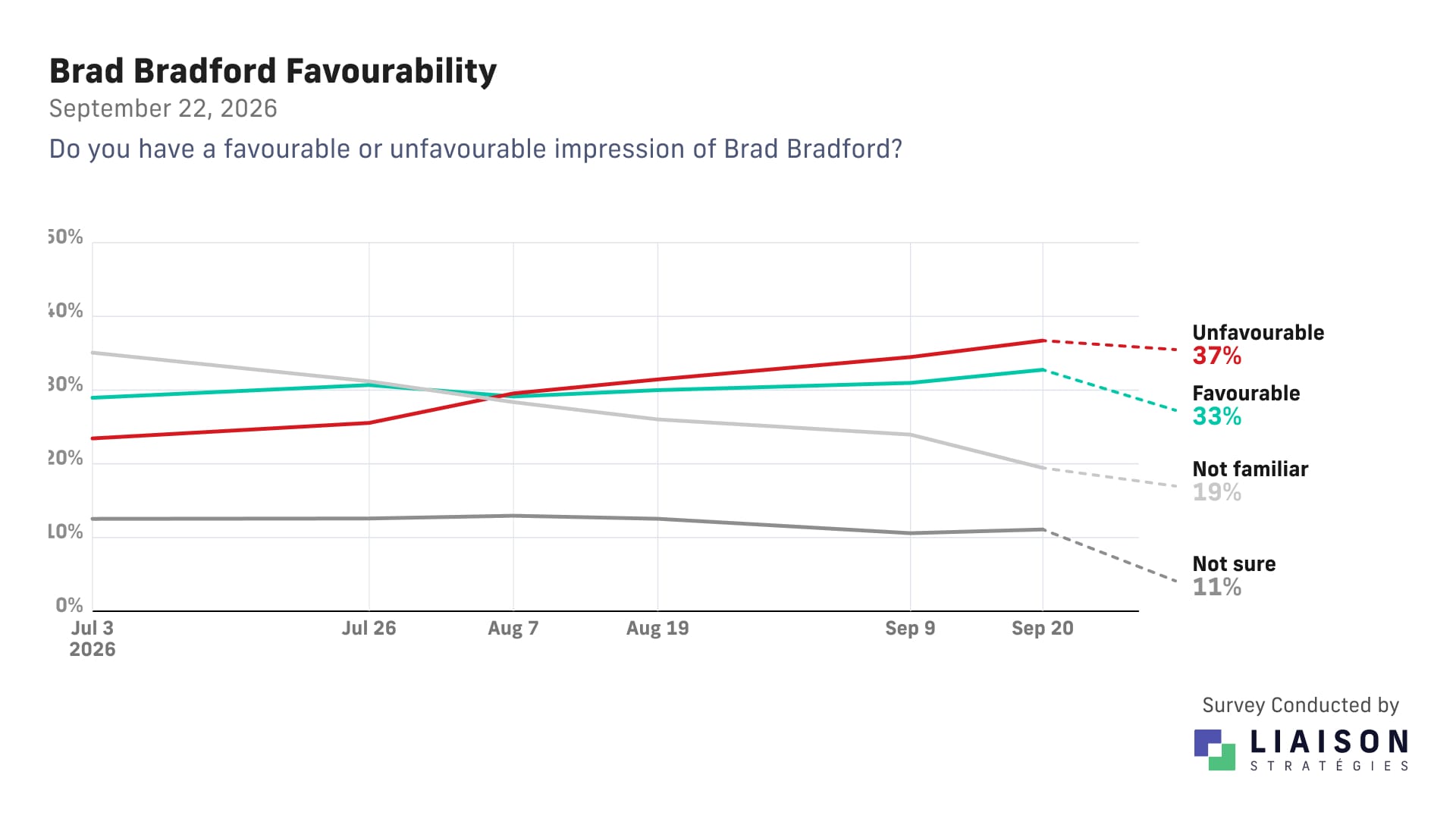
"Bradford's ballot number has improved slightly, but his personal ratings are more complicated. Thirty-three per cent view him favourably, up from 31%, while 37% view him unfavourably, up from 34%. The share unfamiliar with him has fallen from 24% to 19%, with another 11% unsure. A larger audience is forming an opinion, and the unfavourable side is growing too."
"Alexander remains at 10% on the decided and leaning ballot even as his profile grows. Thirty-nine per cent are unfamiliar with him, down from 46% in the previous survey. He is at 21% favourable and 23% unfavourable, with 17% unsure. Greater recognition has not yet produced a higher vote share."
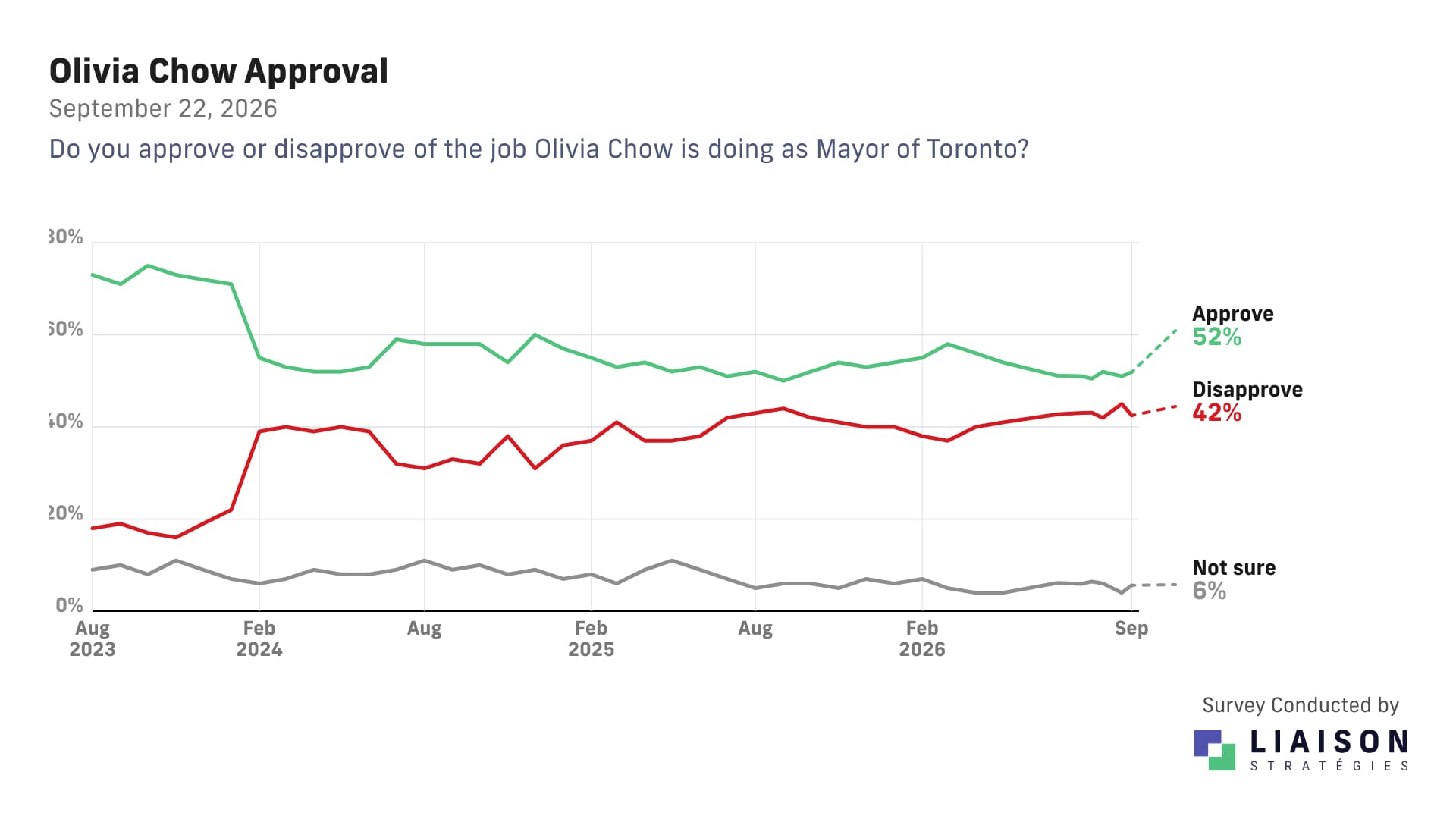
"Chow's approval has held up better than her ballot result. Fifty-two per cent approve of her performance, 42% disapprove, and 6% are unsure. Last time, approval was 51% and disapproval was 45%. The narrower election lead is not accompanied by a deterioration in her job rating."
"The city's direction remains almost evenly split: 47% say right direction, 46% say wrong direction, and 7% are unsure. Among all voters, Chow has 39%, Bradford 33%, Alexander 8%, someone else 2%, and 17% are undecided. There is still a substantial group that has not chosen a candidate."
"For Chow, a positive job rating isn't making re-election automatic. For Bradford, a closer ballot doesn't resolve his personal ratings. The opening for either campaign is to connect its plans to the pressures residents name themselves: making Toronto affordable, safe, and easier to get around."
-30-
Detailed Poll Report:
Detailed Tables:
About Liaison Strategies
Liaison Strategies is a national public opinion research firm. With 13 years of experience in Canadian polling, David Valentin, principal, has fielded hundreds of projects at the municipal, provincial and federal levels and appeared across Canadian media to discuss insights. Liaison is a member of the Canadian Research Insights Council (CRIC), Canada's voice of the research, analytics, and insights profession both domestically and globally.