B.C.: NDP Leads Conservatives 41% to 36% as Election Begins
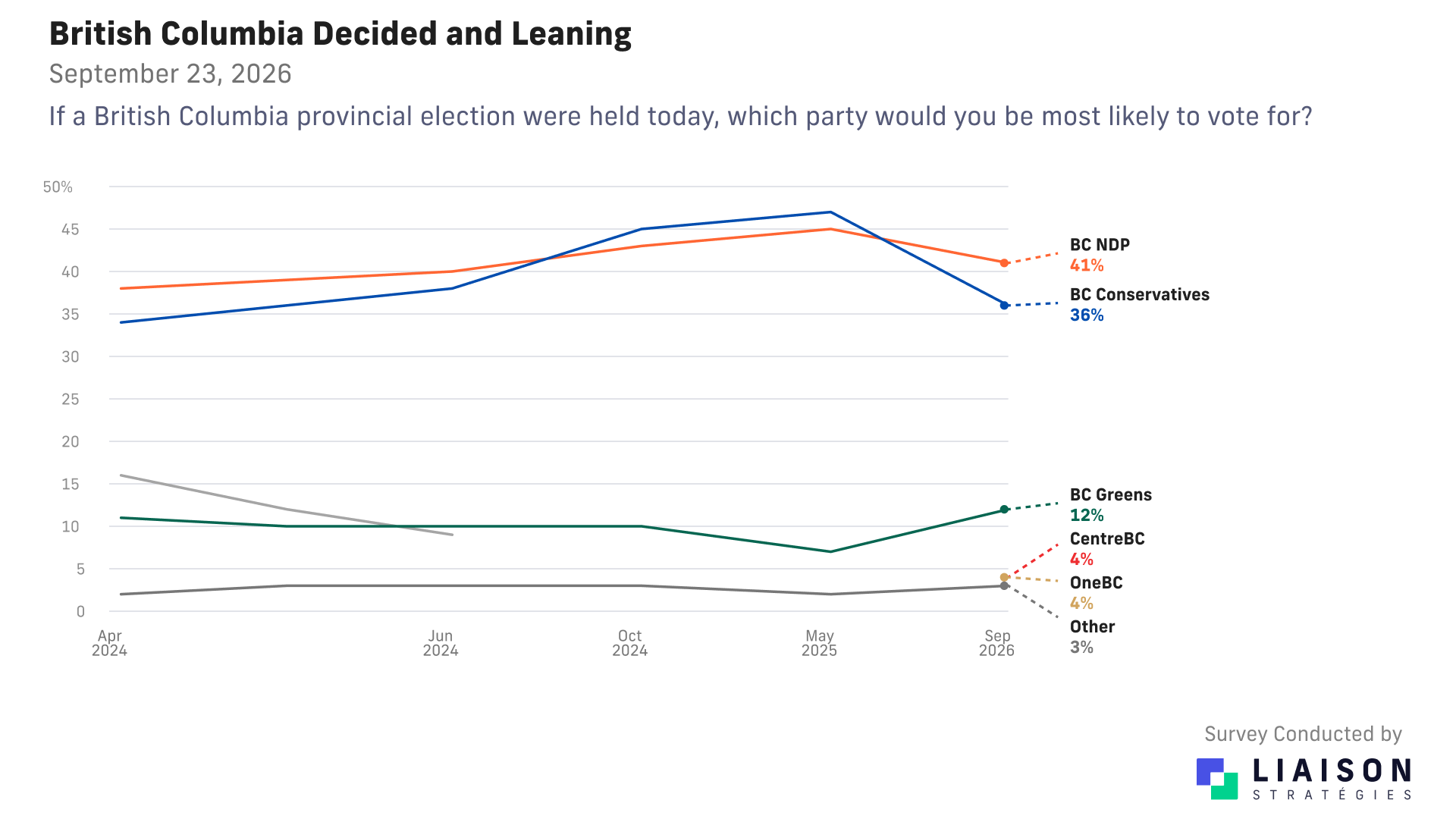
The BC NDP leads 41% to 36% among decided and leaning voters, while half of British Columbians say the province is heading in the wrong direction.
September 23, 2026 (Ottawa, ON) - A new Liaison Strategies British Columbia Political Tracker finds the BC NDP leading the BC Conservatives 41% to 36% among decided and leaning voters as the provincial election begins, despite half of British Columbians saying the province is heading in the wrong direction.
The BC Greens stand at 12%, CentreBC and OneBC at 4% each, and other parties at 3%. The survey was conducted September 21-22, overlapping the election call and the latest changes in opposition party affiliations.
Liaison surveyed a random sample of 1,000 British Columbians from September 21 to September 22, 2026, using Interactive Voice Recording (IVR) technology. Participants were reached through random digit dialling (RDD) across both landline and cellular phone networks. The resulting data was weighted to match targets based on the 2021 Census. For the total sample, the margin of error is +/- 3.1 percentage points, 19 times out of 20. The margin is higher for subsamples, including decided and leaning voters. Totals may not add up to 100% due to rounding.
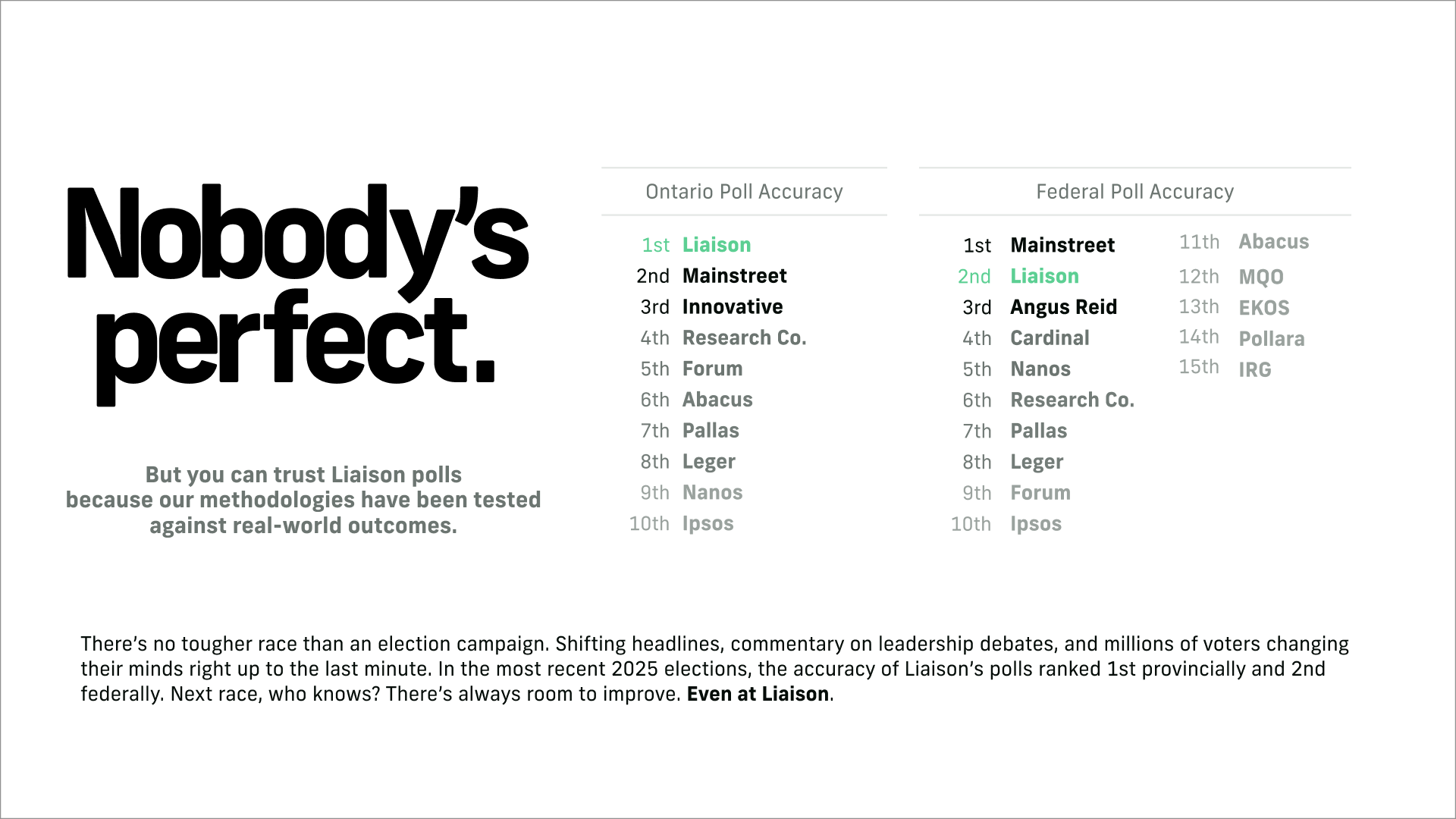
Liaison Strategies is one of the most accurate polling firms in Canada. It received an A grade from 338Canada for its polling in the 2024 British Columbia election, ranked #1 in accuracy in the 2025 Ontario election and #2 nationally in the 2025 federal election. Liaison is a member of the Canadian Research Insights Council.
David Valentin, Principal at Liaison Strategies, said:
"The NDP begins this campaign five points ahead, but there is no overwhelming enthusiasm for the government. Meanwhile, the Conservatives remain competitive after a period of extraordinary turmoil."
"For those catching up with B.C. politics, the opposition has changed considerably in a matter of days. Kerry-Lynne Findlay resigned as Conservative leader, Lorne Doerkson became interim leader, and several MLAs who had joined CentreBC returned to the Conservatives. Eby called an October 24 election on September 22. Our fieldwork began the day before that call and continued on the day itself, so this is a snapshot during those changes, not a full measure of the public's reaction to them."
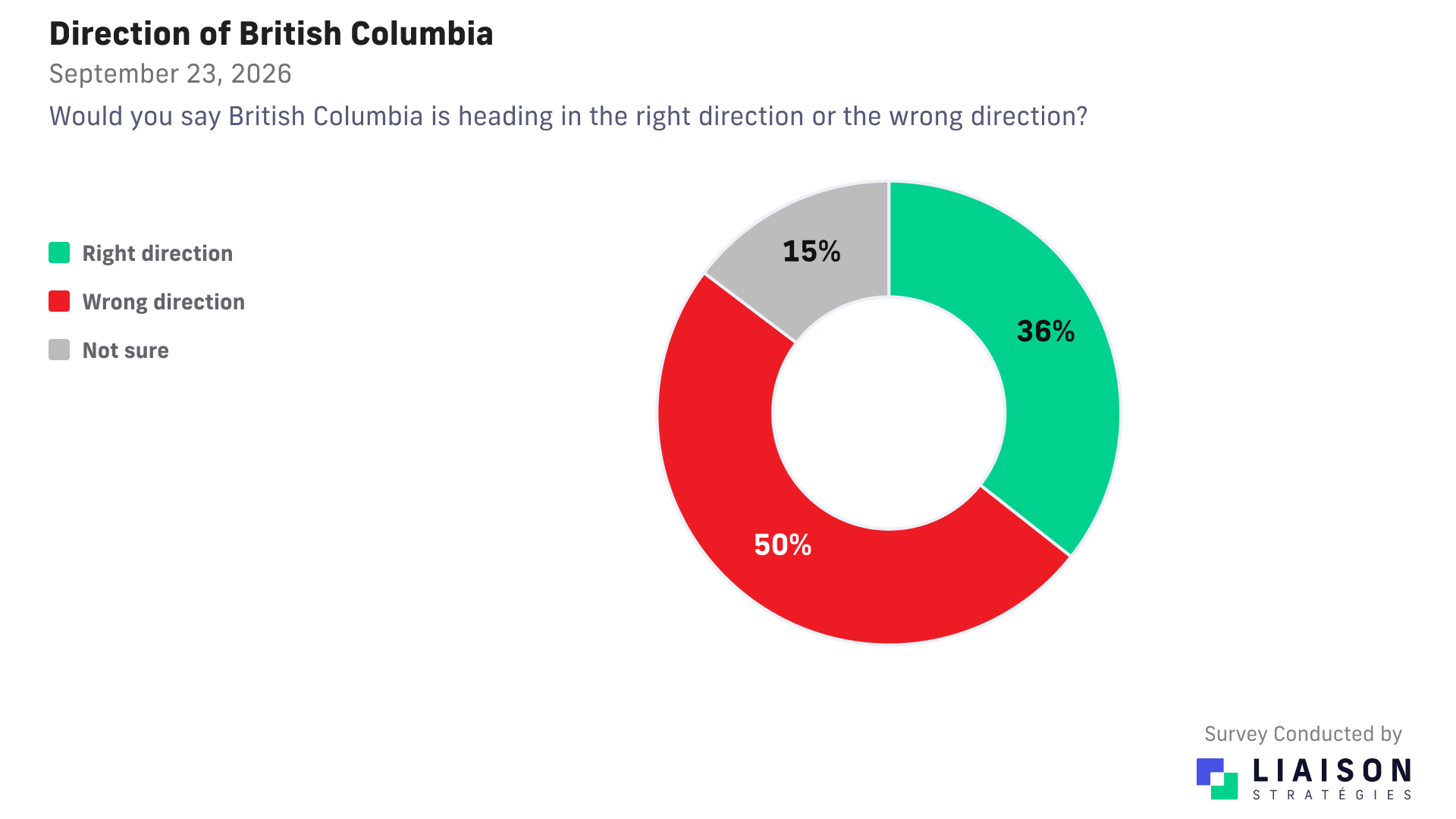
"The province's mood is the warning sign for the NDP. Fifty per cent say B.C. is heading in the wrong direction, compared with 36% who say the right direction and 15% who are unsure."
"Eby's approval is almost evenly divided: 42% approve, 43% disapprove and 15% are unsure. The Conservatives have an opening and now the question is what they can do with the limited time they have."
"Doerkson has a substantial introduction to make. Twenty-one per cent have a favourable view of him and 29% an unfavourable view. Another 23% are familiar with him but unsure, while 27% are not familiar with him. Half the province has not settled on an opinion of the new interim Conservative leader."
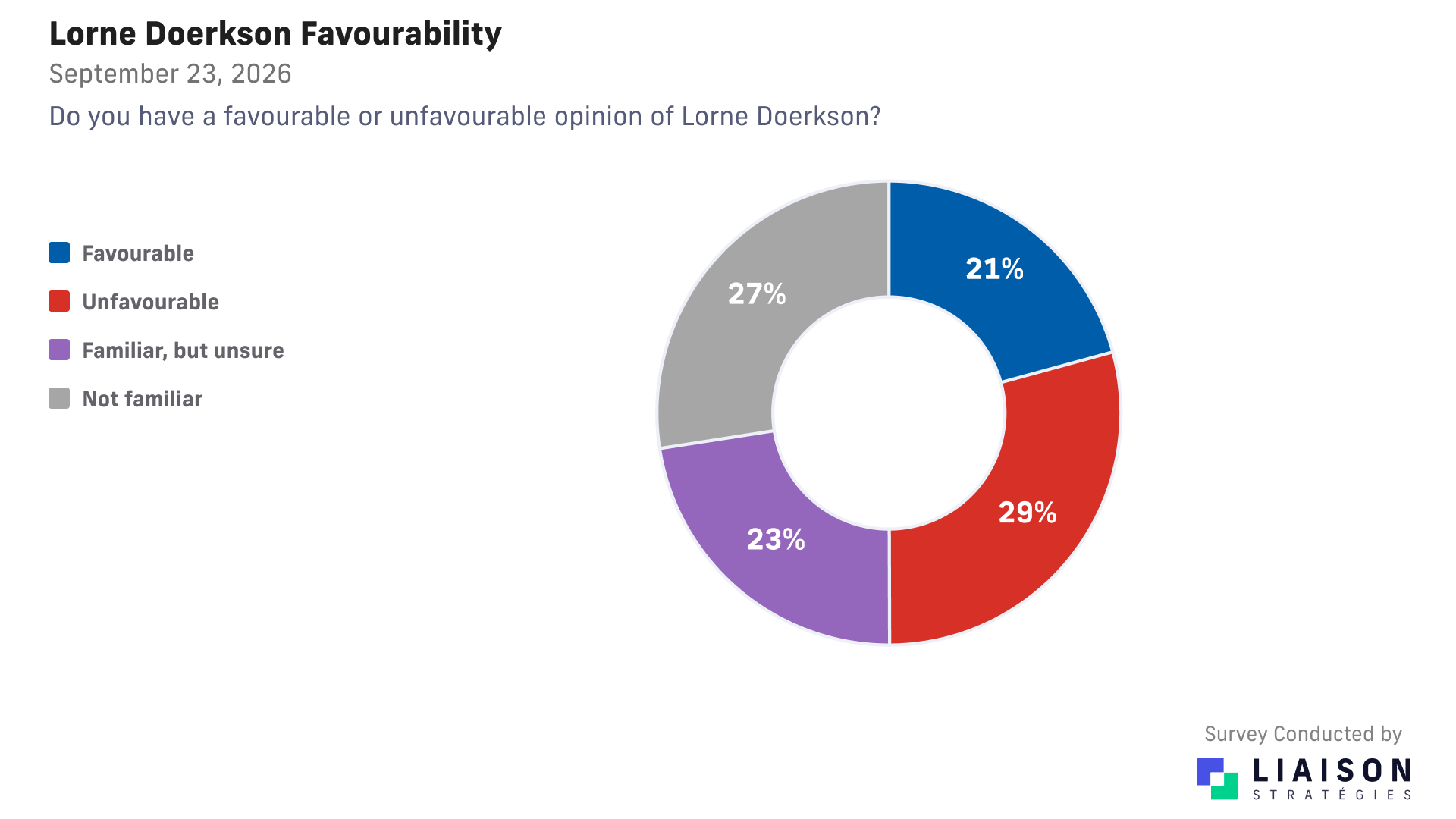
"That leaves room for him to make a favourable impression, but also room for his opponents to define him. The Conservatives need to spend this campaign explaining why they should govern, rather than explaining what is happening inside their own party."
"The regional divide is pronounced. Among decided and leaning voters, the NDP leads 43% to 34% in the Vancouver metropolitan area and 45% to 32% on Vancouver Island. Across the rest of B.C., the Conservatives lead 42% to 35%. Those are smaller samples, but they show why the provincewide result is only part of the electoral picture."
"Women favour the NDP over the Conservatives by 45% to 33%, while men favour the Conservatives 41% to 37%. Women are also more likely to be undecided on the initial vote question, at 29% compared with 19% of men. The NDP leads among women who have a preference, but many women have yet to make a choice."
"The Greens are at 12%, while Emily Lowan is viewed favourably by 20% and unfavourably by another 20%. Twenty-six per cent are unsure and 34% are unfamiliar with her. She, too, has an opportunity to become better known during the campaign."
"CentreBC and OneBC each register 4%. Those votes cannot simply be added to the Conservative column. Politicians returning to a party does not mean every voter follows them."
"The federal picture is quite different. Among decided and leaning voters in B.C., the Liberals lead with 48%, followed by the Conservatives at 32% and the NDP at 15%. The provincial NDP's strength does not translate into equivalent support for its federal counterpart."
"The central contest is whether the Conservatives can turn dissatisfaction with the province's direction into confidence in an alternative government. Eby has the lead. The campaign will test whether he can hold it."
-30-
Detailed Poll Report:
Detailed Tables:
About Liaison Strategies
Liaison Strategies is a national public opinion research firm. With 13 years of experience in Canadian polling, David Valentin, principal, has fielded hundreds of projects at the municipal, provincial and federal levels and appeared across Canadian media to discuss insights. Liaison is a member of the Canadian Research Insights Council (CRIC), Canada's voice of the research, analytics, and insights profession both domestically and globally.