B.C.: Conservatives 40%, NDP 39% as Housing Mandates Collide
Conservatives and NDP are virtually level as concurrent provincial and municipal campaigns raise the prospect of competing housing mandates.

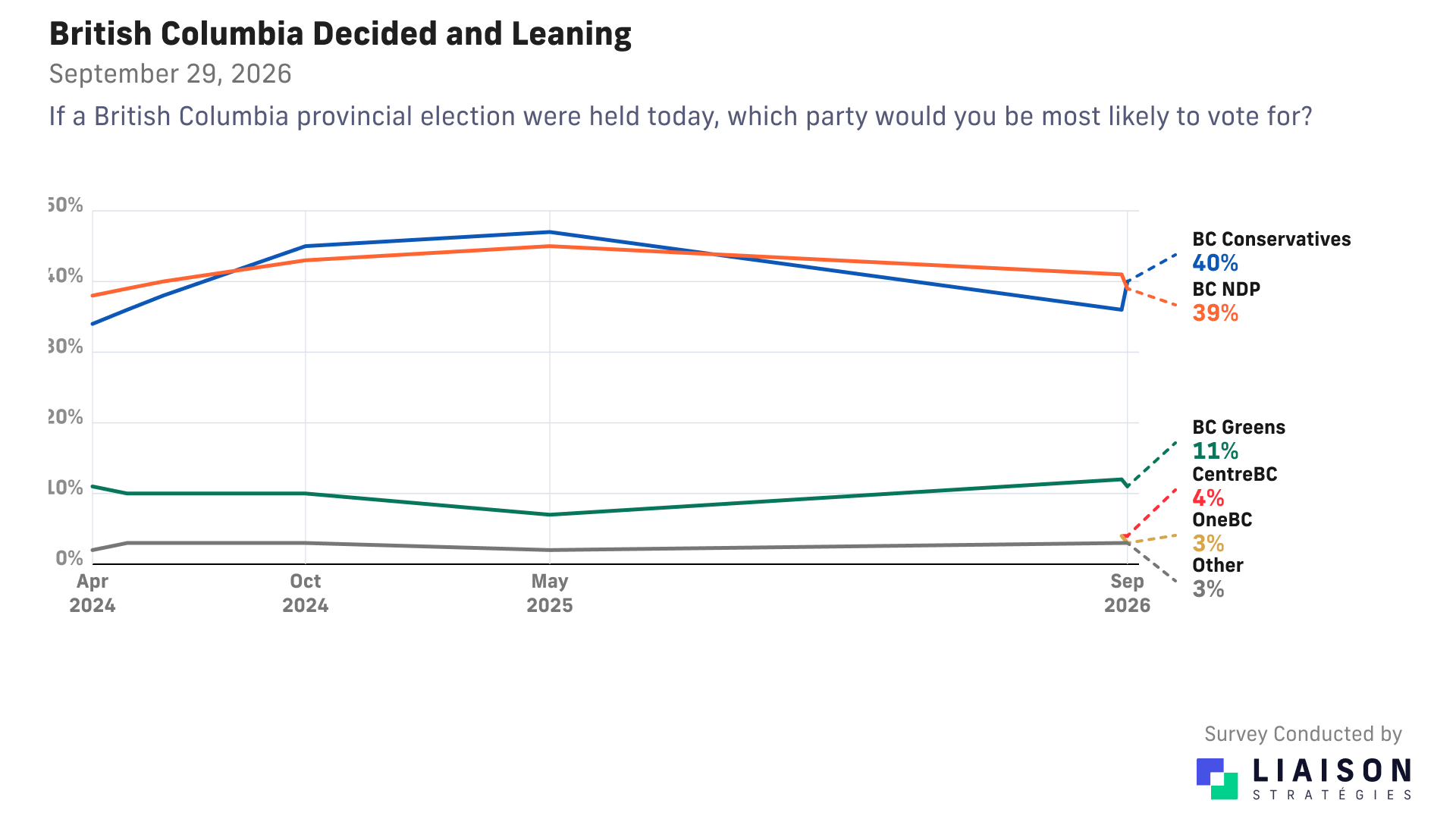
September 29, 2026 (Toronto, ON) - A new Liaison Strategies British Columbia Poll finds the BC Conservatives at 40% and the BC NDP at 39% among decided and leaning voters, putting the parties virtually level. The Conservatives are up four points and the NDP down two from Liaison's September 23 release.
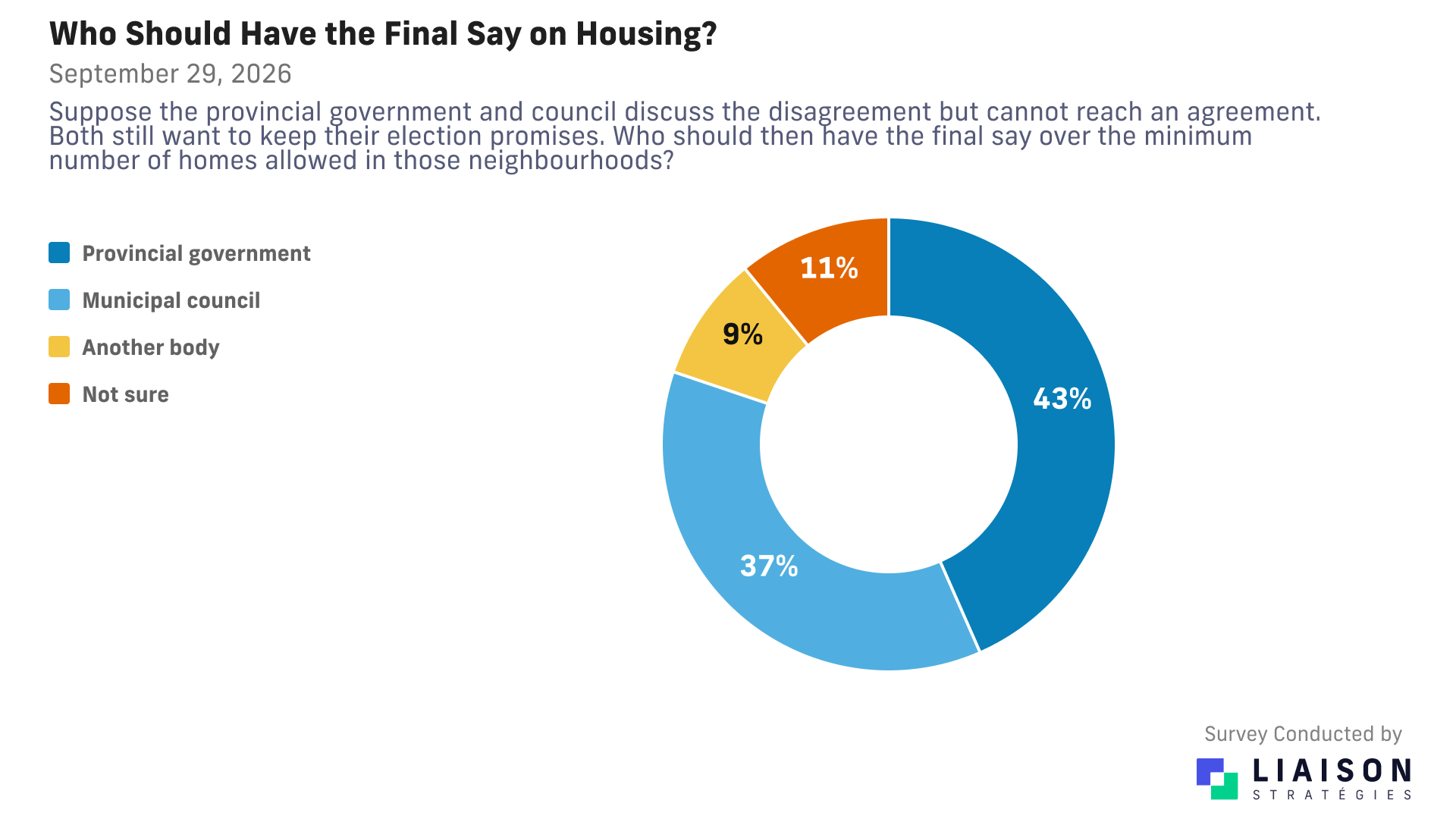
The close provincial race is unfolding alongside municipal election campaigns, raising the prospect of duelling mandates on housing. If the province and a municipal council cannot resolve a disagreement over minimum housing allowances, 43% would give the province the final say and 37% would choose the council. A larger majority, 69%, supports local flexibility when the total number of additional homes is preserved.
Liaison surveyed a random sample of 1,000 British Columbians from September 26 to September 27, 2026, using Interactive Voice Recording (IVR) technology. Participants were reached through random digit dialling (RDD) across both landline and cellular phone networks. The resulting data was weighted to match targets based on the 2021 Census. For the total sample, the margin of error is +/- 3.1 percentage points, 19 times out of 20. The margin is higher for subsamples, including decided and leaning voters. Results may not add to 100% due to rounding.
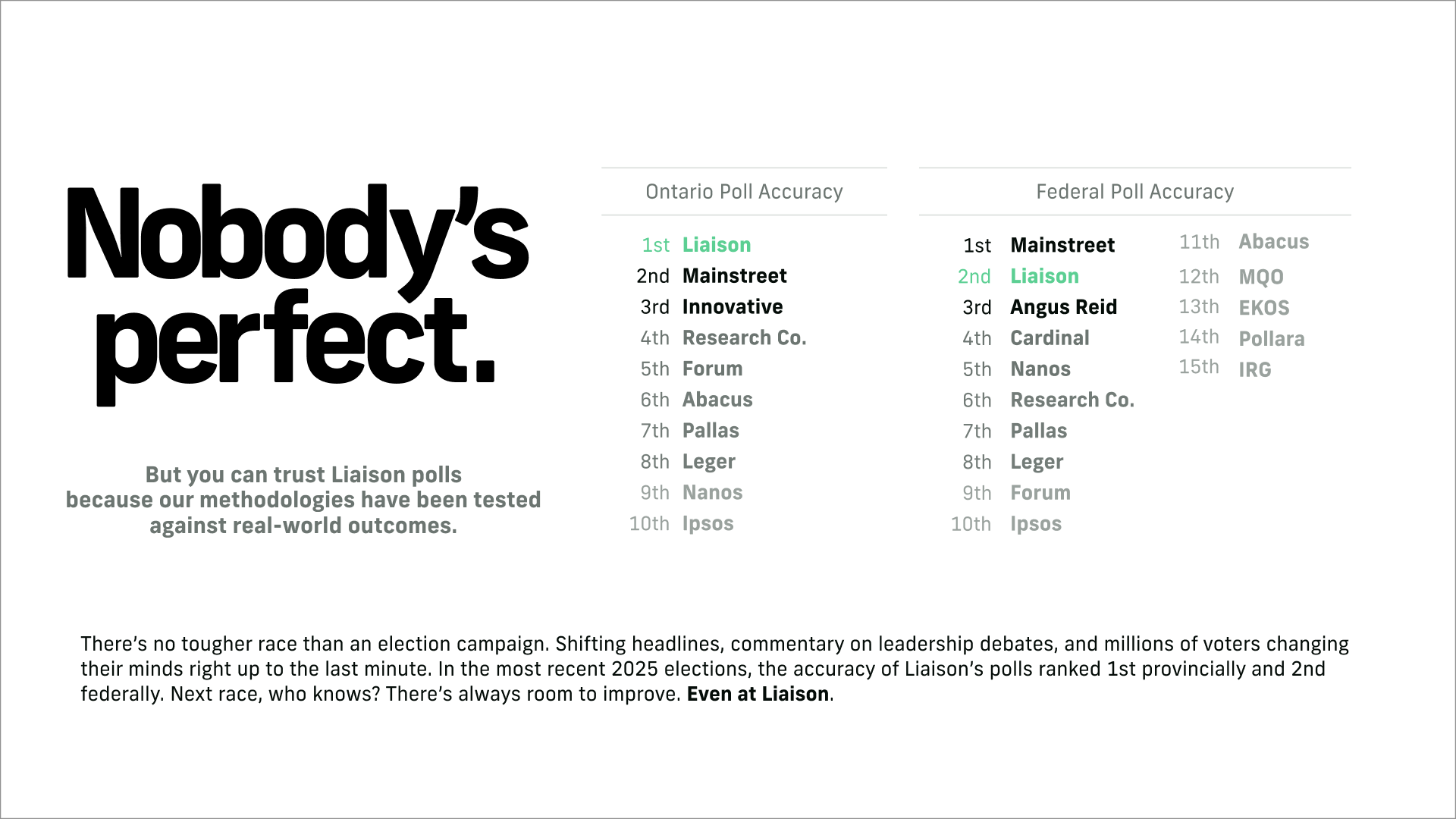
Liaison Strategies is one of the most accurate polling firms in Canada. It received an A grade from 338Canada for its polling in the 2024 British Columbia election, ranked #1 in accuracy in the 2025 Ontario election and #2 nationally in the 2025 federal election. Liaison is a member of the Canadian Research Insights Council.
David Valentin, Principal at Liaison Strategies, said:
"Two elections can produce two mandates that point in opposite directions. A provincial government can promise to require more homes, while a council can promise to allow fewer. Both can win. The question is whose promise takes priority when they cannot both be kept."
"We put that conflict to voters as a hypothetical. Thirty-four per cent say the provincial minimum should apply, 22% would allow the council to set a lower limit, and another 34% want an exception negotiated. Voters are not simply lining up behind one level of government. A substantial group wants them to work out an agreement."
"When we ask what happens if negotiations fail, 43% give the province the final say and 37% choose the council. Nine per cent choose another body and 11% are unsure. The province has the larger share, but neither government has majority backing."
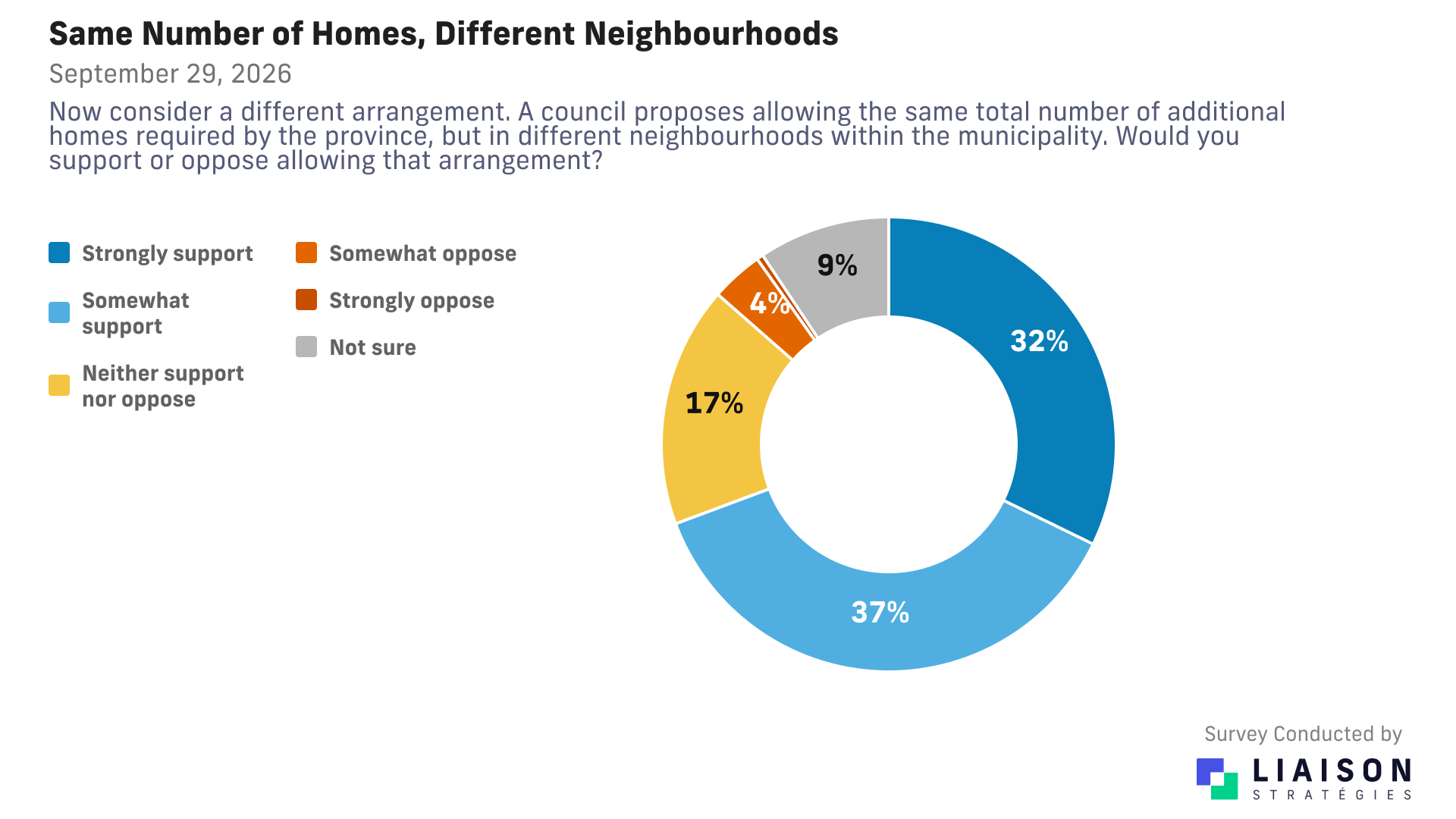
"The strongest consensus is not about which government wins. It is about preserving the number of homes while allowing flexibility over where they go. Sixty-nine per cent support a council accommodating the same total number of additional homes in different neighbourhoods, and just 4% oppose. There is much more agreement on that compromise than on giving either government the last word."
"Voters see housing as an issue in both elections. Seventy-six per cent say housing policy is important to their municipal vote, and 82% say it is important to their provincial vote. Thirty-five per cent think the provincial election will make more difference to local housing affordability, compared with 18% who choose the municipal election and 23% who say both about the same."
"Expecting more from the province does not mean trusting it more. Twenty-nine per cent trust their municipal government more on housing decisions, compared with 27% who choose the province. Meanwhile, 57% disapprove of the province's handling of housing affordability and 53% disapprove of their municipality's performance. Neither side can claim that public frustration is directed only at the other."
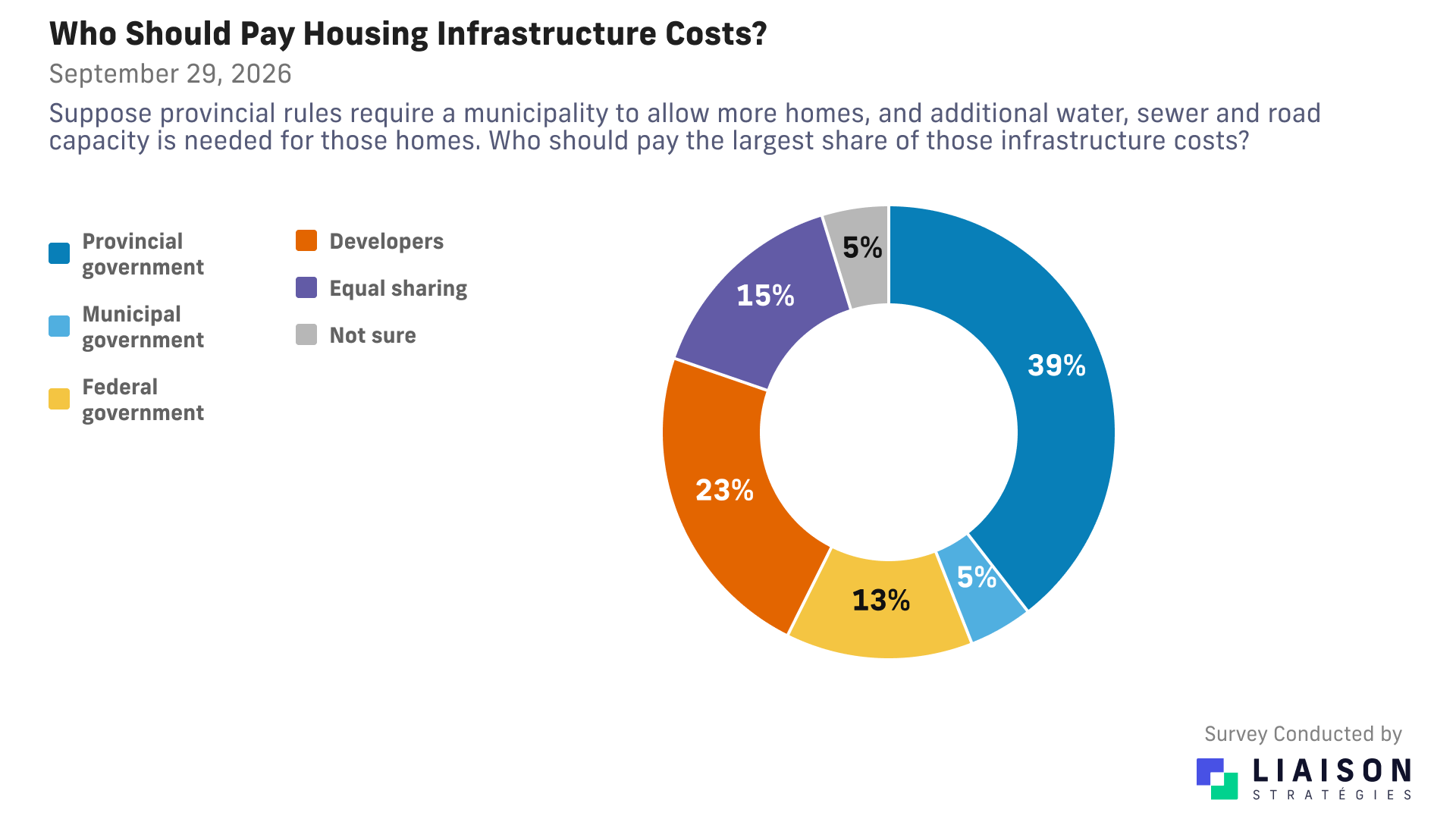
"And what about the bill? When provincial rules require more homes and additional water, sewer and road capacity is needed, 39% say the province should pay the largest share. Twenty-three per cent choose developers, 15% equal sharing and 13% the federal government. Just 5% choose the municipality. The largest group expects Victoria to carry the largest share when it sets the requirement."
"This is not a simple split between people who want more housing and people who do not. Fifty-six per cent support allowing more homes in their city, town or local area, with 13% opposed. Support falls to 47% when those homes are within about a ten-minute walk of the respondent's own home, but still exceeds the 18% opposed. The location matters, even among a public broadly open to more housing."
"For residents, the stakes are immediate. Fifty-eight per cent are concerned about meeting their household's housing costs over the next year, rising to 72% among those aged 18 to 34. A dispute over which government has the stronger mandate will not, by itself, address that pressure."
"The provincial contest itself is virtually level. The Conservatives have 40% among decided and leaning voters and the NDP 39%, compared with 36% and 41% in our September 23 release. The Greens are at 11%, CentreBC at 4%, OneBC at 3%, and other parties at 3%."
"Eby's approval has slipped to 38%, from 42%, while disapproval has risen to 45%, from 43%. Doerkson's favourable rating has increased to 27%, from 21%, although 32% view him unfavourably. Neither the governing party nor its main competitor is approaching this debate with overwhelming public confidence."
"The risk in these concurrent elections is that both governments emerge claiming permission to do incompatible things. Winning an election does not make the other government's mandate disappear."
-30-
Detailed Poll Report:
Detailed Tables:
About Liaison Strategies
Liaison Strategies is a national public opinion research firm. With 13 years of experience in Canadian polling, David Valentin, principal, has fielded hundreds of projects at the municipal, provincial and federal levels and appeared across Canadian media to discuss insights. Liaison is a member of the Canadian Research Insights Council (CRIC), Canada's voice of the research, analytics, and insights profession both domestically and globally.