Quebec: PQ and Liberals Neck-and-Neck; CAQ Gains Ground

Read this in French
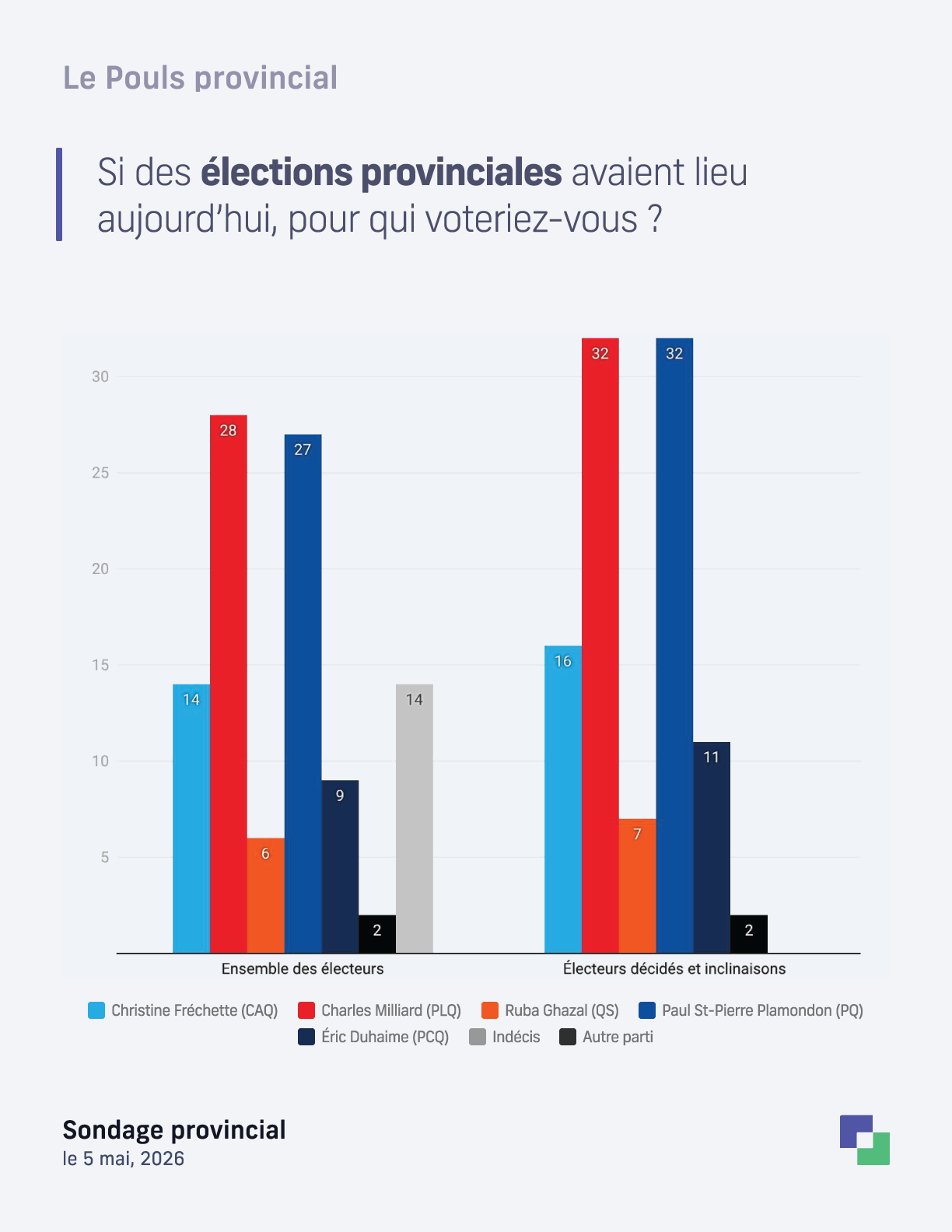
May 5, 2026 (Montreal, QC) – A new Liaison Strategies survey of Quebec shows a close provincial race, with the Parti Québécois narrowly ahead of the Quebec Liberal Party among decided and leaning voters.
If a provincial election were held today, the PQ would receive 32% of the decided and leaning vote, followed by the Liberals at 32%, the CAQ at 16%, the PCQ at 11%, Québec solidaire at 7%, and another party at 2%.
The federal picture remains much more lopsided. Among decided and leaning voters, the Liberals lead in Quebec with 42%, followed by the Bloc Québécois at 22%, the Conservatives at 21%, the NDP at 9%, the Greens at 3%, the PPC at 2%, and another party at 2%.
Liaison surveyed a random sample of 1,000 Quebecers using Interactive Voice Recording technology from April 26 to April 27, 2026. Respondents were reached through random digit dialing across landline and cellular phone networks. The margin of error for the total sample is ±3.1 percentage points, 19 times out of 20.
Liaison Strategies was ranked #1 for accuracy in Ontario in 2025 and #2 nationally in the 2025 federal election.
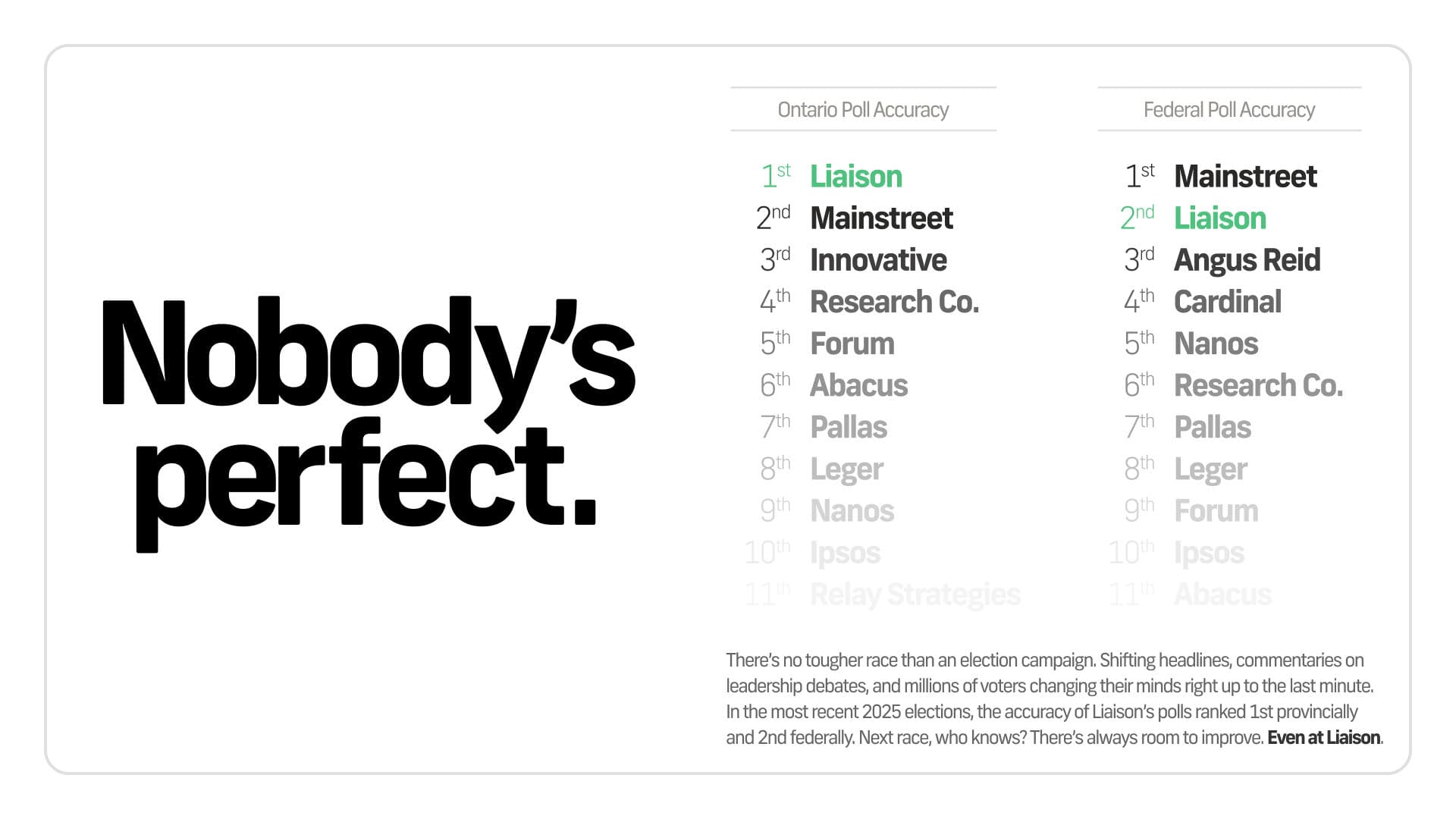
Alex Nanoff, Principal at Liaison Strategies, said:
“The Quebec provincial race is highly competitive at the top, with the PQ and Liberals effectively tied. The PQ has a clear advantage among francophone voters, while the Liberals continue to dominate among non-francophone Quebecers. The CAQ is still well back of first place, but at 16% it is showing signs of life.”
“Among francophones, the PQ leads with 39%, followed by the Liberals and CAQ at 21% and 20% respectively. Among non-francophones, the Liberals are far ahead at 66%. That language divide is the central fact of Quebec politics right now.”
“The regional picture is just as important. The Liberals lead in Montreal with 41%, while the PQ leads in Quebec City and the rest of Quebec. In Quebec City, the PCQ is also competitive at 22%, which continues to complicate the path for the CAQ.”
"On sovereignty, 37% of Quebecers say they would vote in favour of separating from Canada, while 59% would vote against and 5% are not sure. Among francophones, support for sovereignty rises to 44%, compared to 10% among non-francophones."
“The sovereignty number is significant, but not sufficient. Support is clearly concentrated among francophones and PQ voters, but the No side still holds a wide province-wide lead.”
A majority of Quebecers also say the province is headed in the wrong direction. Overall, 55% say Quebec is on the wrong track, compared to 38% who say it is moving in the right direction and 8% who are unsure.
Healthcare remains the top issue at 27%, followed by cost of living and inflation at 22%, housing affordability at 14%, and the economy and jobs at 10%.
“Voters are not happy with the direction of the province, and that dissatisfaction is showing up across several questions. Healthcare is still the top concern, but cost of living is close behind. That creates a difficult environment for any governing party.”
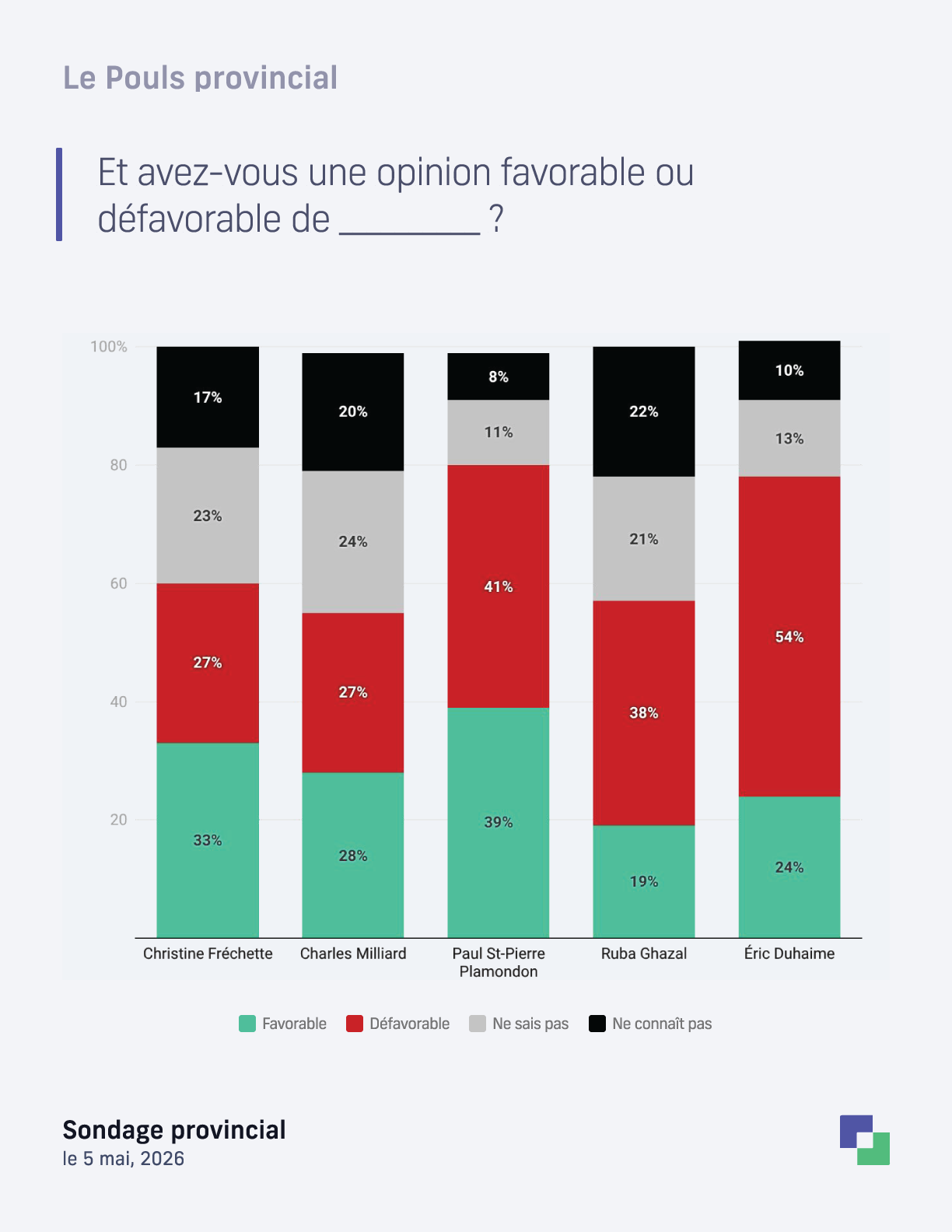
"Leader favourability is mixed. Paul St-Pierre Plamondon is viewed favourably by 39% and unfavourably by 41%. Charles Milliard is at 28% favourable and 28% unfavourable, while Christine Fréchette stands at 33% favourable and 27% unfavourable. Éric Duhaime remains polarizing, with 24% favourable and 54% unfavourable. Ruba Ghazal is at 19% favourable and 38% unfavourable."
“The PQ has the narrow ballot lead, but PSPP’s favourability is not overwhelmingly positive. The Liberals are competitive despite a still-developing leader profile. The CAQ’s challenge is different: they need to turn a modest recovery into something much larger if they want back into contention.”
-30-
Detailed Poll Report:
About Liaison Strategies
Liaison Strategies is a national public opinion research firm. With 12 years of experience in Canadian polling, David Valentin, principal, has fielded hundreds of projects at the municipal, provincial and federal levels and appeared across Canadian media to discuss insights. Liaison is a member of the Canadian Research Insights Council (CRIC), Canada’s voice of the research, analytics, and insights profession both domestically and globally.