Ontario: PCs Lead Liberals by 4 as Ford Rebounds Amid Trump Trade Fight
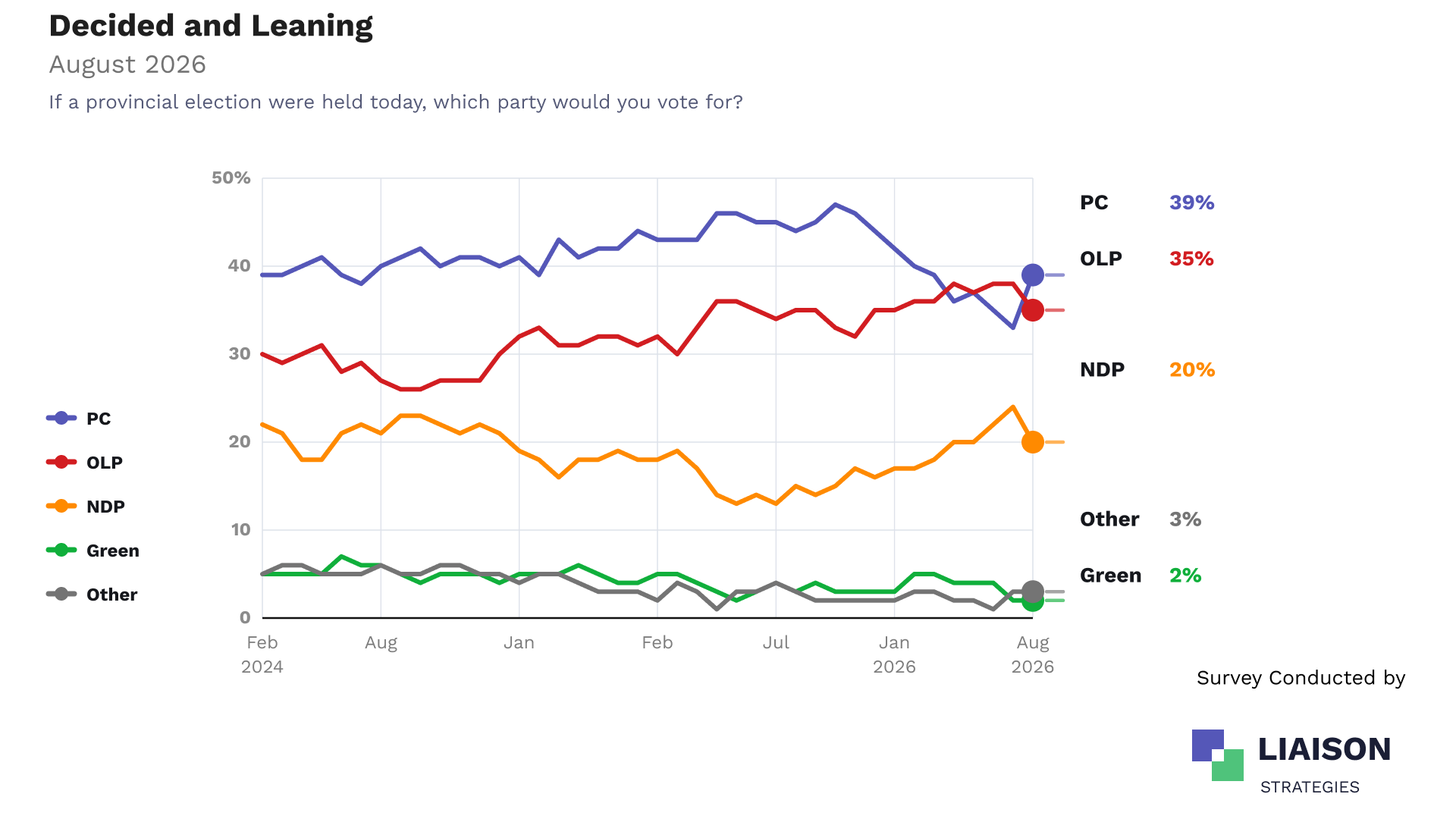
The Ontario PCs lead the Liberals 39% to 35% among decided and leaning voters, while Ford approval rebounds as Ontarians broadly back trade retaliation against the United States.

August 26, 2026 (Toronto, ON) - The latest monthly Ontario survey from Liaison Strategies shows the Progressive Conservatives leading the Ontario Liberals by 4 points among decided and leaning voters, while Premier Doug Ford's approval has rebounded from its July low as the Canada-U.S. trade war puts Ontario at the centre of the fight.
The survey was conducted August 23 to August 24, immediately after new U.S. tariffs on Canadian goods took effect and as the Ford-Trump fight moved from trade policy into a public war of words. Donald Trump called Ford a "flunky" and mocked him as the less impressive brother of Rob Ford; Ford responded by calling Trump a bully and a loser.
Among decided and leaning voters, the PCs are at 39%, followed by the Ontario Liberals at 35%, the Ontario NDP at 20%, other parties at 3%, and the Greens at 2%.
The survey also tests several measures Ford urged Prime Minister Mark Carney to consider in an August 17 letter, including dollar-for-dollar retaliation, tariffs aimed at politically important U.S. states, LCBO restrictions on American alcohol, electricity export charges or restrictions, critical-mineral export restrictions, and supports for affected workers and businesses.
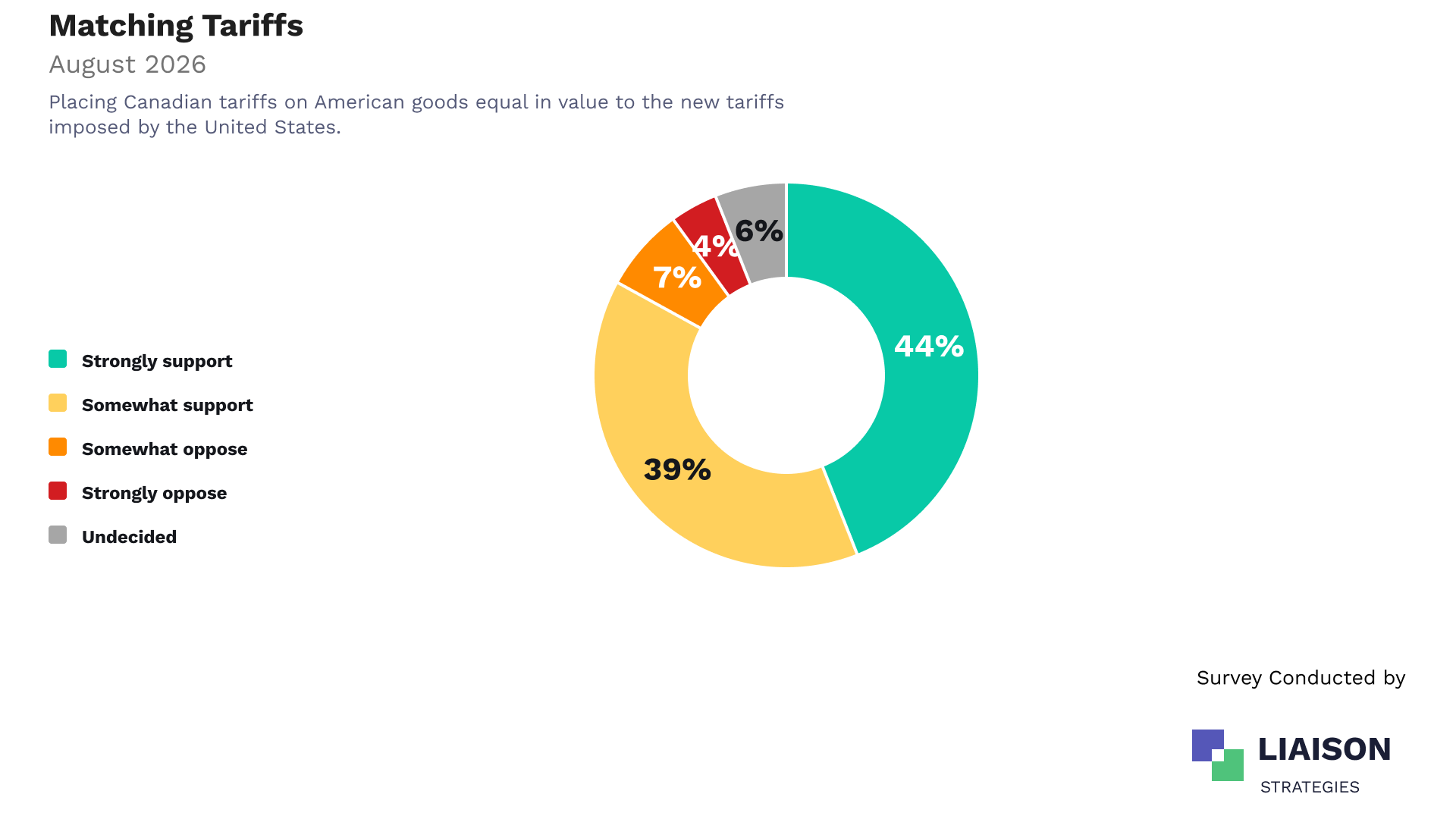
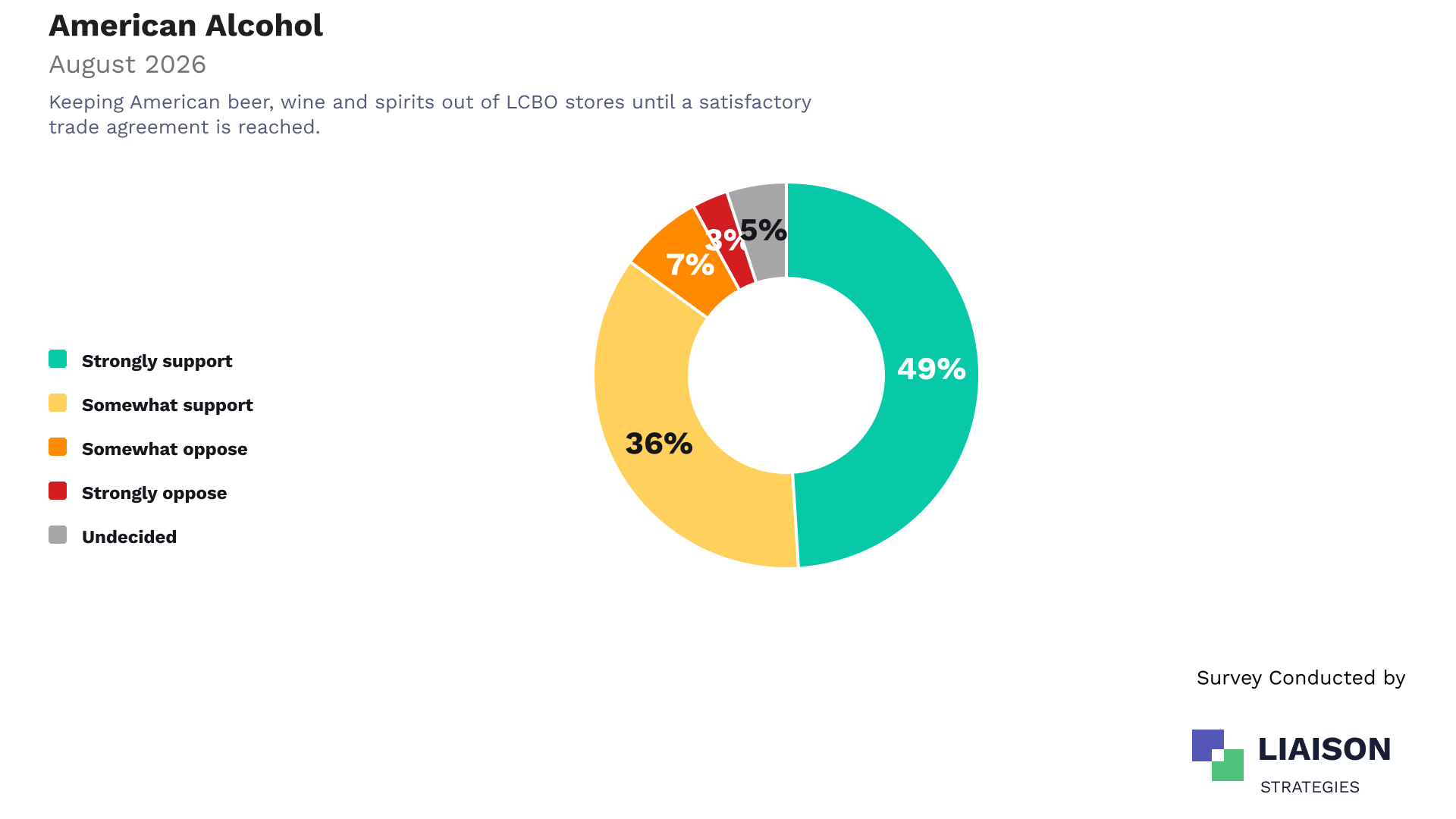
Ontarians broadly support the most visible retaliation options. Eighty-three percent support placing Canadian tariffs on American goods equal in value to the new U.S. tariffs, 85% support keeping American beer, wine, and spirits out of LCBO stores until a satisfactory trade agreement is reached, and 72% support placing an additional charge on electricity exported from Ontario to the United States while continuing to supply the electricity.
The resistance is most visible among federal Conservative voters. While Conservative voters still support several measures, they are consistently less supportive of harder retaliation than Liberal or NDP voters, and they are much more likely to prioritize limiting economic costs.
Liaison surveyed a random sample of 1,500 Ontarians from August 23 to August 24, 2026, using Interactive Voice Recording (IVR) technology. Participants were reached through random digit dialling (RDD) across both landline and cellular phone networks. The resulting data was weighted to match targets based on the 2021 Census. For the total sample, the margin of error is +/- 2.5 percentage points, 19 times out of 20.
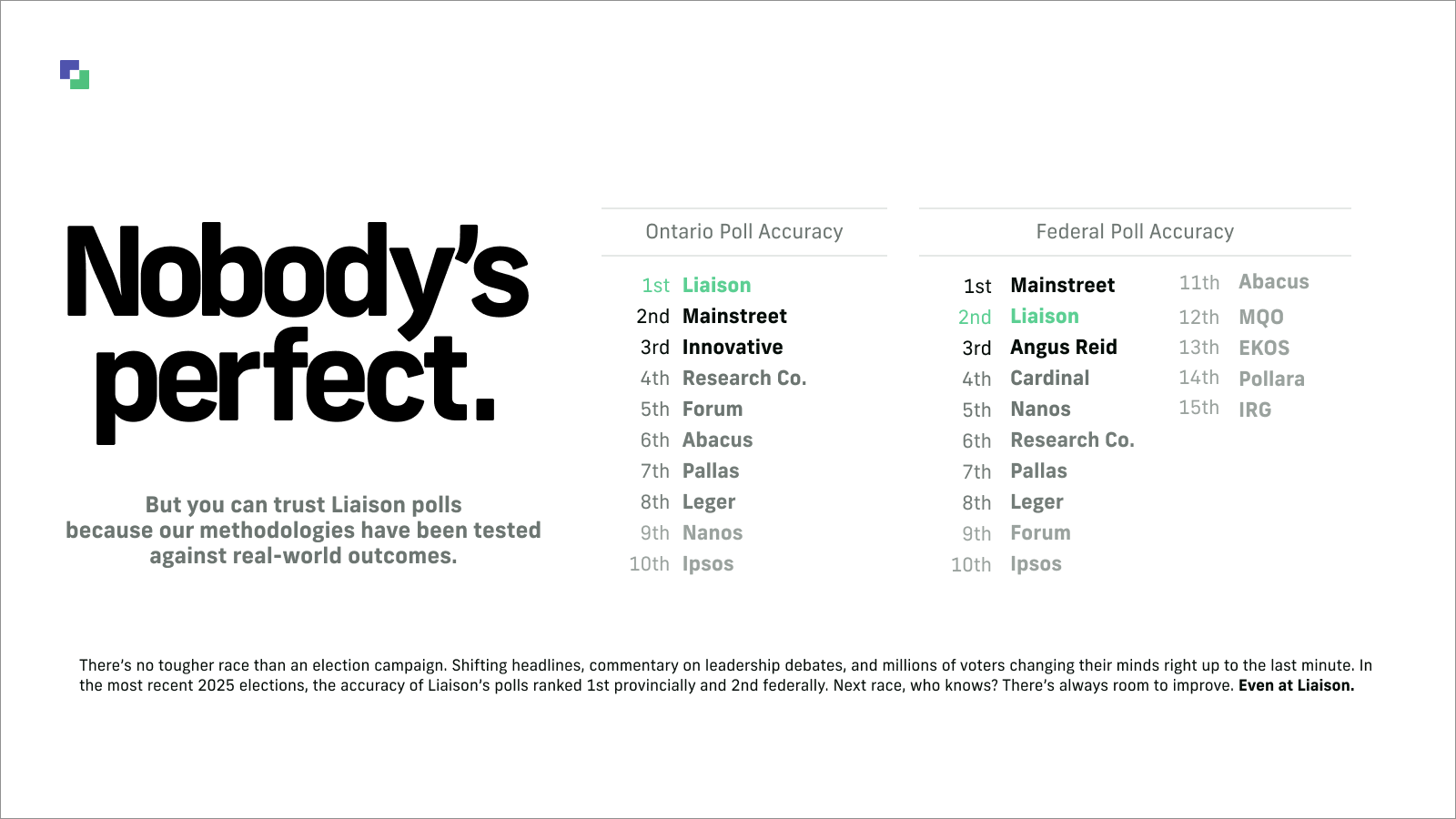
Liaison Strategies is one of the most accurate polling firms in Canada. It ranked #1 in accuracy in the 2025 Ontario election and #2 nationally in the 2025 federal election. Liaison is a member of the Canadian Research Insights Council.
David Valentin, Principal at Liaison Strategies, said:
"This is a very different Ontario race than the one we saw in July. The PCs are up 6 points to 39% among decided and leaning voters, while the Liberals are down 3 points to 35% and the NDP is down 4 points to 20%."
"The obvious context is the trade war. This poll was in field right as the latest U.S. tariffs took effect and as Ford and Trump turned the fight into something personal. Whether voters like Ford in general or not, this is the kind of issue that can temporarily change the frame around a premier."
"The PCs have reclaimed the lead, but that should not be mistaken for a clean bill of political health for Ford. His approval has improved sharply, from 24% in July to 36% now, but 61% still disapprove of the job he is doing as Premier."
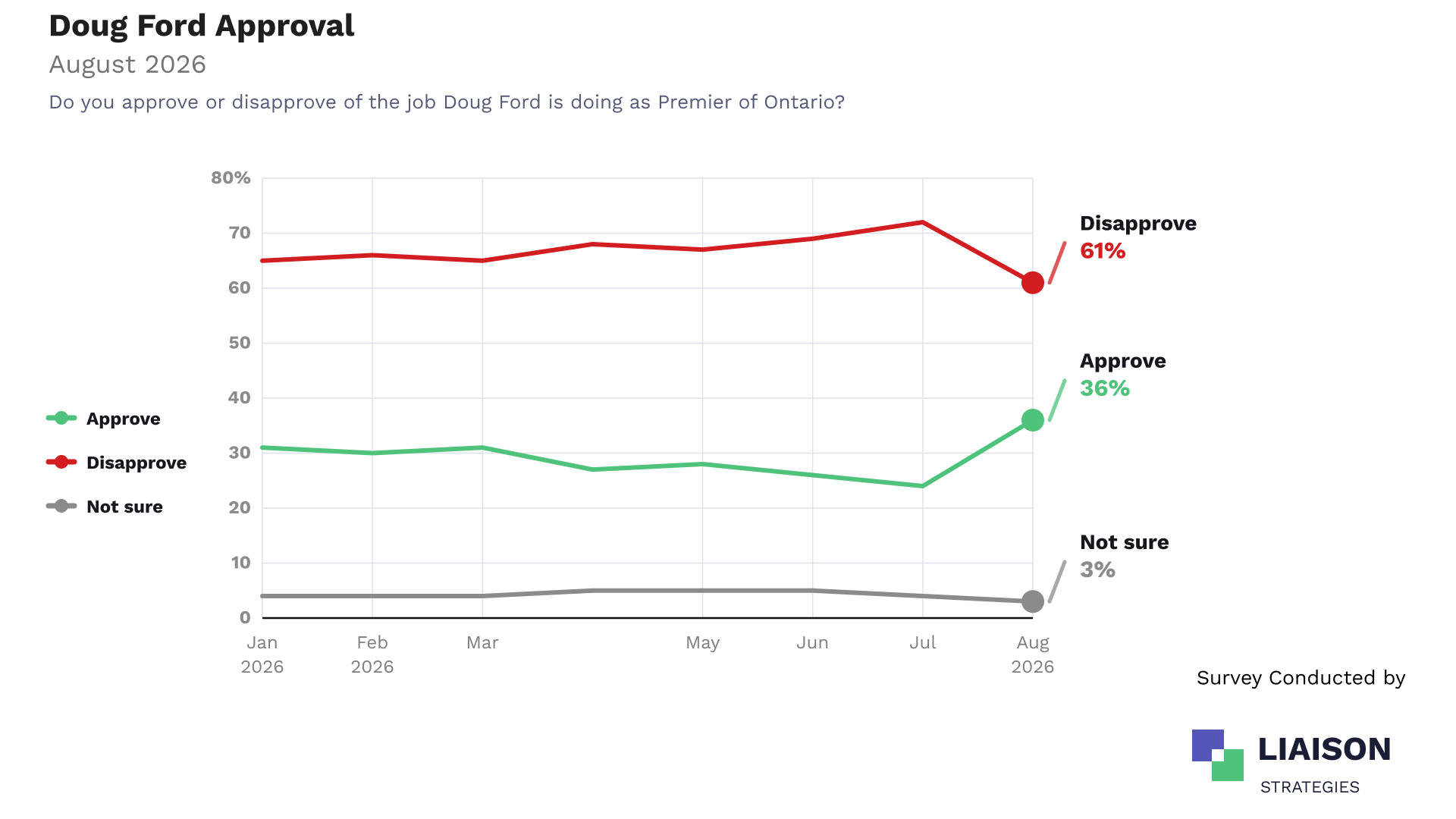
"In other words, Ford is much less damaged than he was a month ago, but he is still deeply underwater. The party is in a better place than the Premier personally."
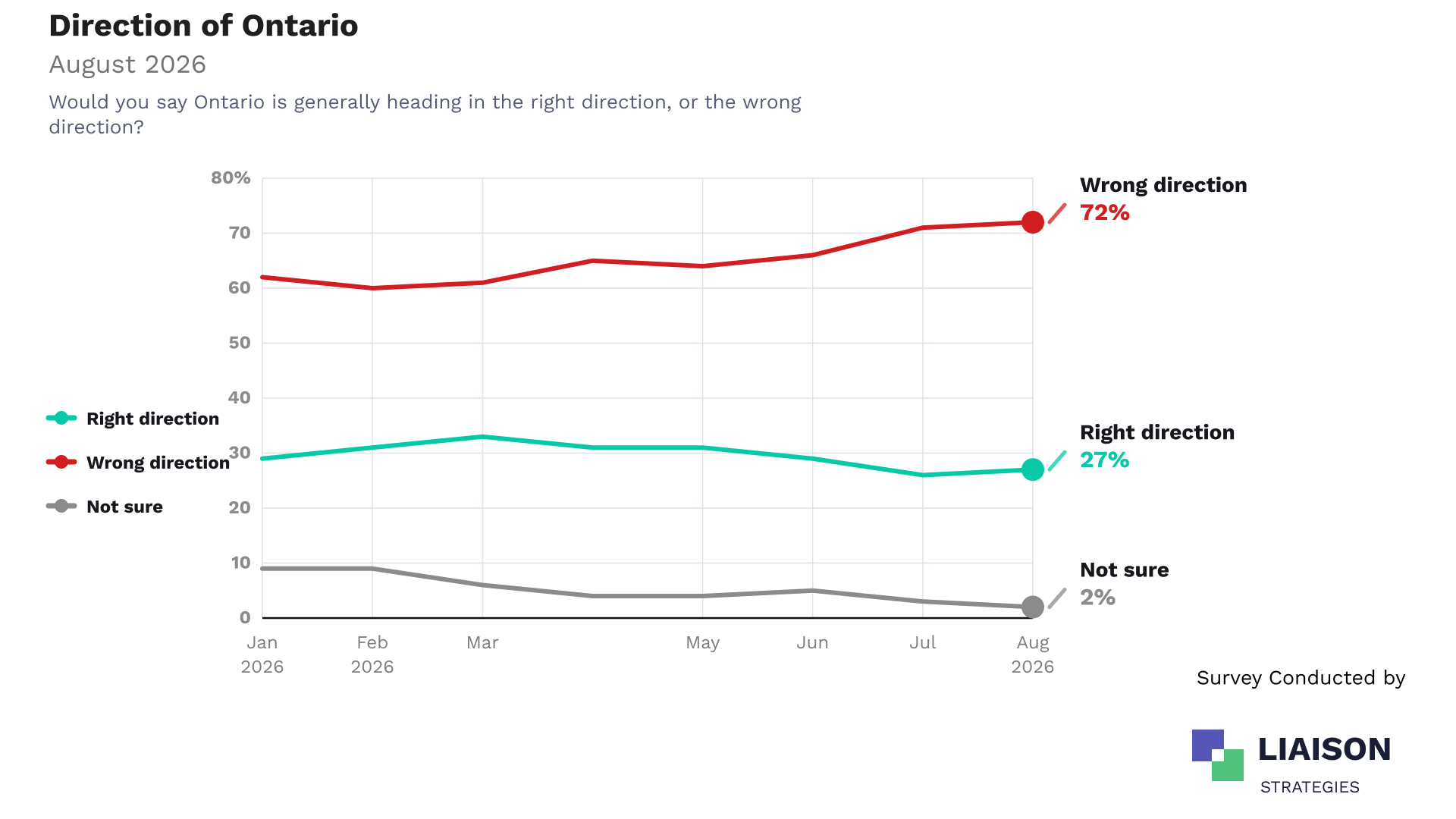
"The direction-of-province numbers are still brutal for the government. Only 27% say Ontario is headed in the right direction, while 72% say wrong direction. That is basically unchanged from July, so the Ford rebound is happening inside a province that remains very unhappy with the overall direction of things."
"The regional shape of the race matters. The Liberals lead in Toronto, 44% to 29%, and are competitive in the 905, where the PCs lead 41% to 38%. The PCs are strongest in South Central Ontario at 47%, the North at 42%, and Southwestern Ontario at 42%."
"There is also a gender split. Among women, the Liberals lead 41% to 33%. Among men, the PCs lead 46% to 30%. That is a big part of why the topline has moved back toward the PCs."
"Federally, Ontario is still a Liberal province in this poll. Among decided and leaning voters federally, the Liberals lead the Conservatives 48% to 36%, with the NDP at 11%. So Ontario voters are currently giving Ford's PCs a provincial lead while still giving Carney's Liberals a federal lead."
"The trade questions are based on the letter Ford sent to Carney before the latest escalation, so this is a test of the political runway for the retaliatory options Ford has been pushing."
"The trade numbers are striking because Ontarians are not divided on the basic idea of hitting back. Eighty-three percent support matching U.S. tariffs dollar-for-dollar, including 44% who strongly support it. That gives Ford a lot of room to be aggressive with Trump."
"Support is even higher for keeping American beer, wine, and spirits out of LCBO stores. Eighty-five percent support that, including 49% who strongly support it. It is the kind of retaliatory measure that is both easy to understand and politically popular."
"Where things get more complicated is on the harsher measures in Ford's letter. Majorities support electricity export charges, reducing or stopping electricity exports, and reducing critical-mineral exports, but voters also recognize that pressure can create costs at home."
"The public is more complicated when you ask them to choose between pressure and economic risk. Forty-two percent say governments should take stronger measures against the United States even if they create additional economic costs in Ontario, while 35% say governments should place equal weight on pressure and economic risk, and 18% say governments should limit measures to reduce economic costs."
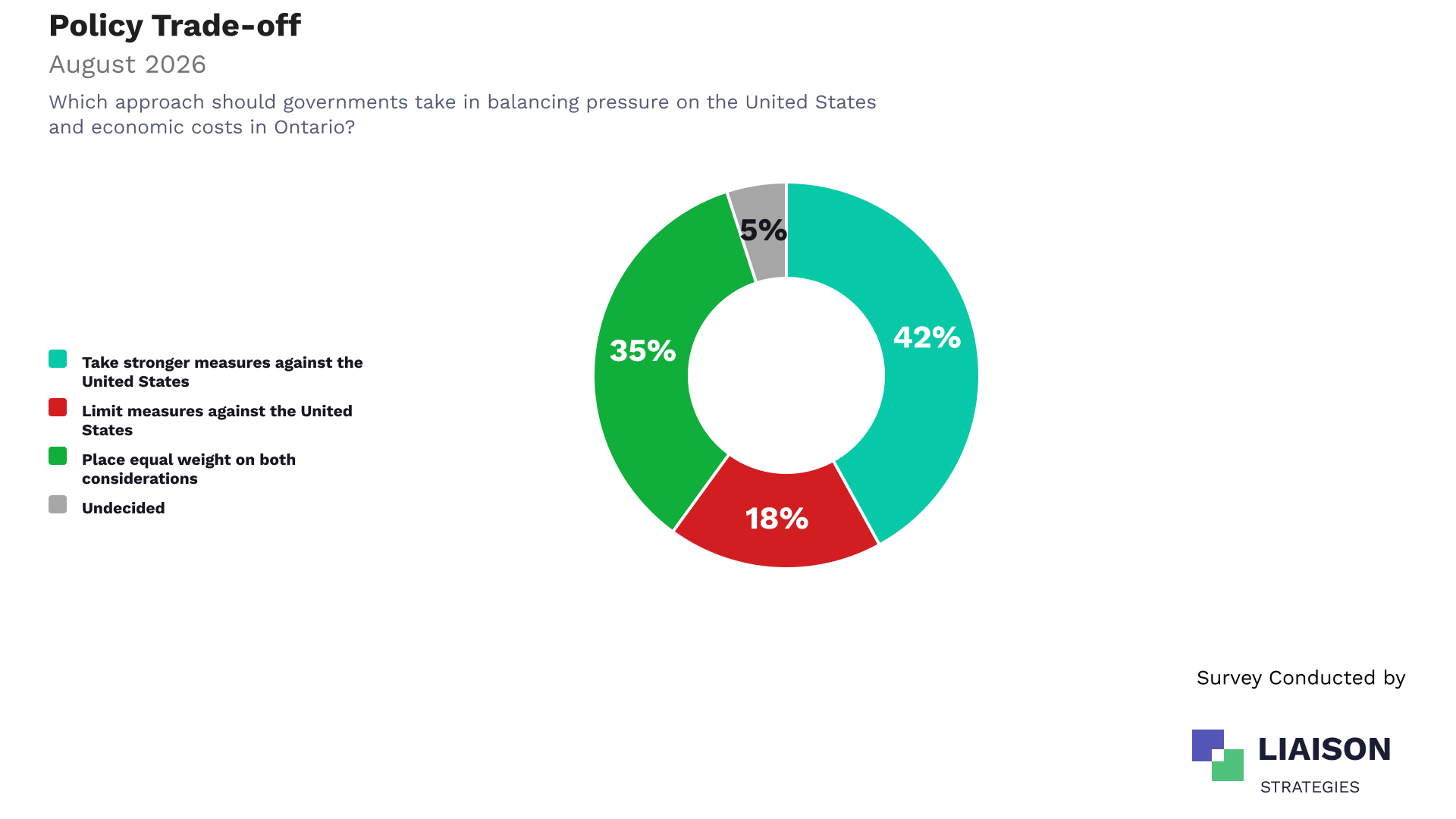
"That tells us voters are hawkish, but not reckless. They support retaliation, but they are aware that some measures could come back onto Ontario households, workers, or businesses."
"The federal Conservative column is the brake on the harder stuff. Among federal Conservative voters, only 10% say governments should take stronger measures against the United States even if they create additional economic costs in Ontario. By contrast, 43% say governments should limit measures to reduce those costs, and 41% say governments should put equal weight on pressure and economic risk."
"You see the same pattern on specific measures. Federal Conservative voters are the most resistant to electricity export charges, reducing electricity exports, restricting critical minerals, and reducing oil or potash exports. The exception is regulatory relief for industry, where Conservative voters are more supportive."
"When Ontarians are asked which action they most want governments to pursue, additional tariffs are first at 32%. Increasing financial assistance to affected workers and businesses is next at 17%, followed by restricting exports of electricity or critical minerals at 16%, and keeping American alcohol out of LCBO stores at 15%."
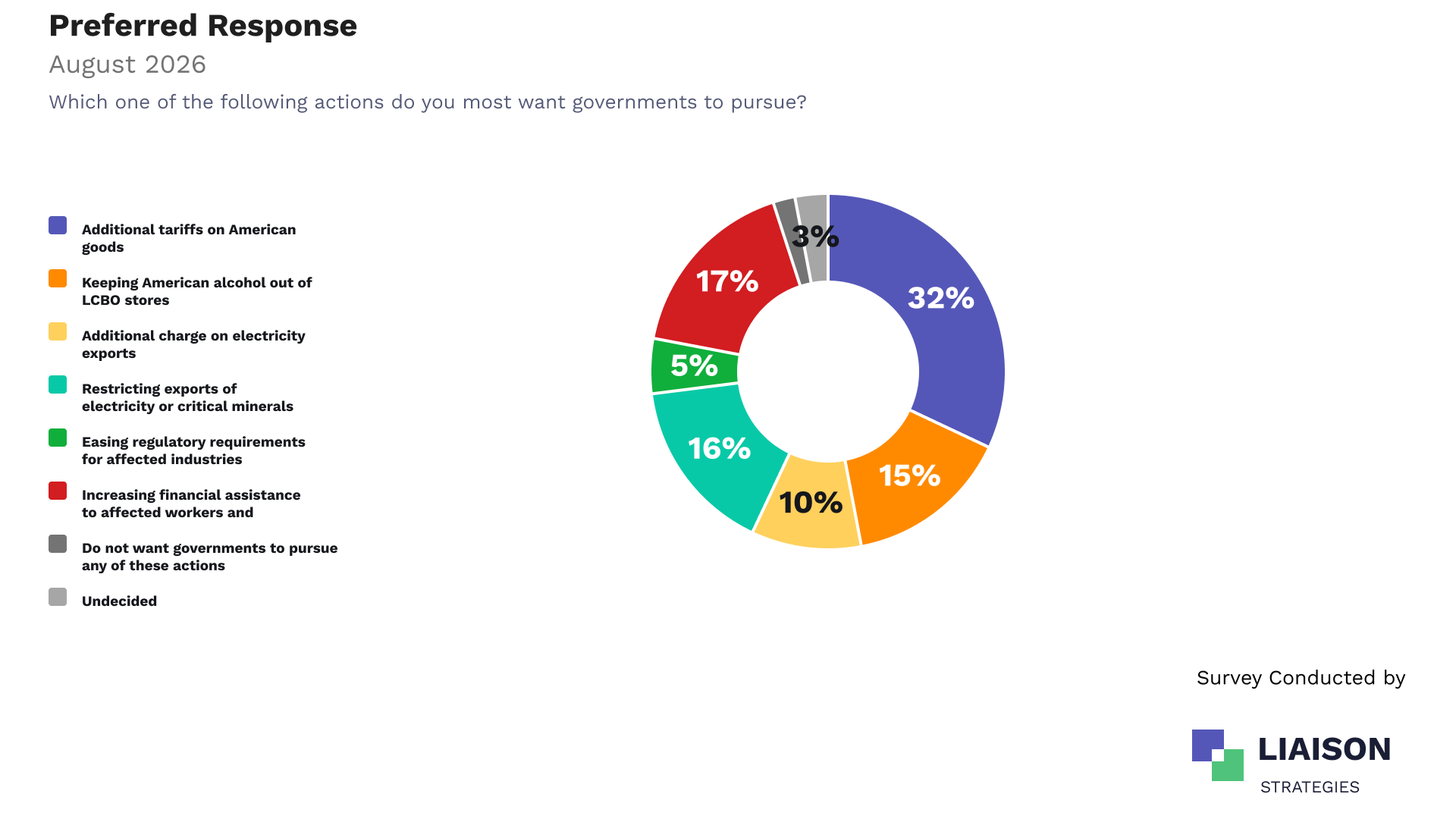
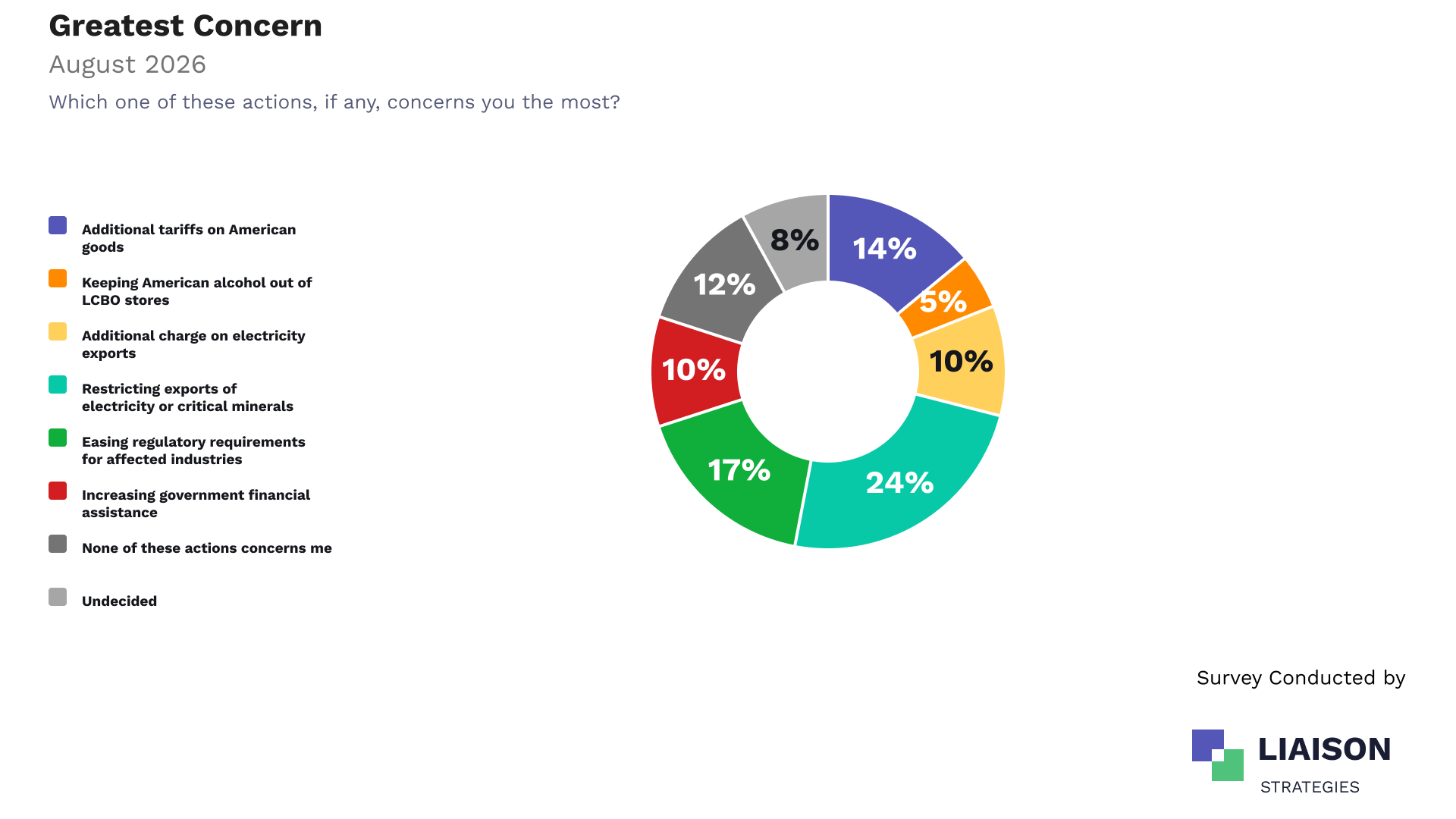
"The most concerning action is restricting exports of electricity or critical minerals, at 24%. People may support strong measures in principle, but the more those measures touch strategic exports, employment, prices, or investment, the more complicated the politics become."
"For Ford, the upside is that the PCs are back in front, his approval has recovered, and the public is broadly onside with retaliation against Trump. The downside is that the province is still overwhelmingly in a wrong-track mood, and the trade file is a high-stakes issue where voters want toughness but also want economic caution."
-30-
Detailed Poll Report:
Detailed Tables:
About Liaison Strategies
Liaison Strategies is a national public opinion research firm. With 13 years of experience in Canadian polling, David Valentin, principal, has fielded hundreds of projects at the municipal, provincial and federal levels and appeared across Canadian media to discuss insights. Liaison is a member of the Canadian Research Insights Council (CRIC), Canada's voice of the research, analytics, and insights profession both domestically and globally.