Ontario: PCs Lead by 7; 62% Disapprove of Ford on Education
PCs lead 39% to 32%, but education is a weak spot for Ford. More would blame the government for school closures, even as 51% oppose a province-wide teachers' strike.

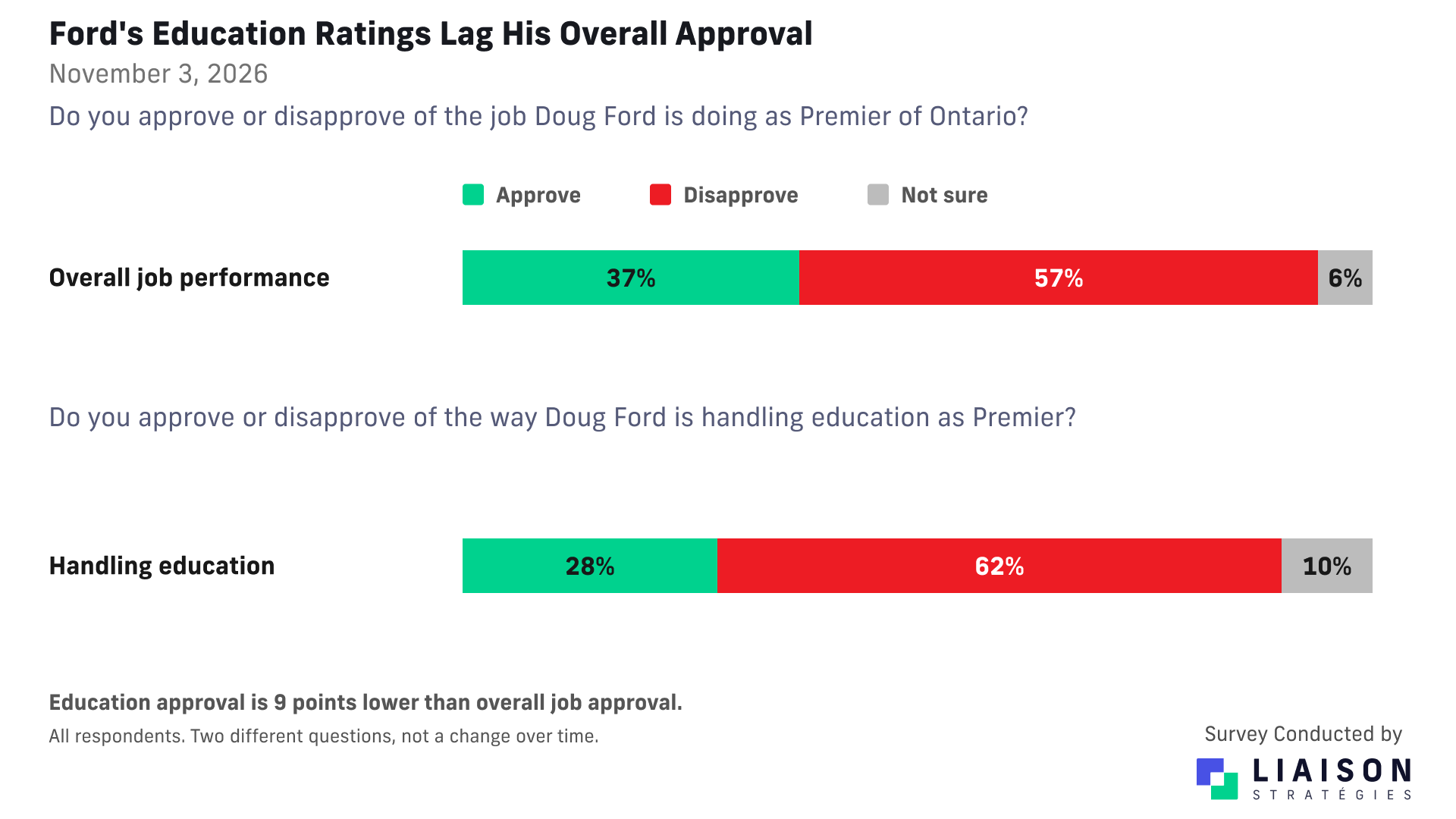
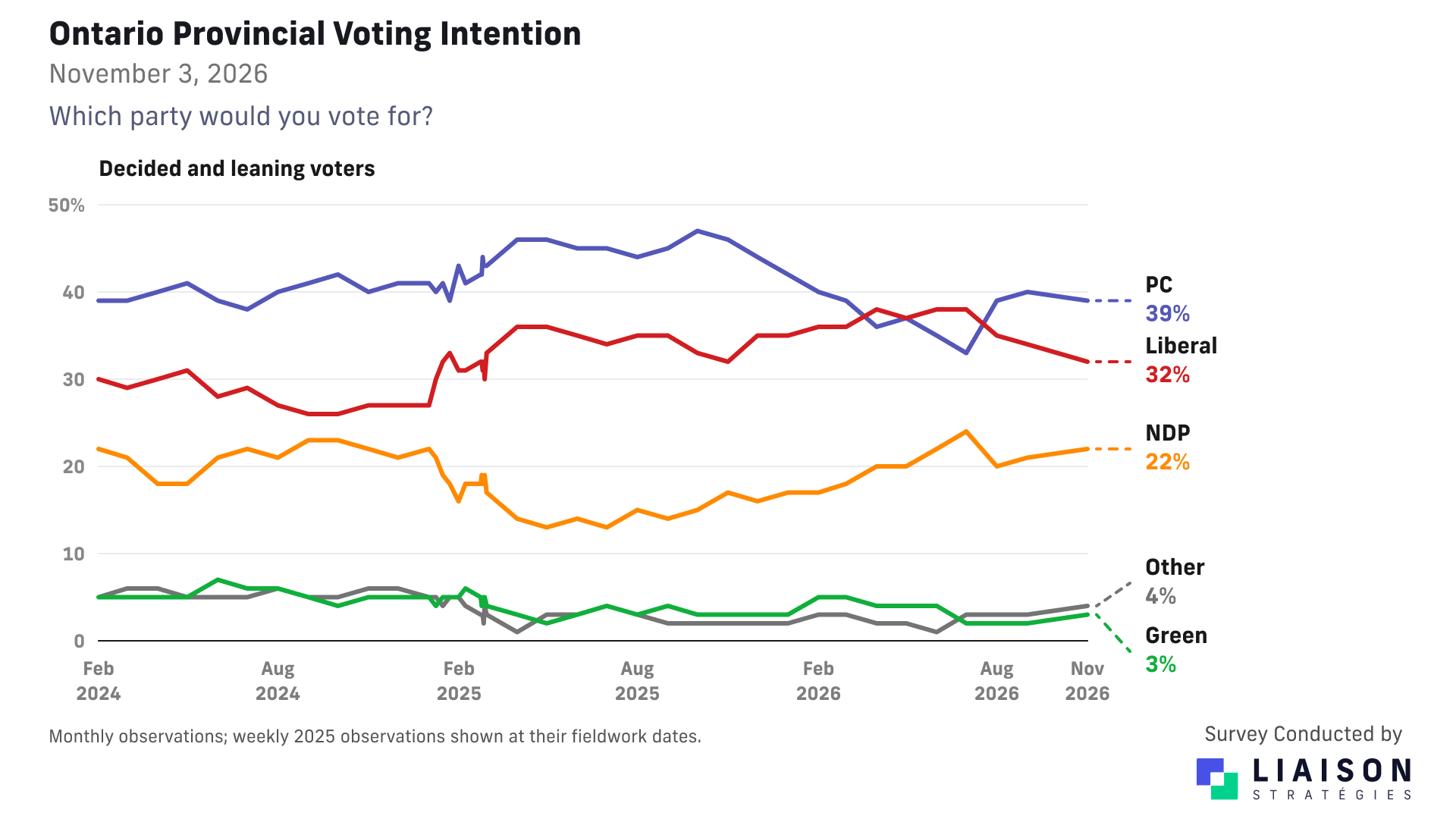
November 3, 2026 (Toronto, ON) - A new Liaison Strategies Ontario Political Tracker puts the Progressive Conservatives at 39%, the Ontario Liberals at 32% and the Ontario NDP at 22% among decided and leaning voters. The PCs hold a seven-point lead, but education presents a more difficult picture for Premier Doug Ford: 62% disapprove of his handling of the file.
Liaison surveyed a random sample of 1,000 Ontarians from October 30 to October 31, 2026, using Interactive Voice Recording (IVR) technology. Participants were reached through random digit dialling (RDD) across both landline and cellular phone networks. The resulting data was weighted by age, gender and region to match targets based on the 2021 Census. For the total sample, the margin of error is +/- 3.1 percentage points, 19 times out of 20. The margin is higher for subsamples. Results may not add to 100% due to rounding.
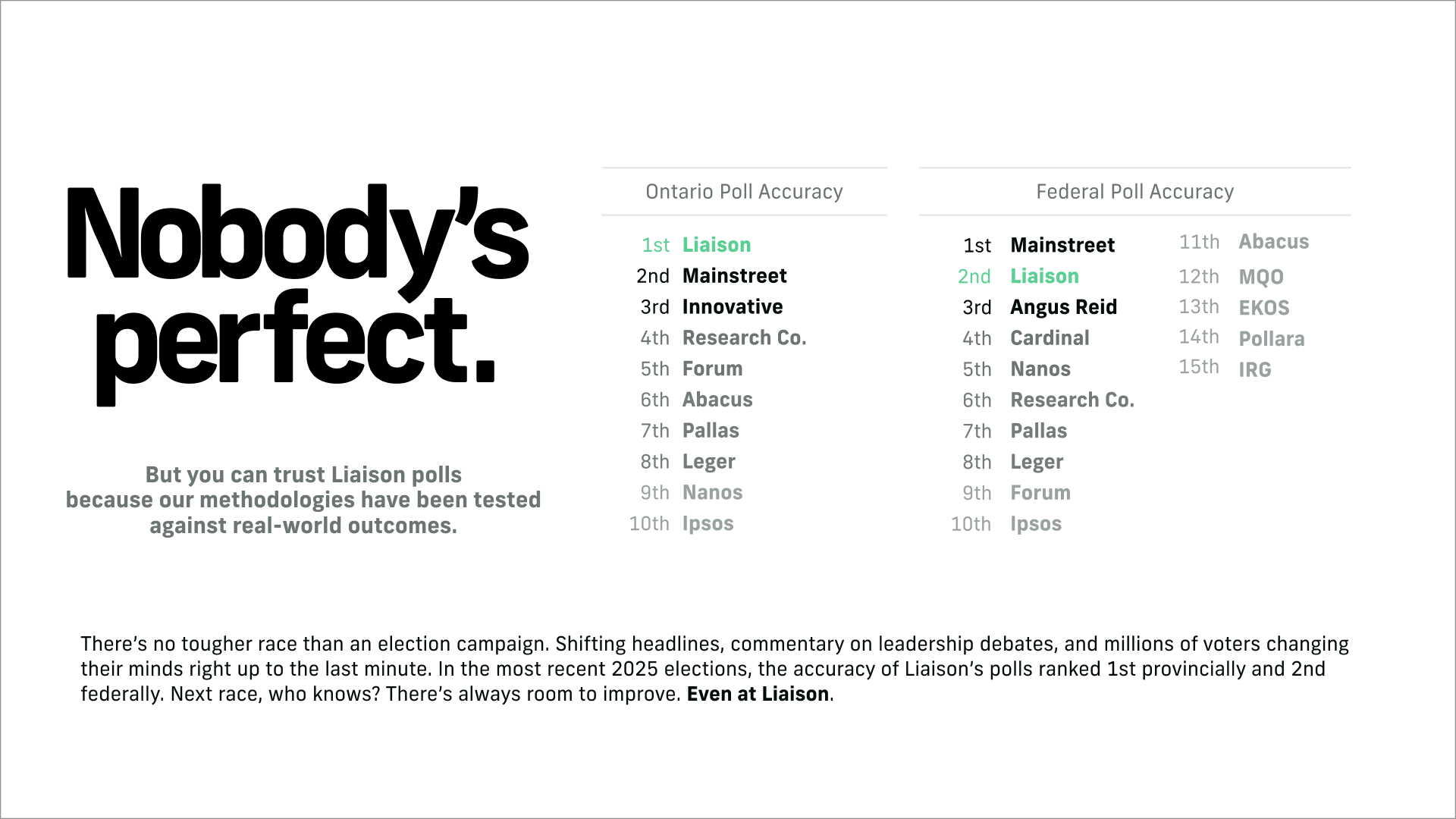
Liaison Strategies is one of the most accurate polling firms in Canada. It ranked #1 in accuracy in the 2025 Ontario election and #2 nationally in the 2025 federal election. Liaison is a member of the Canadian Research Insights Council.
David Valentin, Principal at Liaison Strategies, said:
"Most Ontarians oppose a province-wide teachers' strike. But more would blame the government for school closures than the unions. Ford cannot assume that opposition to a strike means support for his handling of negotiations."
"Ford's overall approval is 37%, with 57% disapproving. On education, just 28% approve and 62% disapprove."
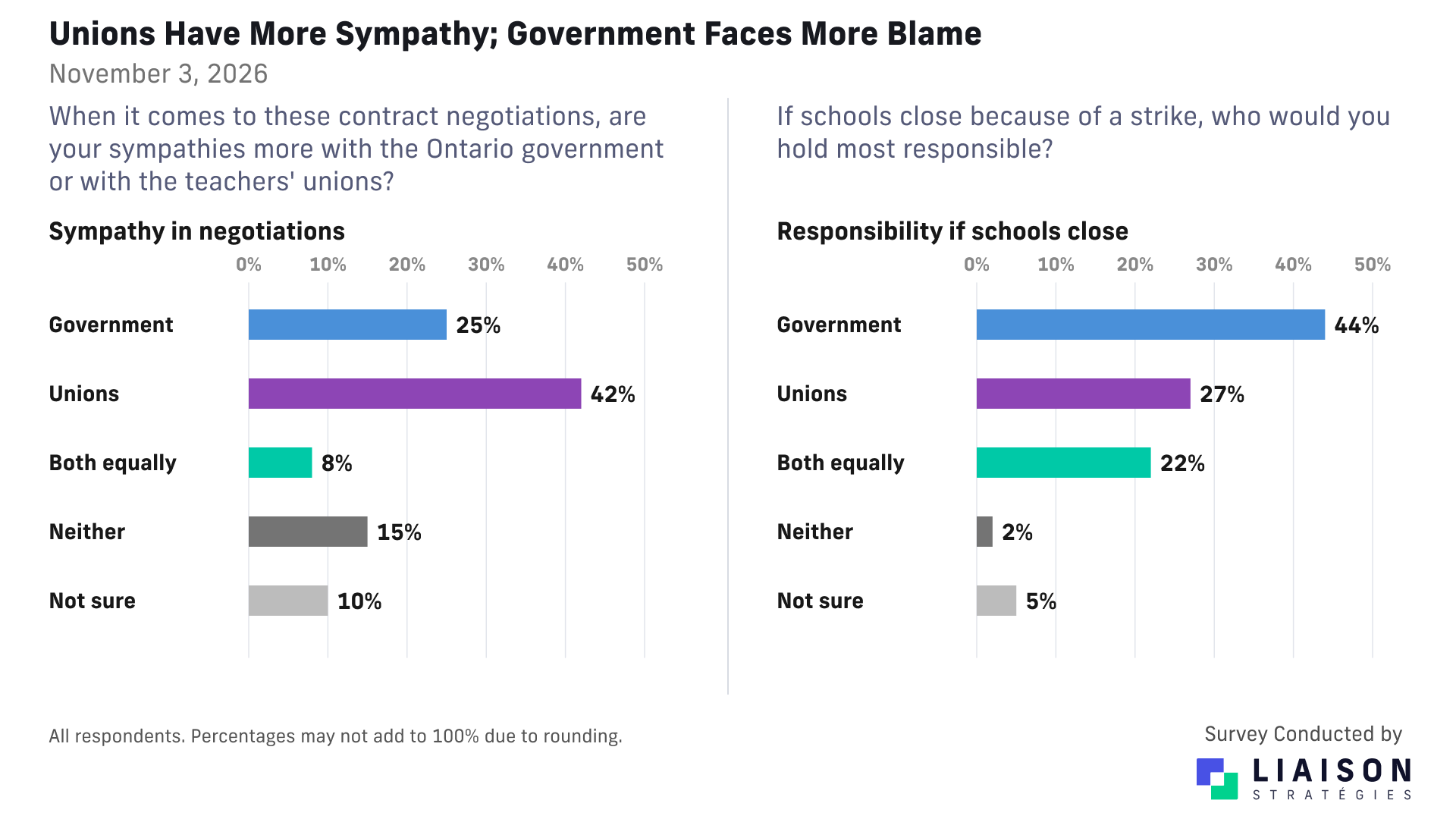
"The unions have more public sympathy than the government, by 42% to 25%. If schools close because of a strike, 44% would hold the government most responsible and 27% would blame the unions. Another 22% would blame both equally. The government cannot assume that frustration over closed schools would be directed mainly at teachers."
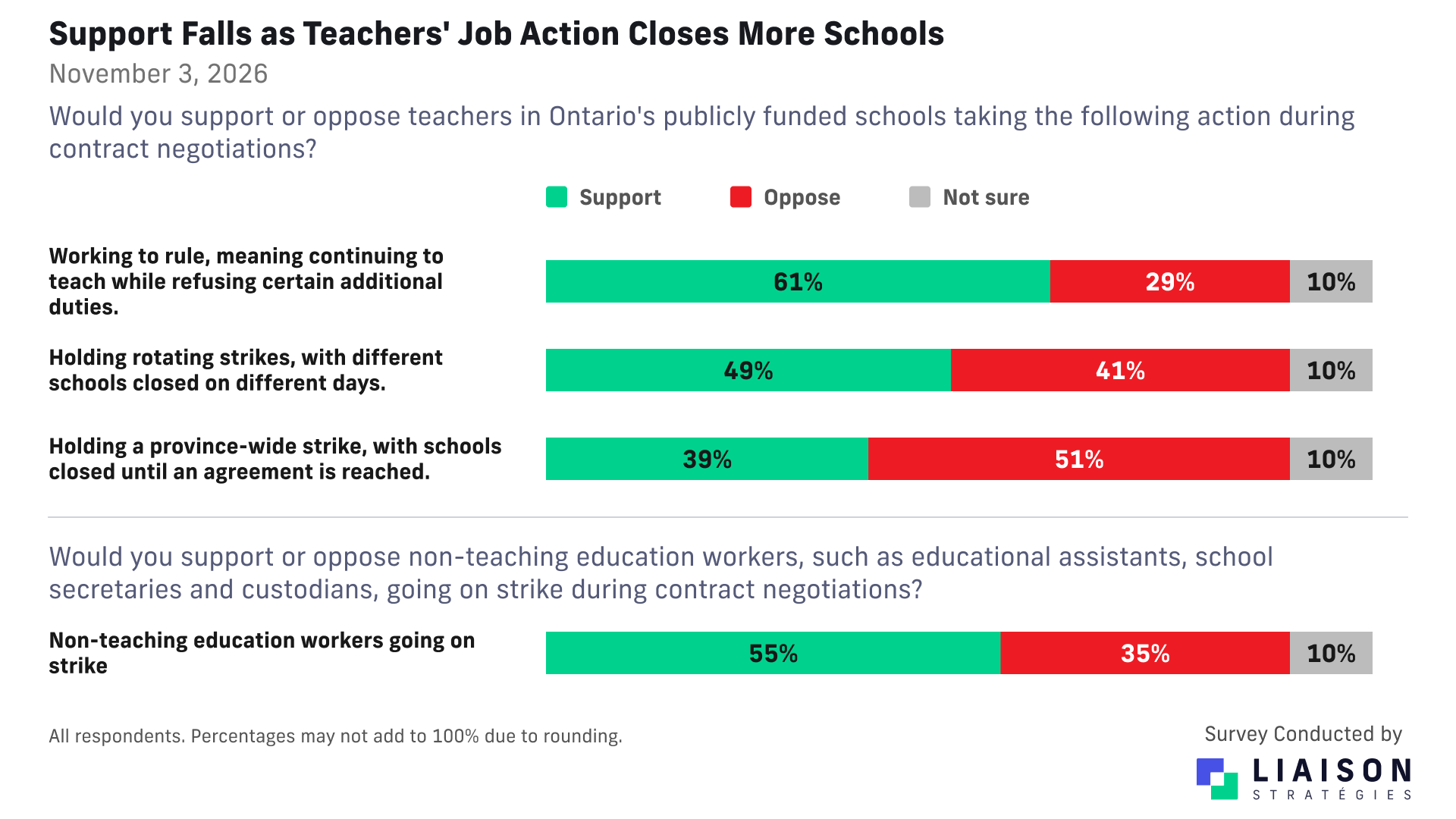
"That does not mean the public supports every form of job action. Sixty-one per cent support working to rule, where teachers continue teaching but refuse certain additional duties. Support falls to 49% for rotating strikes and 39% for a province-wide strike that closes schools until an agreement is reached. Fifty-one per cent oppose that last option."
"Households with children are following negotiations more closely: 63% are following very or somewhat closely, compared with 48% of households without children."
"Having children in the household does not translate into greater support for a province-wide teachers' strike. These respondents are more sympathetic to the unions, by 46% to 23% for the government. But 54% oppose a province-wide teachers' strike and 38% support it. A majority still oppose that shutdown."
"Non-teaching education workers receive a different response. Fifty-five per cent support them going on strike during negotiations, while 35% oppose it. Forty-nine per cent think these workers are paid too little, compared with 22% who say that about teachers. The public does not see teachers and other school employees as interchangeable."
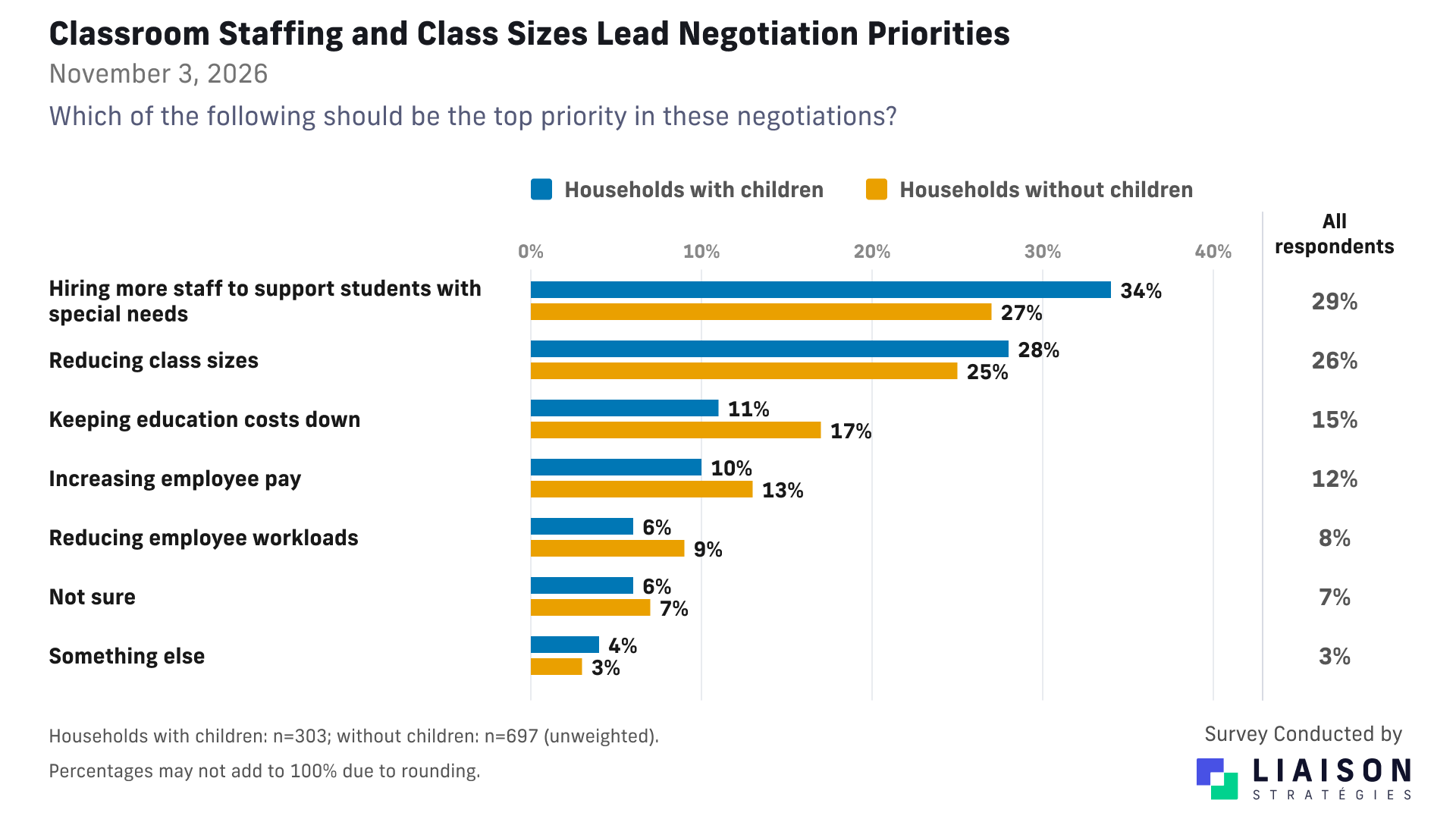
"The priorities are more about what happens in classrooms than employee pay alone. Twenty-nine per cent choose hiring more staff to support students with special needs, followed by reducing class sizes at 26%. Increasing employee pay is the top priority for 12%. Among households with children, special-needs staffing and class sizes together account for 62%."
"If talks fail, 49% prefer requiring both sides to accept a settlement decided by an independent arbitrator, without a strike. Forty-one per cent would allow a strike while negotiations continue. That question tests an independent settlement, not support for the government imposing its own contract."
"PC voters largely back the government: 58% sympathize with it and 12% with the unions. But even among its own voters, one-quarter disapprove of Ford's handling of education."
"The dissatisfaction extends beyond negotiations. Fifty-nine per cent say publicly funded education has worsened over the past few years, rising to 64% among households with children."
"The PCs have a slightly larger lead without gaining votes. They are down one point from our September release, while the Liberals are down two. The NDP is up one point to 22%, with the Greens at 3% and other parties at 4%."
"The PCs' electoral strength remains concentrated outside Toronto. They lead the Liberals 44% to 33% in the 905 and 45% to 25% in Southwestern Ontario. In Toronto, the Liberals have 40%, with the PCs and NDP tied at 26%. The opposition has plenty of dissatisfaction to work with, but it remains divided on the ballot."
-30-
Detailed Poll Report:
Detailed Tables:
About Liaison Strategies
Liaison Strategies is a national public opinion research firm. With 13 years of experience in Canadian polling, David Valentin, principal, has fielded hundreds of projects at the municipal, provincial and federal levels and appeared across Canadian media to discuss insights. Liaison is a member of the Canadian Research Insights Council (CRIC), Canada's voice of the research, analytics, and insights profession both domestically and globally.