Ontario: PCs Lead, But 65% Disapprove of Ford

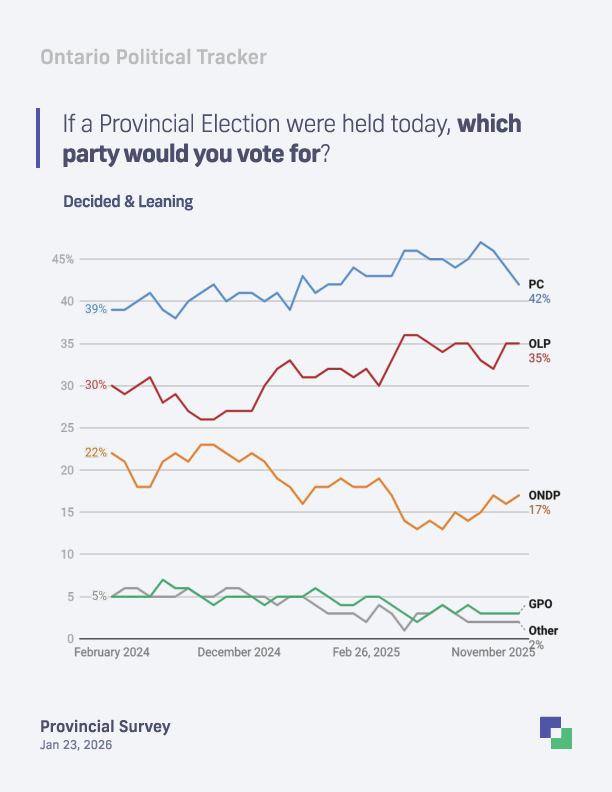
January 23, 2026 (Toronto, ON) – New Liaison Strategies tracking data shows the Progressive Conservatives continue to lead province-wide, but the political environment is increasingly defined by broad dissatisfaction: nearly two-thirds of Ontarians say the province is headed in the wrong direction and Premier Doug Ford’s job approval remains sharply negative. The PCs have lost 5 points since a high of 47% in October.
Liaison surveyed a random sample of 1,000 Ontarians from January 19-21, 2026, using Interactive Voice Recording (IVR) technology. To ensure a representative sample, participants were reached through random digit dialing (RDD) across both landline and cellular phone networks. For the total sample, the margin of error is ±3.1 percentage points, 19 times out of 20.
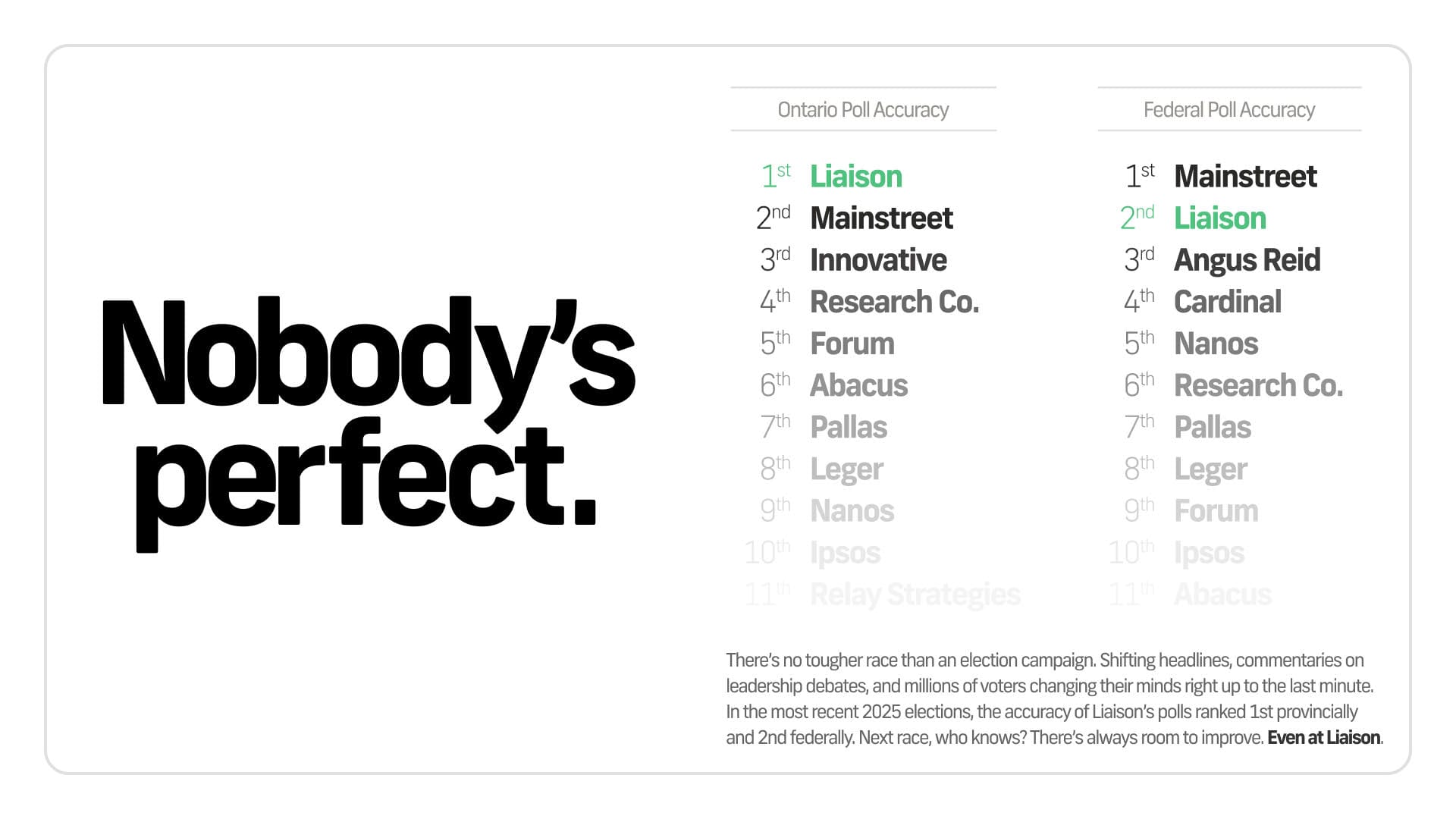
Liaison Strategies is one of the most accurate polling firms in Canada. It ranked #1 in accuracy in the 2025 Ontario election and #2 nationally in the 2025 federal election.
Vote intention (Decided & leaning):
- PC (Doug Ford): 42%
- Ontario Liberal (John Fraser): 35%
- Ontario NDP (Marit Stiles): 17%
- Green (Mike Schreiner): 3%
- Other: 2%
David Valentin, Principal at Liaison Strategies, said the following:
"Ontario’s party numbers tell one story, the PCs are still in first, but the broader mood tells another."
"Last month we remarked that the regional numbers for the 905 were surprising - but once again the Liberals are leading there, albeit narrowly and within the margin of error, for a second straight month. So unless this is regional noise, we have the beginning of a trend."
"The PC Party is leading but 65% of Ontario voters disapprove of the Premier and 62% think the province is moving in the wrong direction. Given that the PCs are still in the lead, some voters disapprove of the Premier but are voting PC anyway (29% of PC voters say they disapprove, 57% of undecided voters disapprove too)."
"All of this comes as the Ontario Liberals register 35% support, enough for second place, but still seven points back of the PCs. It’s also worth noting the Liberals are putting up these numbers without a permanent leader, which may be inflating their standing: in the absence of a defined alternative, many Ontarians are free to project their own preferred candidate onto the party."
"One thing I’m confident we’ll see is this: whoever the Liberals choose as leader, the PCs will move immediately to define them before they have a chance to introduce themselves on their own terms. Once that happens, once voters are given a clearer, and likely more polarized, picture of the Liberal leader, it wouldn’t be surprising to see the Liberal numbers soften and begin to slide again."
Key findings from the survey include:
- Gender split: Men are substantially more likely to back the PCs, while women are more likely to support the Liberals.
- Regional split: The PCs post their strongest numbers in Eastern Ontario, while Liberal support is strongest in Toronto (416) and competitive in the 905.
- Age: The NDP’s strongest cohort is 18–34, while PCs and Liberals are more competitive across older age groups.
"The PCs’ regional map is narrowing, their only truly dominant advantage is in Eastern Ontario, where they hold a large lead. The Liberals are out front in Northern Ontario and Toronto, and the critical 905 is essentially a dead heat between the two parties. In Southwestern Ontario (Windsor, Kitchener-Waterloo, London), the PCs still maintain an 11-point edge over the Liberals. And in South Central Ontario (Hamilton, Niagara), the PCs are ahead by six points, with the NDP in second. Depending on how these regional splits are concentrated they could have unexpected results," concluded Valentin.
-30-
Detailed Poll Report:
About Liaison Strategies
Liaison Strategies is a national public opinion research firm. With 12 years of experience in Canadian polling, David Valentin, principal, has fielded hundreds of projects at the municipal, provincial and federal levels and appeared across Canadian media to discuss insights. Liaison is a member of the Canadian Research Insights Council (CRIC), Canada’s voice of the research, analytics, and insights profession both domestically and globally.