Ontario: Liberals Lead PCs by 5 as Ford Approval Falls to 24% Amid Expense Scandal
The Ontario Liberals lead the PCs 38% to 33%, Ford approval falls to 24%, and the numbers land amid a hotel expense scandal at Queen’s Park.

July 24, 2026 (Toronto, ON) - The latest Ontario Political Tracker from Liaison Strategies shows the Ontario Liberals holding a 5-point lead over the Progressive Conservatives, while Premier Doug Ford's approval has fallen to 24% amid a hotel expense scandal at Queen's Park.
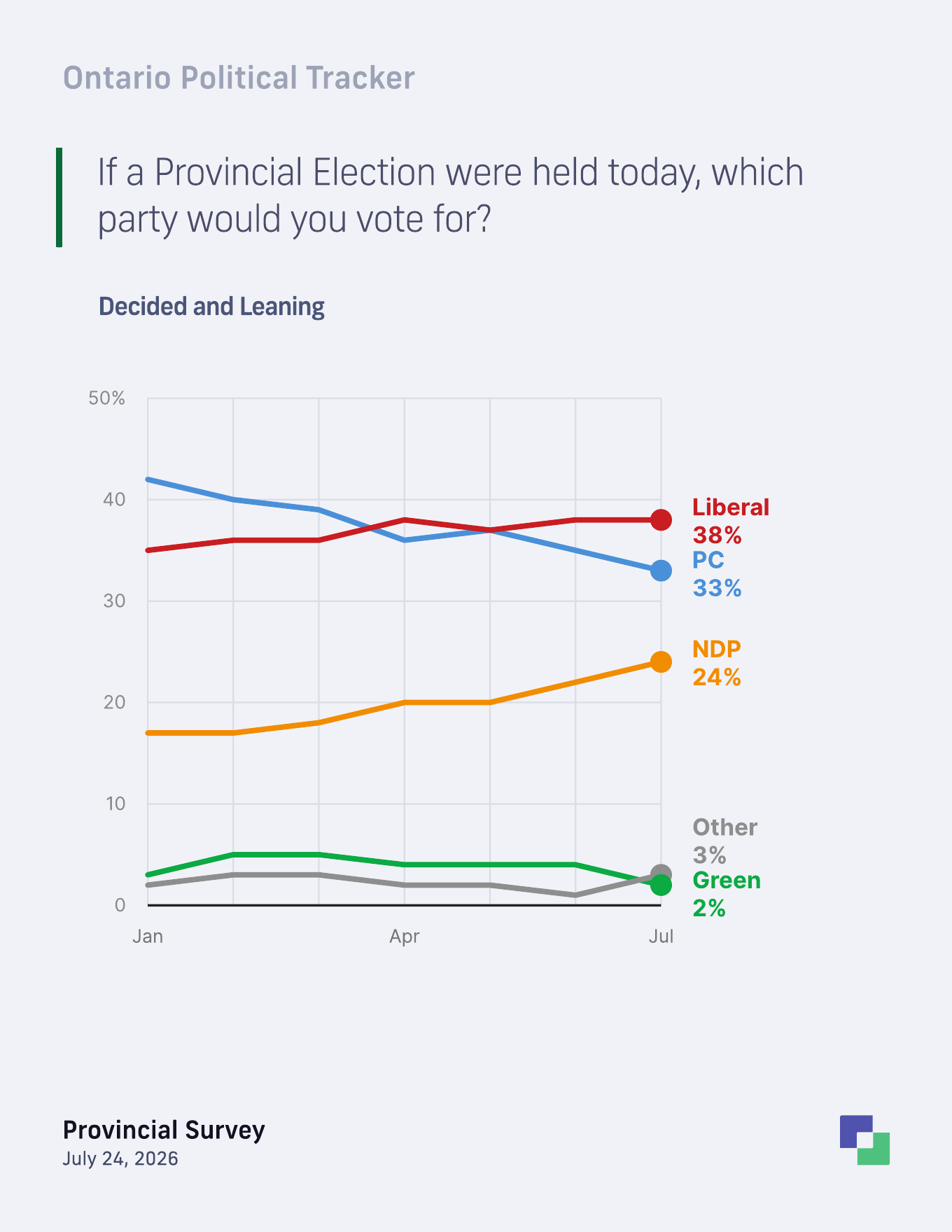
Among decided and leaning voters, the Ontario Liberal Party stands at 38%, followed by the Progressive Conservatives at 33%, the Ontario NDP at 24%, other parties at 3%, and the Green Party at 2%.
Among all voters, the Liberals are at 33%, the PCs are at 29%, the NDP is at 21%, other parties are at 3%, the Greens are at 2%, and 13% are undecided.
The poll lands as the Ford government faces scrutiny over hotel expenses claimed by Progressive Conservative MPPs. Published reports have detailed thousands of dollars in downtown Toronto hotel claims by government members and Ford has apologized while saying members will repay the legislature.
Liaison surveyed a random sample of 1,000 Ontarians from July 20 to July 21, 2026, using Interactive Voice Recording (IVR) technology. To ensure a representative sample, participants were reached through random digit dialling (RDD) across both landline and cellular phone networks. The resulting data was weighted to match targets based on the 2021 Census. For the total sample, the margin of error is ±3.1 percentage points, 19 times out of 20.
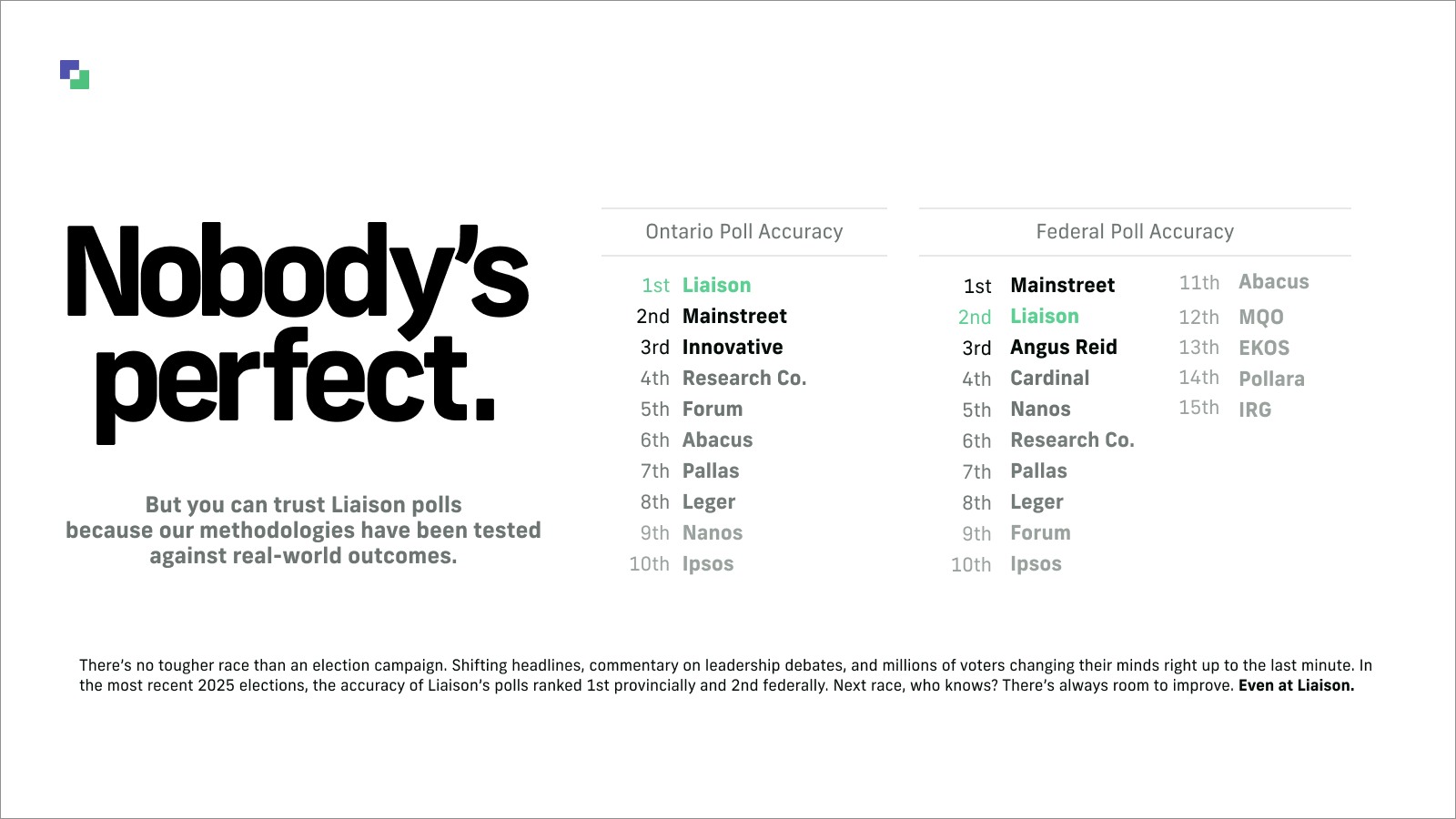
Liaison was ranked #1 for accuracy in Ontario in 2025, and #2 nationally in the 2025 federal election.
David Valentin, Principal at Liaison Strategies, said the following:
"The Liberals continue to lead in Ontario, but this is not a runaway race. The Liberals are unchanged from our June tracker at 38% among decided and leaning voters, while the PCs are down 2 points to 33% and the NDP is up 2 points to 24%. The movement is small, but it is still movement away from Ford and toward the opposition parties."
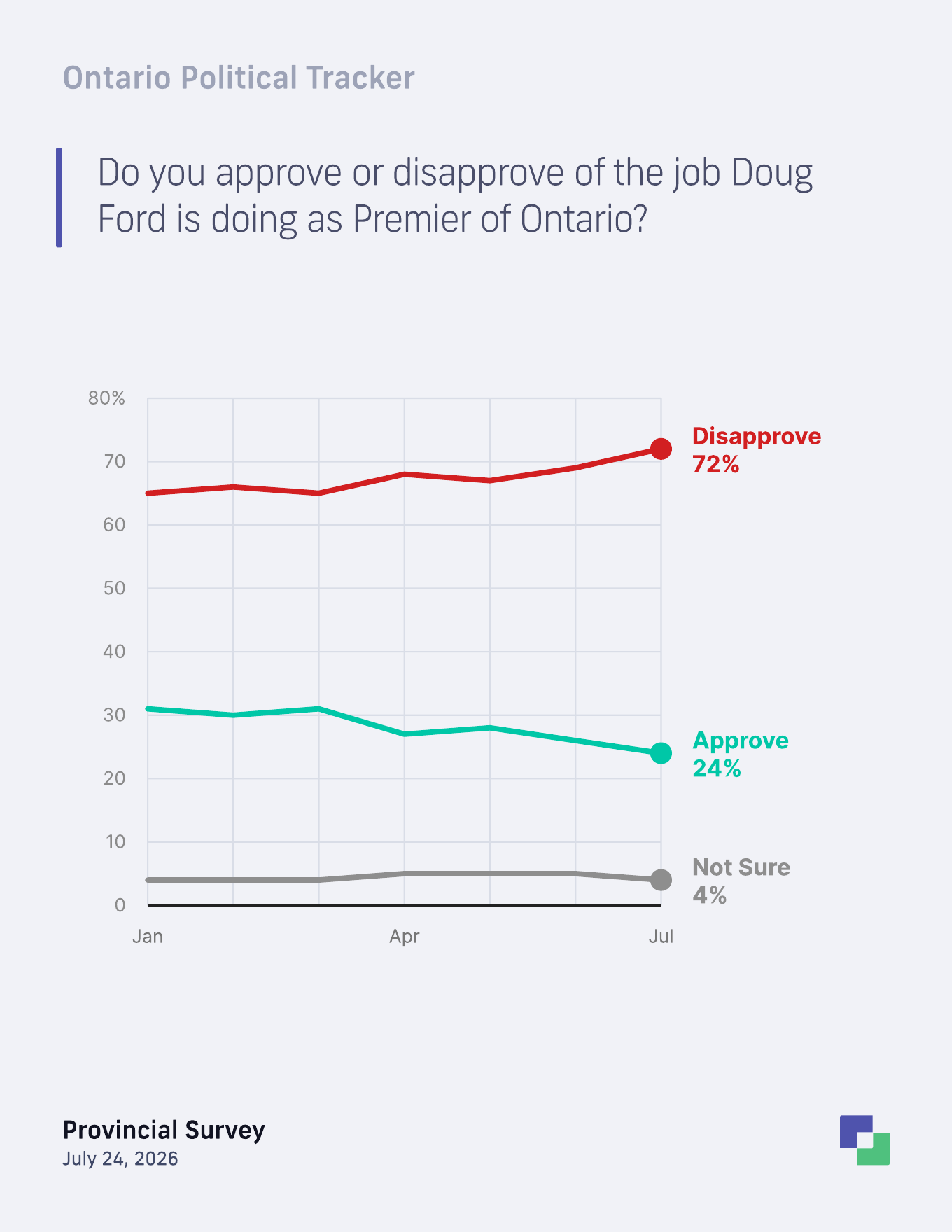
"Ford's personal numbers are the bigger problem. Just 24% approve of the job he is doing as Premier, while 72% disapprove. That is the lowest approval and highest disapproval we have measured for Ford in this Ontario tracker."
"Those numbers are landing in the middle of an expense scandal, and that matters politically. The poll did not ask voters directly about hotel expenses, so I would not say the scandal caused the movement. But when an incumbent premier is already at 24% approval, stories about MPPs billing taxpayers for Toronto hotel rooms are exactly the kind of thing that reinforces a bad frame."
"The damaging part is not just the dollar amount, it is the contrast. Ontarians are being squeezed by household costs, and now they are seeing a government explain why members who live near Queen's Park were billing hotel stays. That is a rough fairness test for any government, but especially one with Ford's approval numbers."
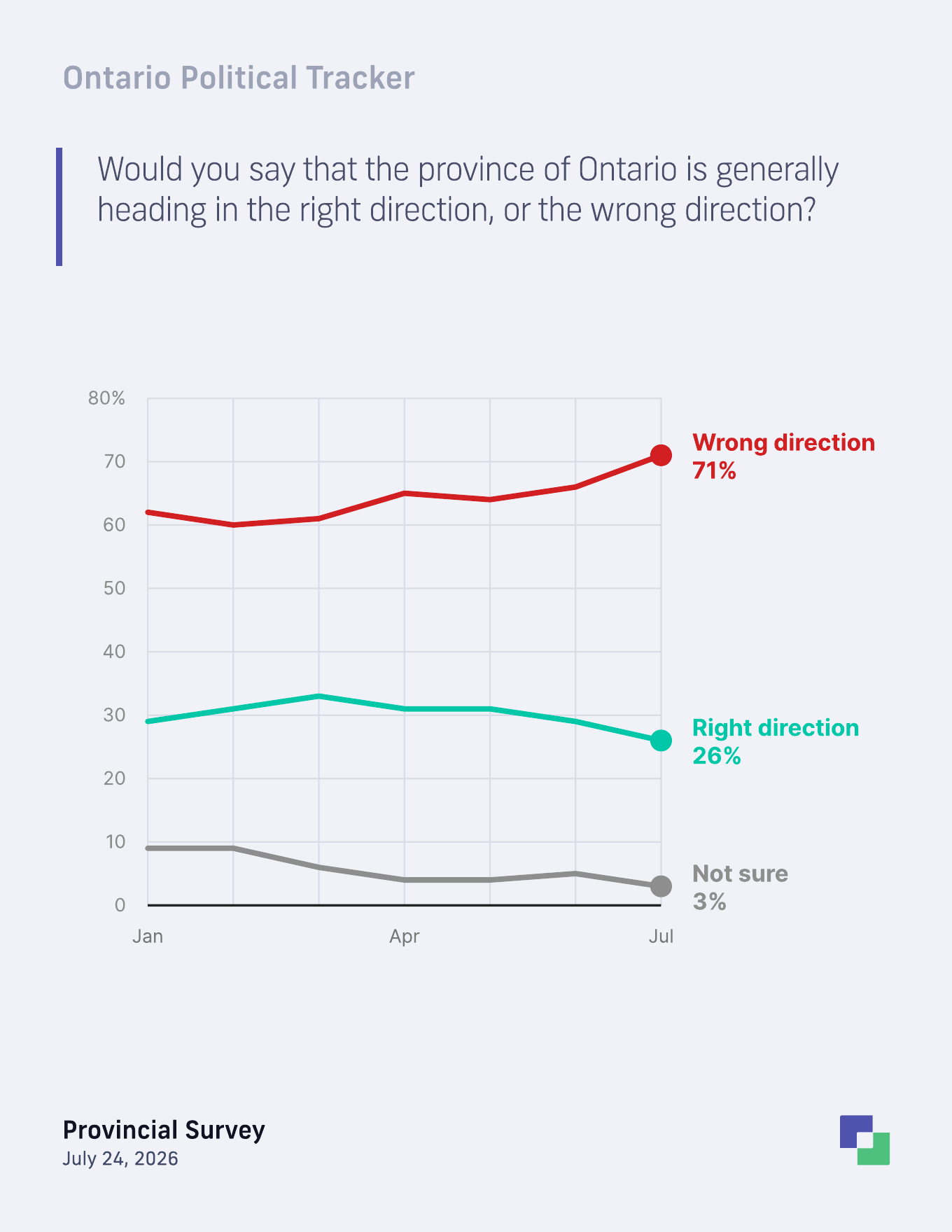
"The province's direction numbers are also grim for the government. Twenty-six percent say Ontario is headed in the right direction, while 71% say it is headed in the wrong direction."
"Regionally, the race is fractured. The Liberals lead in Toronto at 46% and are tied with the PCs in the 905 at 40%. The PCs lead in Eastern Ontario at 42%, while the NDP is strongest in Northern Ontario and South Central Ontario. That means the Liberal lead is real, but the map is not uniform."
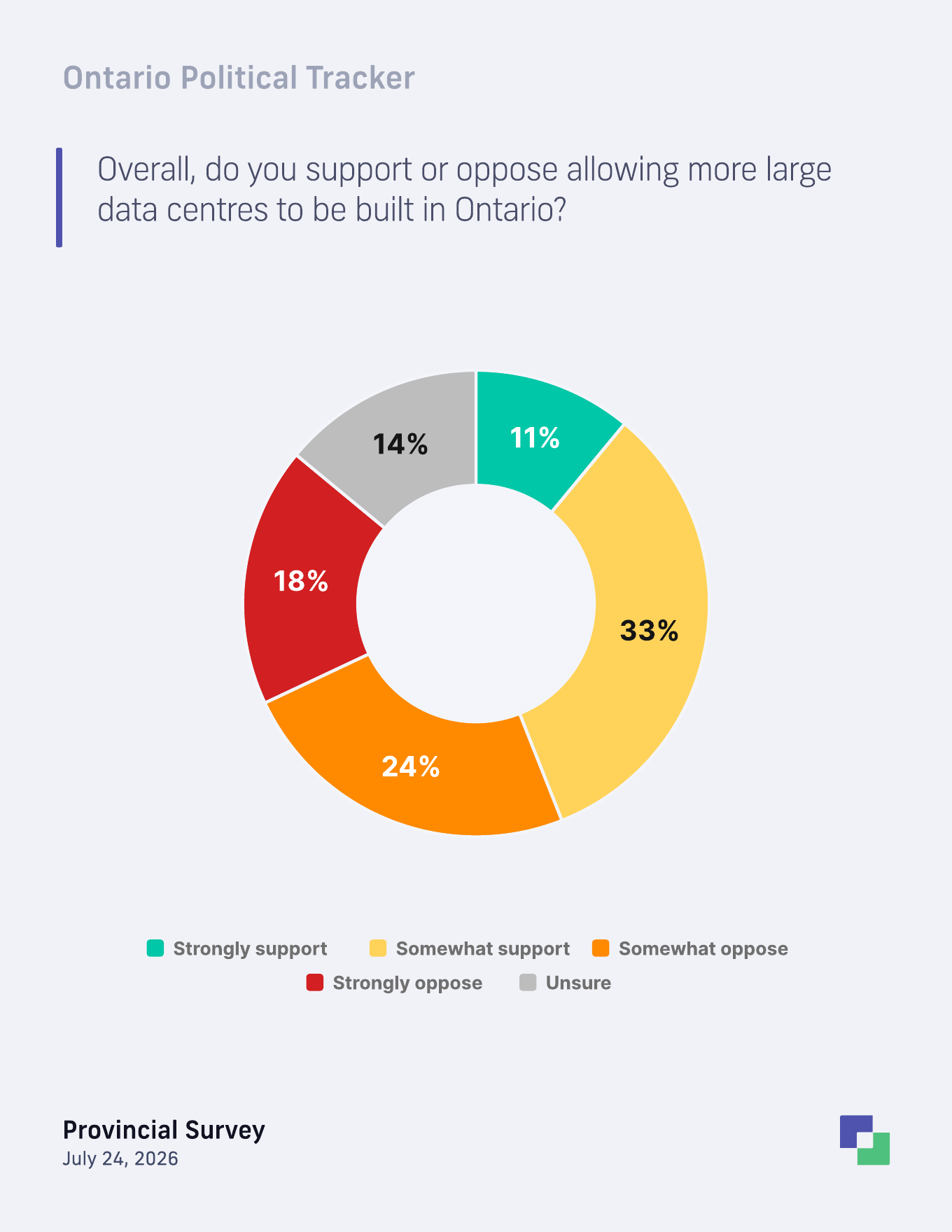
"On data centres, Ontarians are split at the topline: 44% support allowing more large data centres to be built in Ontario, while 42% oppose it and 14% are unsure. That is a very narrow opening for supporters of these projects."
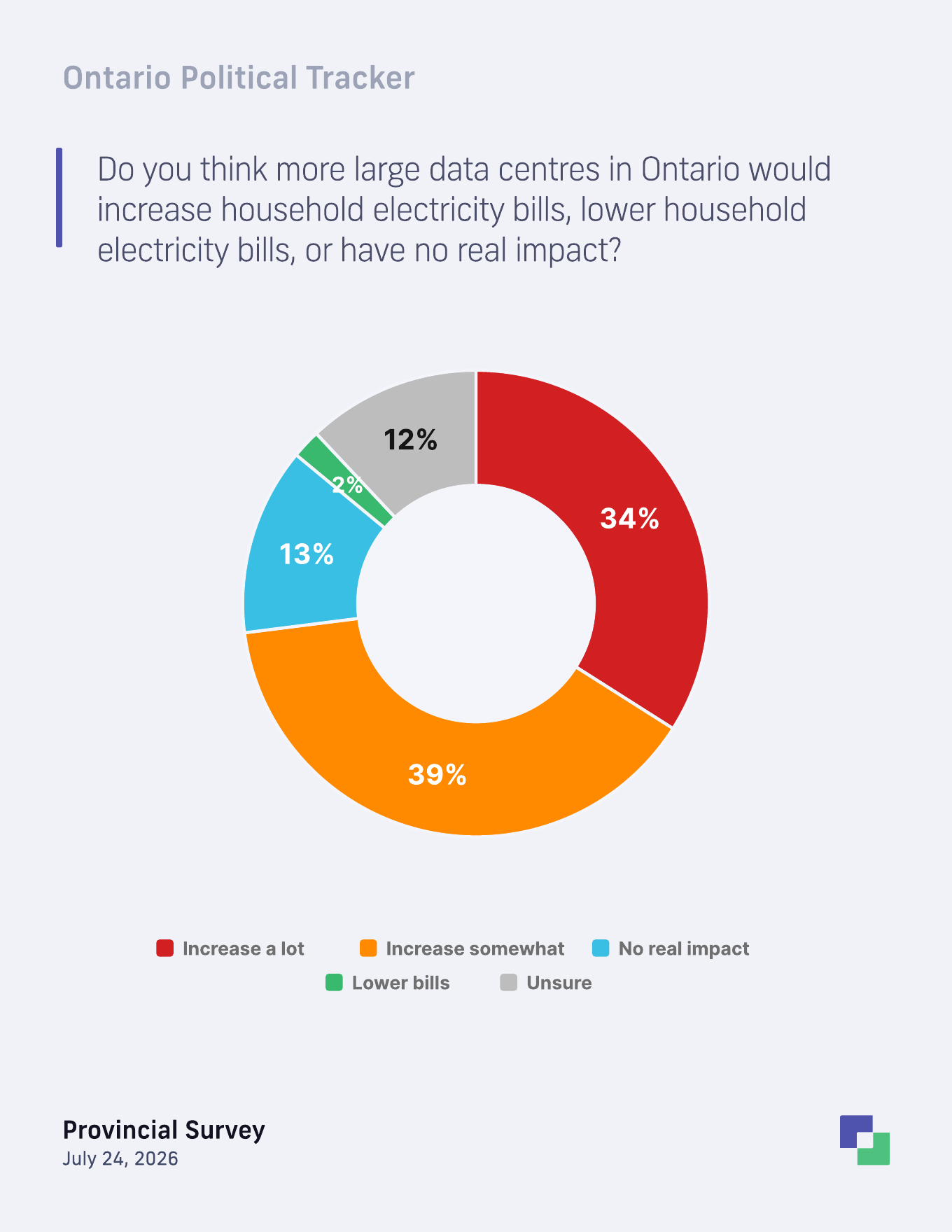
"The problem is electricity. Seventy-three percent of Ontarians think more large data centres would increase household electricity bills, including 34% who say bills would increase a lot. Only 2% think they would lower bills."
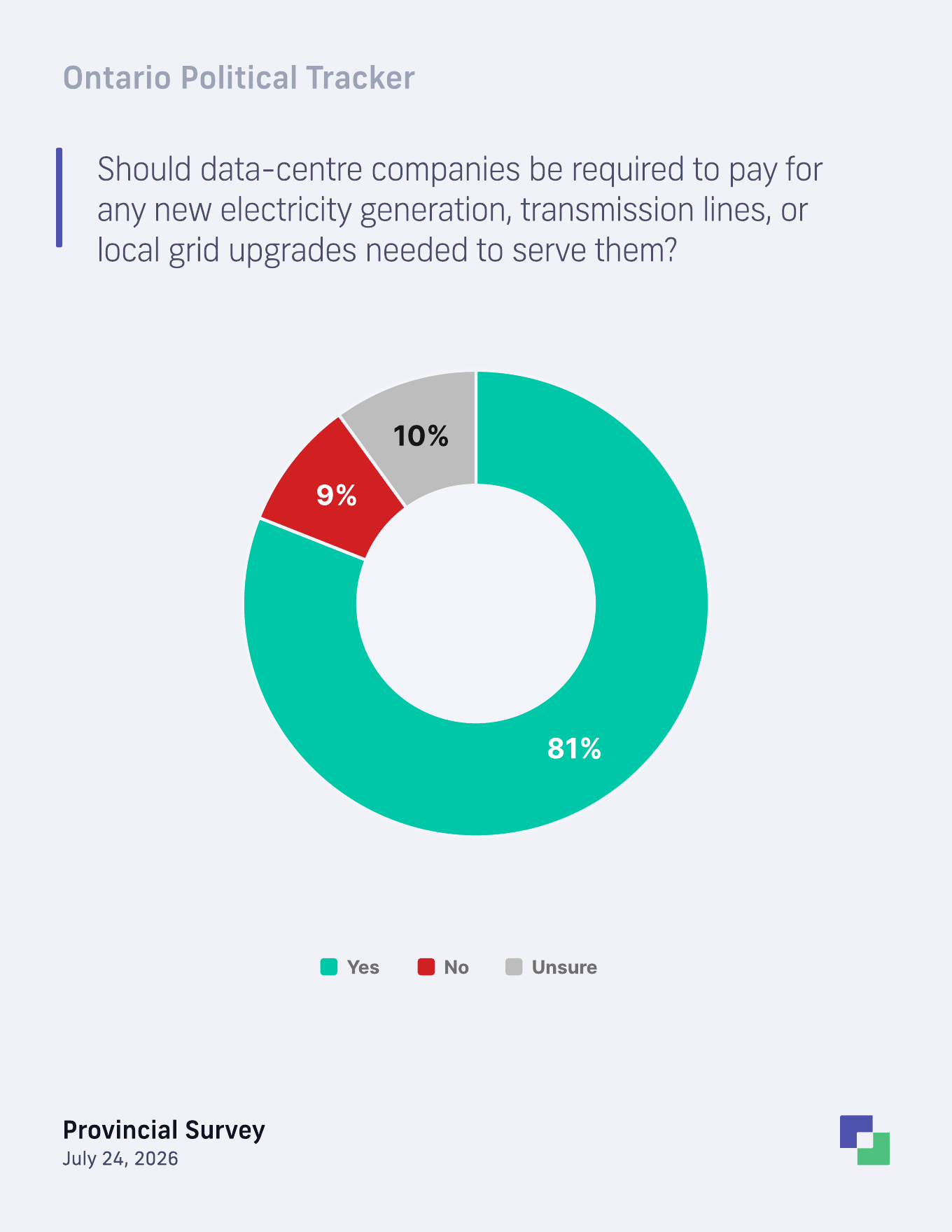
"There is also a clear consensus that data-centre companies should pay for any new electricity generation, transmission lines, or local grid upgrades needed to serve them. Eighty-one percent say yes, while just 9% say no."
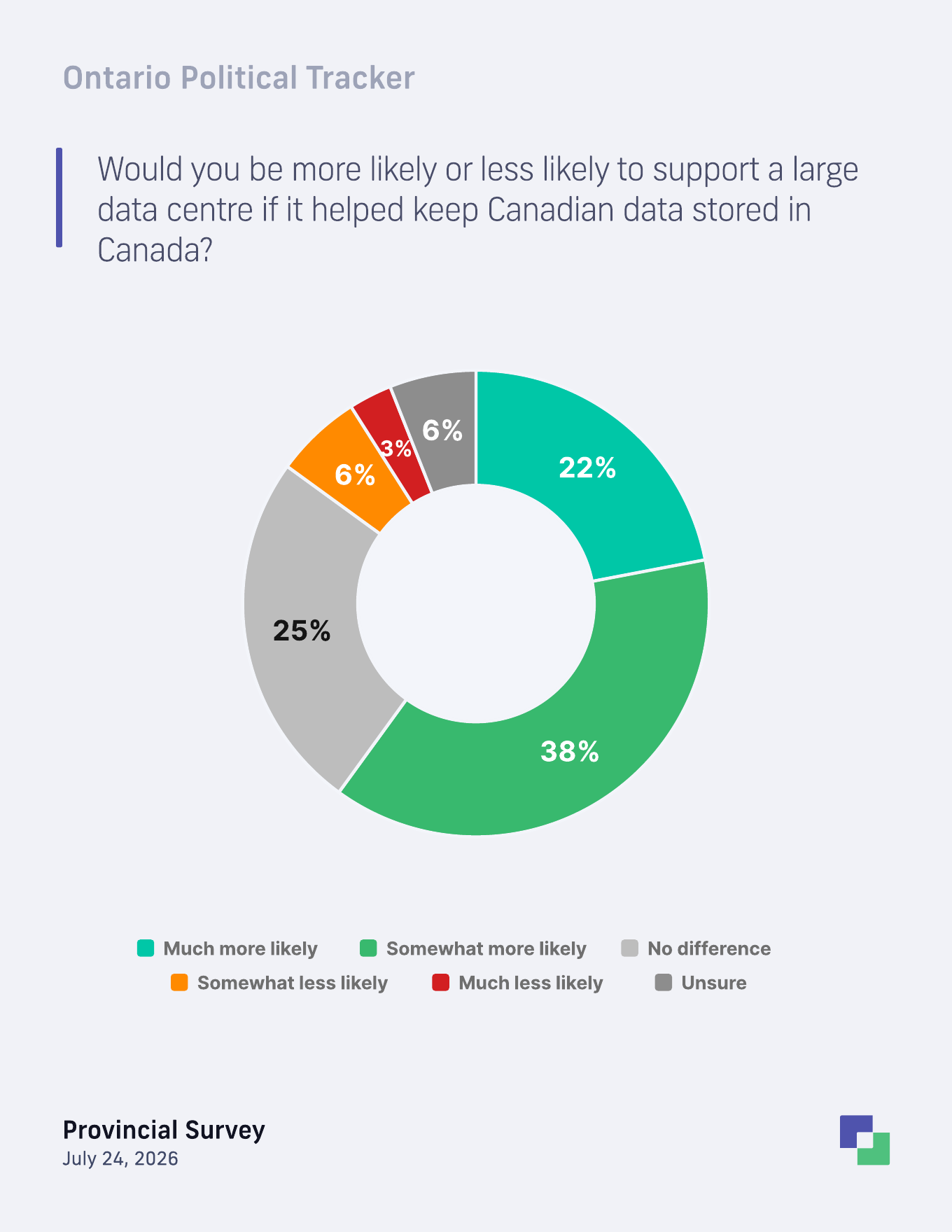
"The strongest argument for data centres is sovereignty. Sixty percent say they would be more likely to support a large data centre if it helped keep Canadian data stored in Canada, while 9% say that would make them less likely to support it."
"The condition that matters most is household bills. Thirty-three percent say no increase to household electricity bills would make them most likely to support a large data centre, followed by using low-emission power at 21% and funding energy upgrades for local homes at 20%."
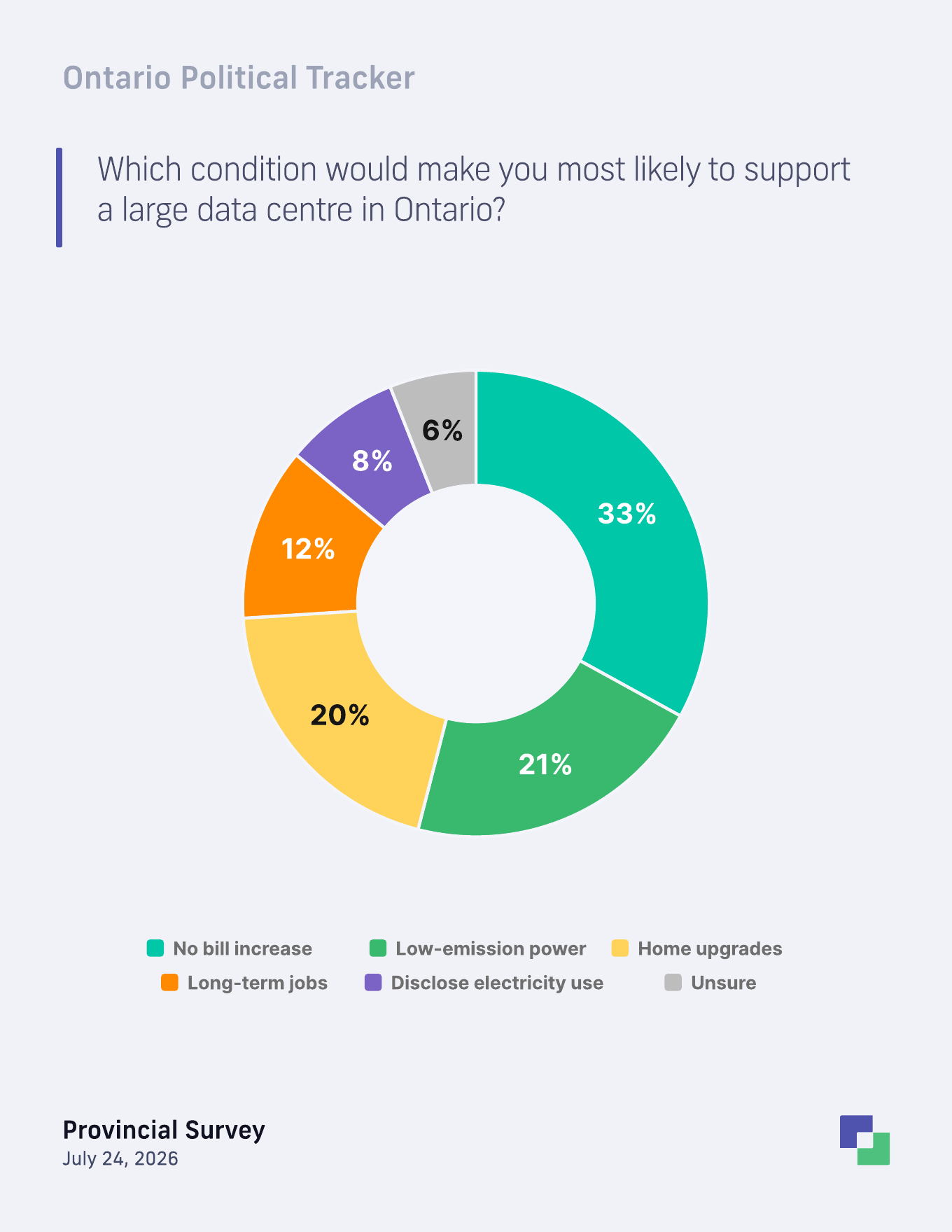
"The political story is that Ford is weaker than his party, the Liberals have a lead but not a lock, and data centres are a live issue because they collide with household affordability. If voters think a project will raise their hydro bill, they are going to want the company, not the household, to pay for the infrastructure."
"That same affordability and fairness instinct applies to the expense scandal. If voters believe public money is being used for political convenience while they are worried about bills, it becomes harder for the government to argue it is on their side."
-30-
Detailed Poll Report:
Detailed Tables:
About Liaison Strategies
Liaison Strategies is a national public opinion research firm. With 13 years of experience in Canadian polling, David Valentin, principal, has fielded hundreds of projects at the municipal, provincial and federal levels and appeared across Canadian media to discuss insights. Liaison is a member of the Canadian Research Insights Council (CRIC), Canada's voice of the research, analytics, and insights profession both domestically and globally.