Ontario Liberals: Five Votes from a Fairclough Win
Five strategically placed vote switches could have elected Lee Fairclough. A riding-by-riding look at Bains's narrow win, the regional divides and the student clubs that made the difference.

By David Valentin | November 21, 2026
Five people voting differently could have made Lee Fairclough the leader of the Ontario Liberal Party.
Had Three Navdeep Bains voters at the University of Windsor student club and two at Brock voted for Fairclough first, she would have won. Dylan Marando and Stephanie Bowman would still have been eliminated in the same order.
Bains won with 50.29 per cent of the leadership points to Fairclough's 49.71 per cent. He also won the popular vote, finishing ahead 9,961 to 9,669 on the final count. But look through the riding and club results and you'll see Fairclough won the most points from riding associations.
She finished ahead in 66 ridings to Bains's 55, with three tied. She picked up far more support as the other candidates were eliminated. Bains's lead in the student clubs was enough to keep her from winning.
Why Windsor and Brock Mattered
Every riding association gets 100 points in the Liberal leadership contest. Each recognized student club gets 50, and each recognized women's club gets five. The points are divided among the candidates according to their share of the vote in each association.
That makes a small club with a handful of voters a very worthwhile place to campaign.
At Windsor, Bains finished with three votes to Fairclough's two. Those five votes divided 50 points, so each was worth 10. Moving one from Bains to Fairclough would take 10 points off his total and add 10 to hers, changing the margin by 20 points.
At Brock, they finished tied at three votes each. A switch there would change the margin by about 16.67 points.
Three switches at Windsor and two at Brock would therefore change the overall margin by about 93.33 points. Bains won by 77.64. Fairclough would have finished ahead by about 15.7 points.
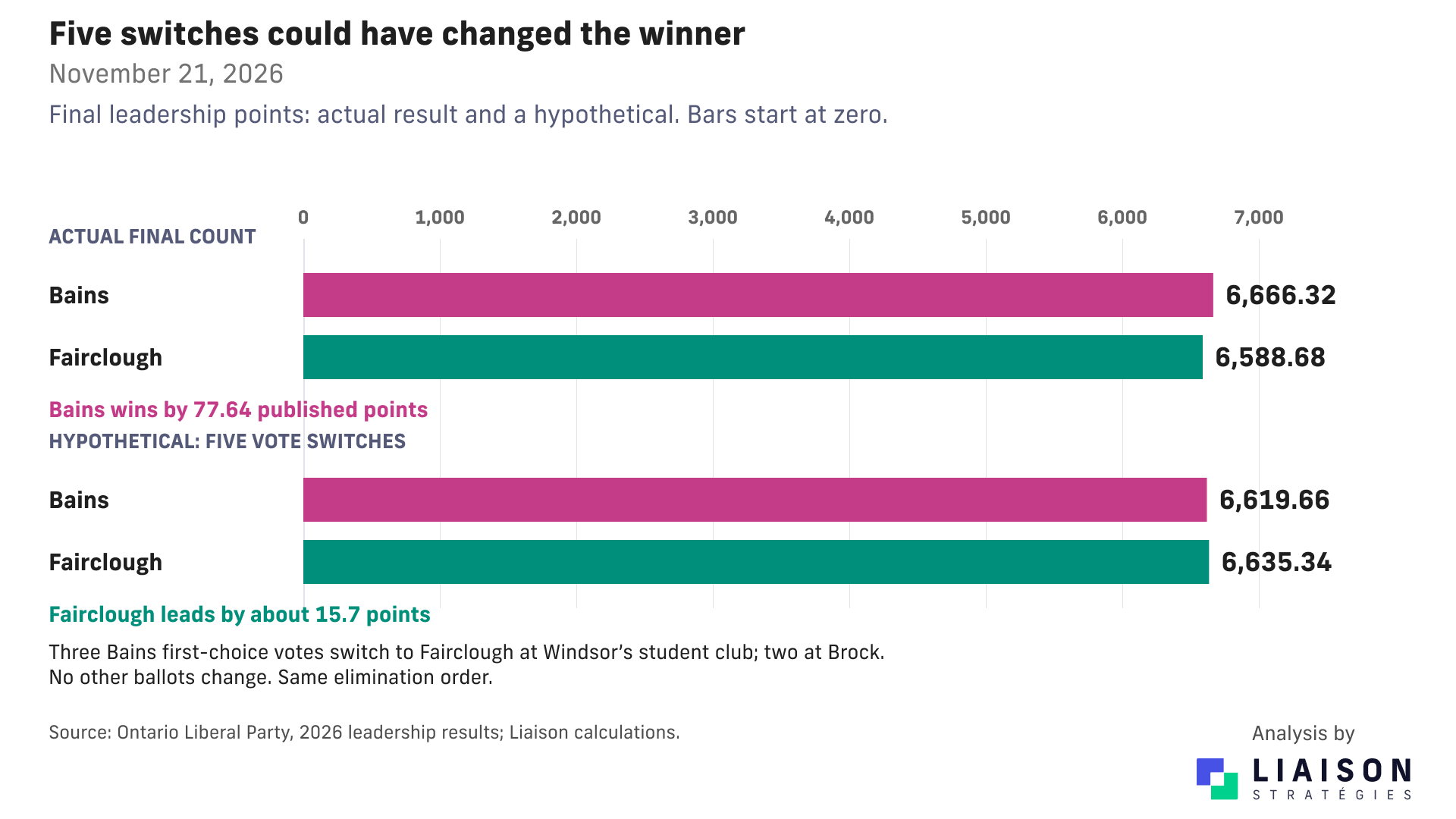
Compare that with Brampton East, where 556 valid ballots remained on the final count. Five switches there would have moved the province-wide margin by fewer than two points. The same number of people changing their minds could have elected a different leader at Windsor and Brock, or barely moved the result in Brampton East.
The Campus Clubs Made the Difference
Fairclough won 6,263.62 points across the 124 riding associations, compared with 6,136.38 for Bains. She was ahead by roughly 127 points before counting the clubs.
The student clubs gave Bains 508.24 points to Fairclough's 291.76, a lead of approximately 216. Fairclough's roughly 12-point advantage in the women's clubs brought her closer, but Bains still finished ahead.
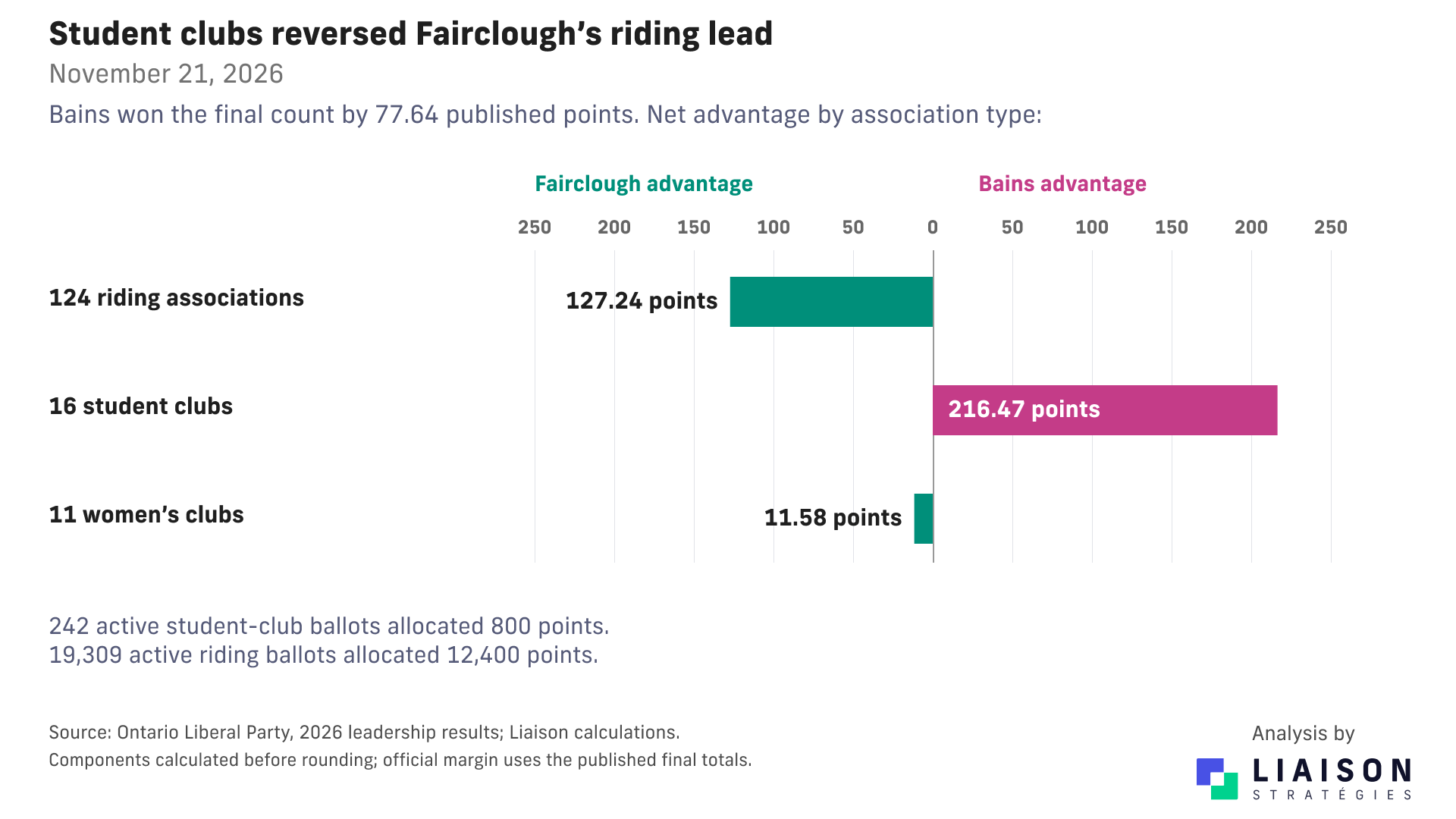
Just 242 student-club ballots remained active on the final count. Together, those clubs allocated 800 points, as many as eight ridings. The riding associations had 19,309 active ballots dividing their 12,400 points.
Bains led in 12 of the 16 student clubs. Fairclough led in two, and two were tied. He won all 18 final-count votes at Wilfrid Laurier and 14 of 17 at the University of Waterloo. Her two wins were at the University of Toronto's St. George and Mississauga campuses.
Under the Ontario Liberal leadership rules a campaign can persuade hundreds of people in a large riding and still find itself overtaken by a much smaller number elsewhere.
Bains's Brampton Results Were Enormous
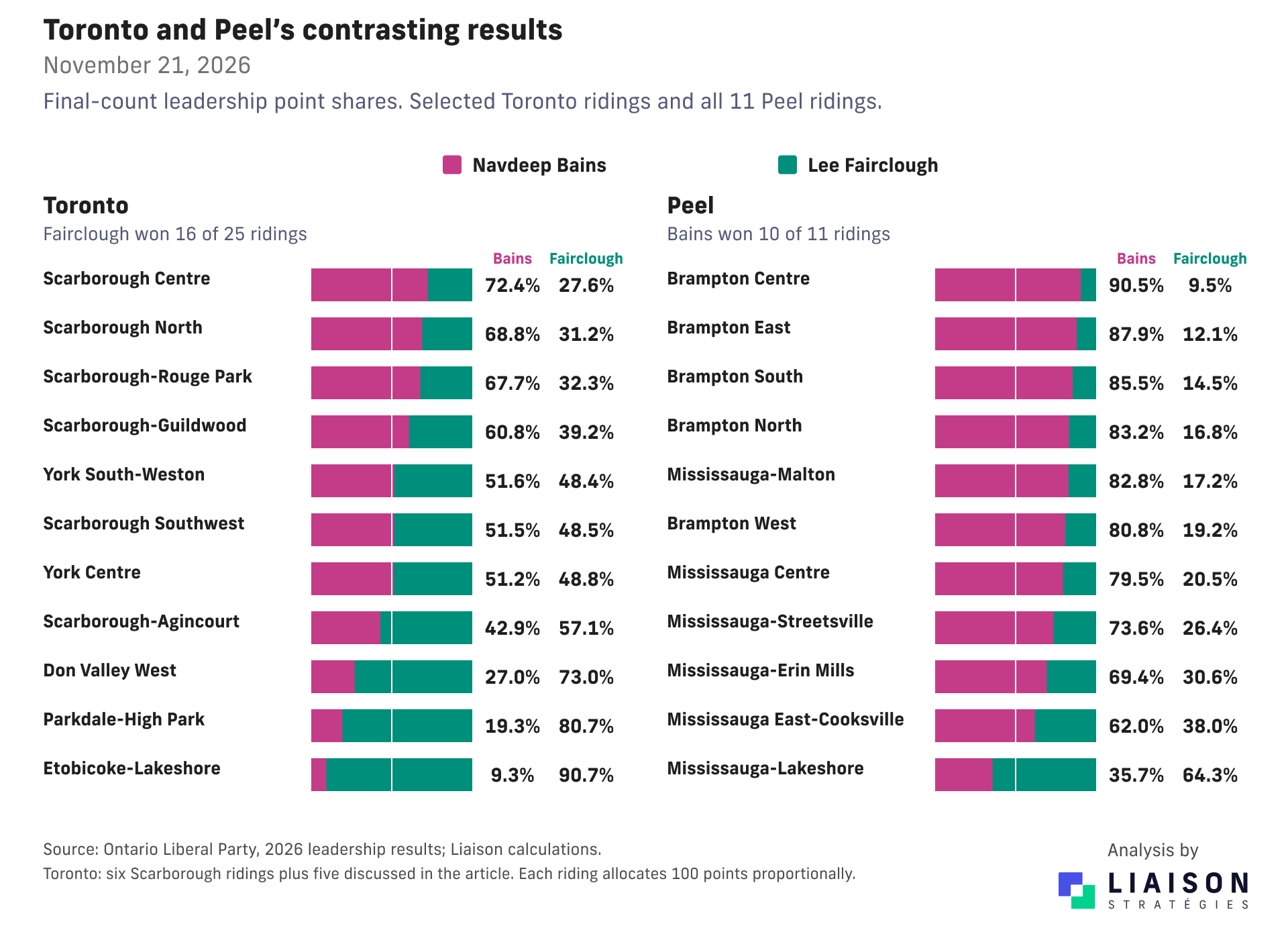
Bains won more than 80 per cent of the points in every Brampton riding. His lowest result was 80.8 per cent in Brampton West; his highest was 90.5 per cent in Brampton Centre.
He also won five of Mississauga's six ridings, including 82.8 per cent in Mississauga-Malton. Fairclough's exception was Mississauga-Lakeshore, where she finished at 64.3 per cent.
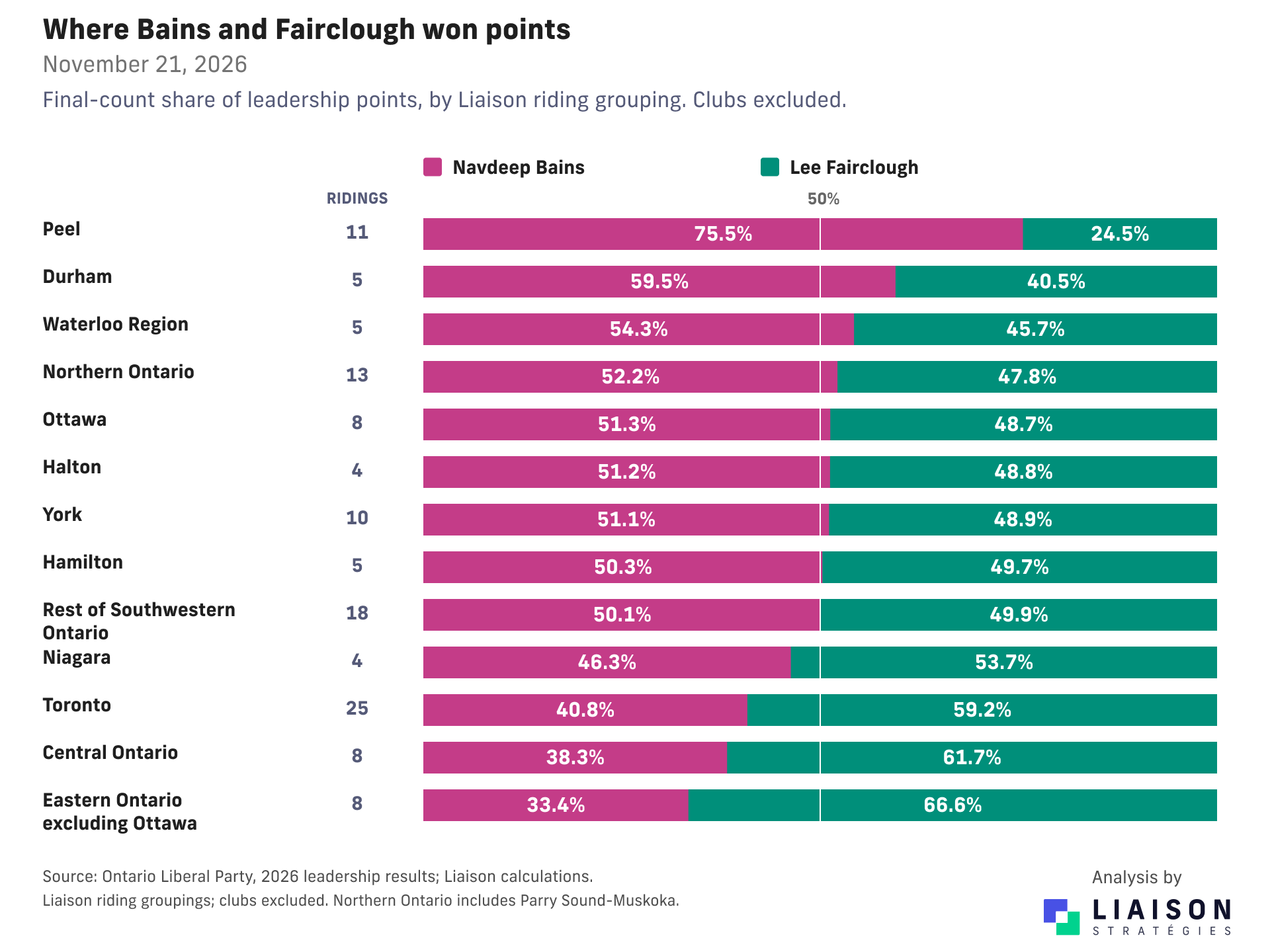
Across Peel, Bains won 10 of 11 ridings and 75.5 per cent of the points. That gave him an advantage of about 562 points in a contest he won by fewer than 78.
Fairclough took about 459 more points than Bains in Toronto and about 266 more in eastern Ontario outside Ottawa. Bains needed those big Peel margins to withstand losses of that size. Winning Brampton's ridings narrowly would have left him well short.
There is also a limit to what signing up more members in an already strong riding can accomplish. The riding still has 100 points. Getting from 80 to 90 per cent adds 10 points; getting from 20 to 40 per cent somewhere else adds 20. The campaign has to win support beyond the places where its candidate is already popular.
Fairclough's Toronto Lead Had Limits
Fairclough won 16 of Toronto's 25 ridings and 59.2 per cent of the city's riding points. She did considerably better in actual votes, taking 66.1 per cent of those remaining in the final count.
Her home riding of Etobicoke-Lakeshore gave her 90.7 per cent. Parkdale-High Park gave her 80.7 per cent, Eglinton-Lawrence 77.2 per cent, and Beaches-East York and Toronto-Danforth roughly three-quarters each.
Bowman's Don Valley West also finished strongly for Fairclough. Bowman had won 63.6 per cent there on the first count; Fairclough finished with 73.0 per cent on the last.
But Bains won five of Scarborough's six ridings. Scarborough-Agincourt was the only one Fairclough carried. He also won Etobicoke North, Humber River-Black Creek, York Centre and York South-Weston.
Some of those wins were very close. York Centre finished 44 votes to 42, York South-Weston 33 to 31, and Scarborough Southwest 124 to 117. Fairclough had comfortable wins elsewhere in the city, but Bains kept collecting points in ridings where he had just enough support to finish ahead.
That is why her two-thirds share of Toronto's votes produced less than 60 per cent of its points. Large participating memberships in several of her strongest ridings could only deliver so much. She needed more support in the Toronto ridings Bains was winning as well.
Ottawa Divided Four Ridings Apiece
Fairclough won Ottawa Centre, Ottawa South, Ottawa-Vanier and Ottawa West-Nepean. Bains won Carleton, Kanata-Carleton, Nepean and Orléans, finishing with 51.3 per cent of Ottawa's riding points.
Nepean gave Bains his largest Ottawa result, at 66.5 per cent. Fairclough's strongest was Ottawa-Vanier, at 63.5 per cent.
Outside Ottawa, Fairclough did much better. She won 88.1 per cent in Kingston and the Islands, 85.2 per cent in Lanark-Frontenac-Kingston and 71.5 per cent in Leeds-Grenville-Thousand Islands and Rideau Lakes. Across the eight eastern Ontario ridings outside Ottawa, she took 66.6 per cent of the points.
So even within eastern Ontario, there were quite different results. Fairclough's big Kingston-area wins did not extend into Bains's strongest Ottawa ridings.
More Riding Wins Didn't Always Mean More Points
Fairclough won eight of the 13 ridings in our northern Ontario grouping and received 447 votes to Bains's 431. Bains still took 52.2 per cent of the region's points.
He won 85.7 per cent in Kiiwetinoong, 83.3 per cent in Timmins and 72.5 per cent in Sault Ste. Marie. Kiiwetinoong had 14 active ballots on the final count and the same 100 points as Sudbury, where 199 remained. Bains's large margins in smaller associations outweighed Fairclough's greater number of riding wins.
York had a similar result. Fairclough won six ridings to Bains's four, but his margins in places such as Markham-Thornhill and King-Vaughan left him ahead on points across the region.
Halton split between Fairclough's wins in Burlington and Oakville and Bains's wins in Milton and Oakville North-Burlington. Durham was better for Bains, who took 59.5 per cent of the points and won Ajax with 70.1 per cent. Oshawa and Whitby both finished tied.
Hamilton was almost evenly divided on points. Fairclough won Hamilton Centre and Hamilton West-Ancaster-Dundas; Bains won the other three Hamilton ridings. In Waterloo Region, his large Cambridge and Kitchener South-Hespeler wins helped offset her victories in Kitchener Centre and Waterloo. Kitchener-Conestoga went to Bains by one vote, 60 to 59.
Fairclough also won comfortably in Huron-Bruce and Bruce-Grey-Owen Sound, while Bains did well in both Windsor ridings. Calling this an urban-rural split would miss a lot of what happened. Fairclough won rural ridings by large margins. Bains won city ridings by large margins. Both had places where they needed only a little more support.
Fairclough Got Much Closer as the Field Narrowed
Bains started with 44.12 per cent of the points to Fairclough's 33.72 per cent. Bowman had 12.85 per cent and Marando 9.30 per cent.
Marando's elimination added 727 votes to Fairclough, 438 to Bowman and 198 to Bains. Another 311 ballots had no continuing preference.
When Bowman was eliminated, Fairclough picked up 1,947 of the 3,018 ballots then sitting with her, compared with 615 for Bains. The remaining 456 exhausted. That pool included ballots transferred from Marando, but Fairclough received 64.5 per cent of it to Bains's 20.4 per cent.
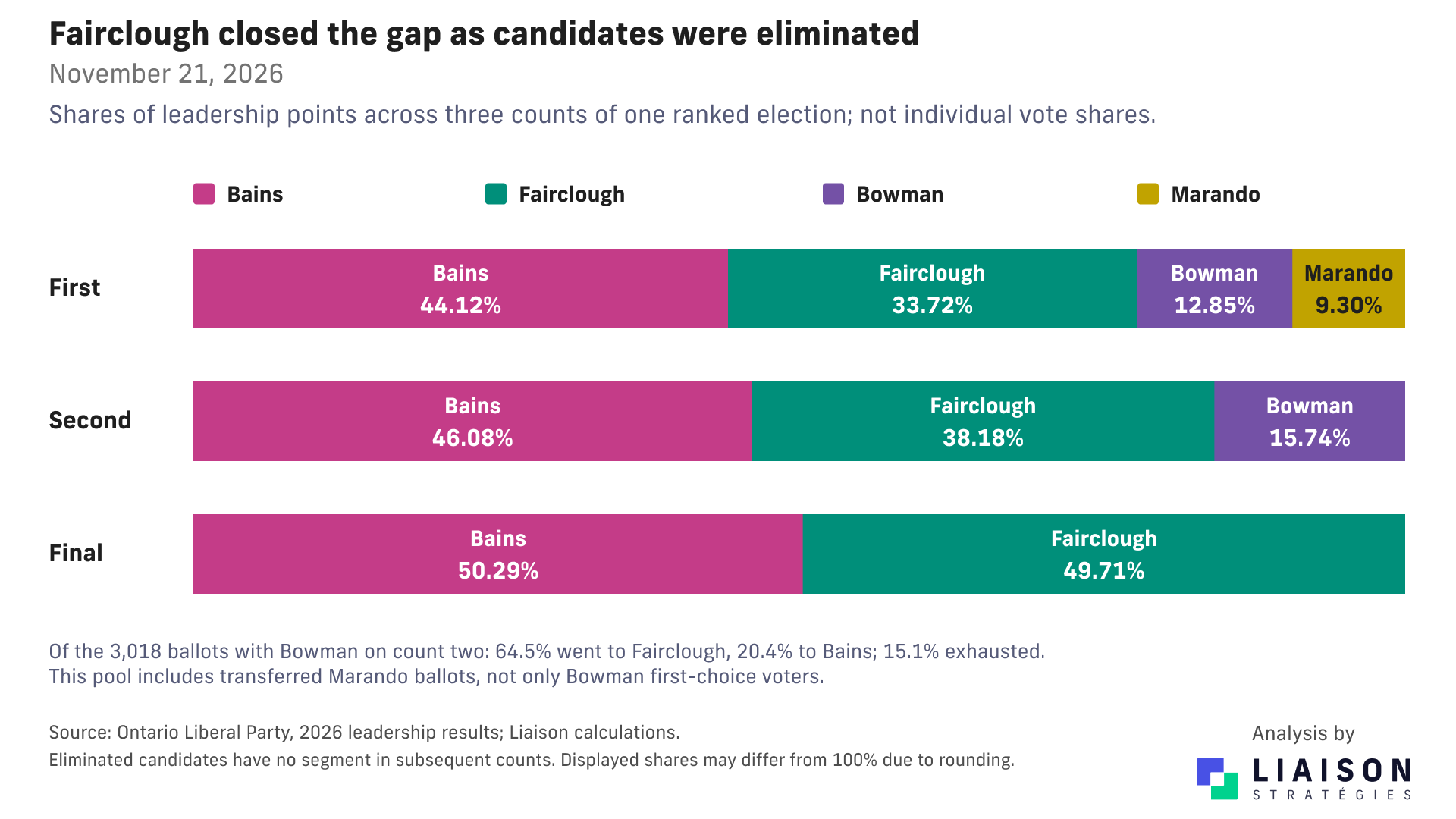
Fairclough gained about 2,119 points between the first and final counts. Bains gained about 818. She almost erased a first-count gap of more than 10 percentage points.
She received more than three votes for every one Bains gained when Bowman was eliminated. She needed a little more support before those transfers, and the campus clubs offered a particularly efficient way to get it.
Plenty of Members Didn't Vote
About 20,500 ballots were cast from a list of 55,849 eligible members. Participation was 36.7 per cent. By the final count, 767 initially valid ballots had exhausted.
Scarborough Southwest had 3,800 eligible members listed, but only 253 ballots were cast. The final Bains-Fairclough margin there was seven votes. A large membership list and a large number of people actually voting are very different things.
These results cannot tell us why members stayed home, or who they would have supported. But with fewer than four in 10 eligible members participating and the winner decided by less than one percentage point, getting existing members to vote offered plenty of room for either campaign to improve its result.
Bains won both the votes and the points. Fairclough came close enough that five switches in the right places would have changed the result. For the next leadership campaign, I would be paying as much attention to where another five supporters could be found as to the size of the membership list.
Sources and Calculations
Results come from the Ontario Liberal Party's official riding- and club-level breakdown, using the weighting rules in section 9.14 of its constitution. Regional groupings are Liaison's. Northern Ontario includes Parry Sound-Muskoka. Central Ontario includes the Barrie/Simcoe ridings, Dufferin-Caledon, Haliburton-Kawartha Lakes-Brock and the two Peterborough-area ridings. Clubs are counted separately from riding totals. Points are calculated before rounding..