72% Back Social Media Age Verification; Support Falls to 50% When Platforms Get ID or Card Details
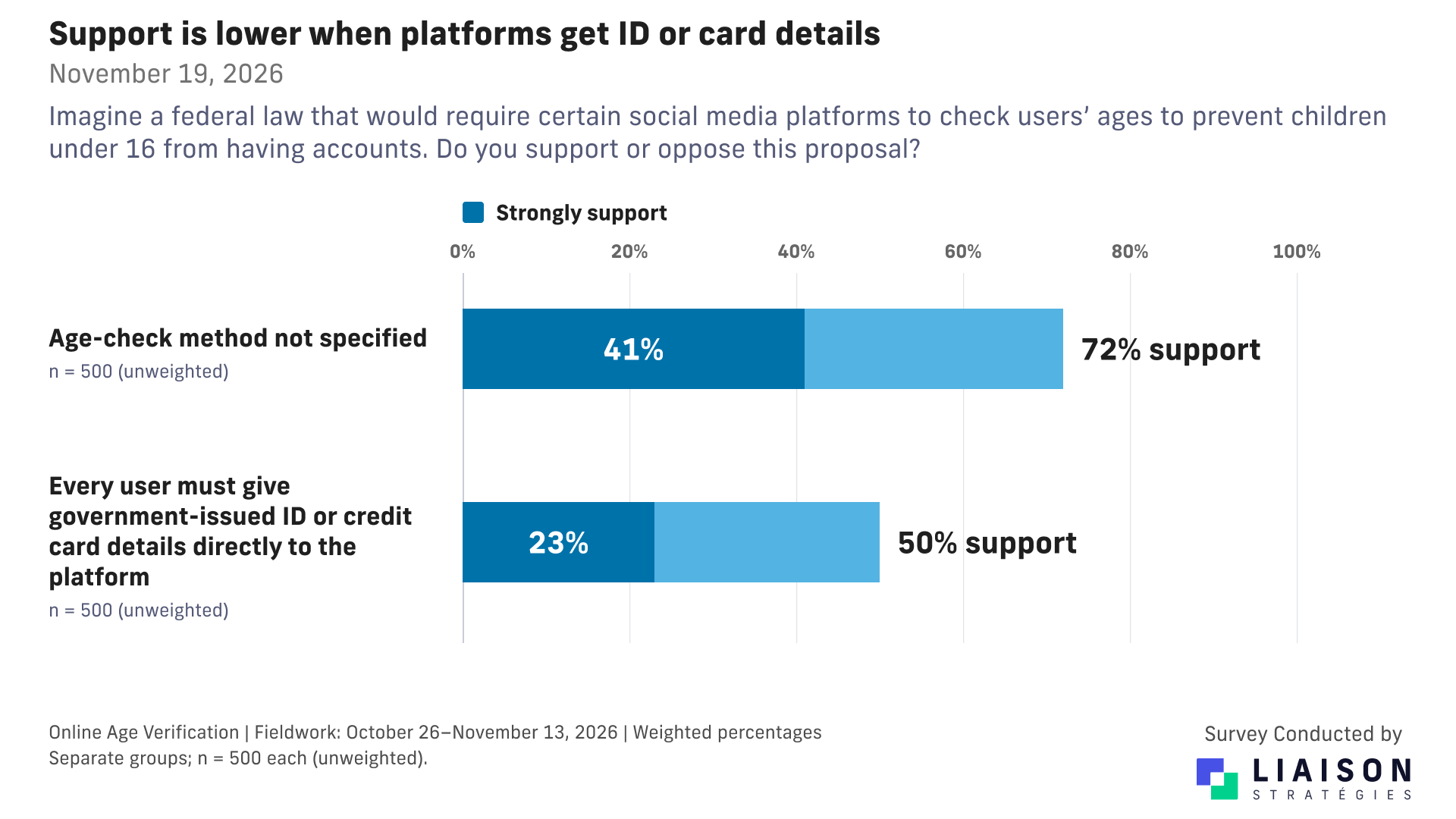
Support is 72% when the age-check method is unspecified and 50% when users would have to give the platform government ID or credit card details.

November 19, 2026 (Toronto, ON) - Canadians back age checks to keep children under 16 off certain social media platforms, but support is lower when the platforms would get users’ ID or credit card details. A new Liaison Strategies survey finds 72% support age checks when the method is unspecified, compared with 50% in a separate group told every user would have to provide government-issued ID or credit card details directly to the platform.
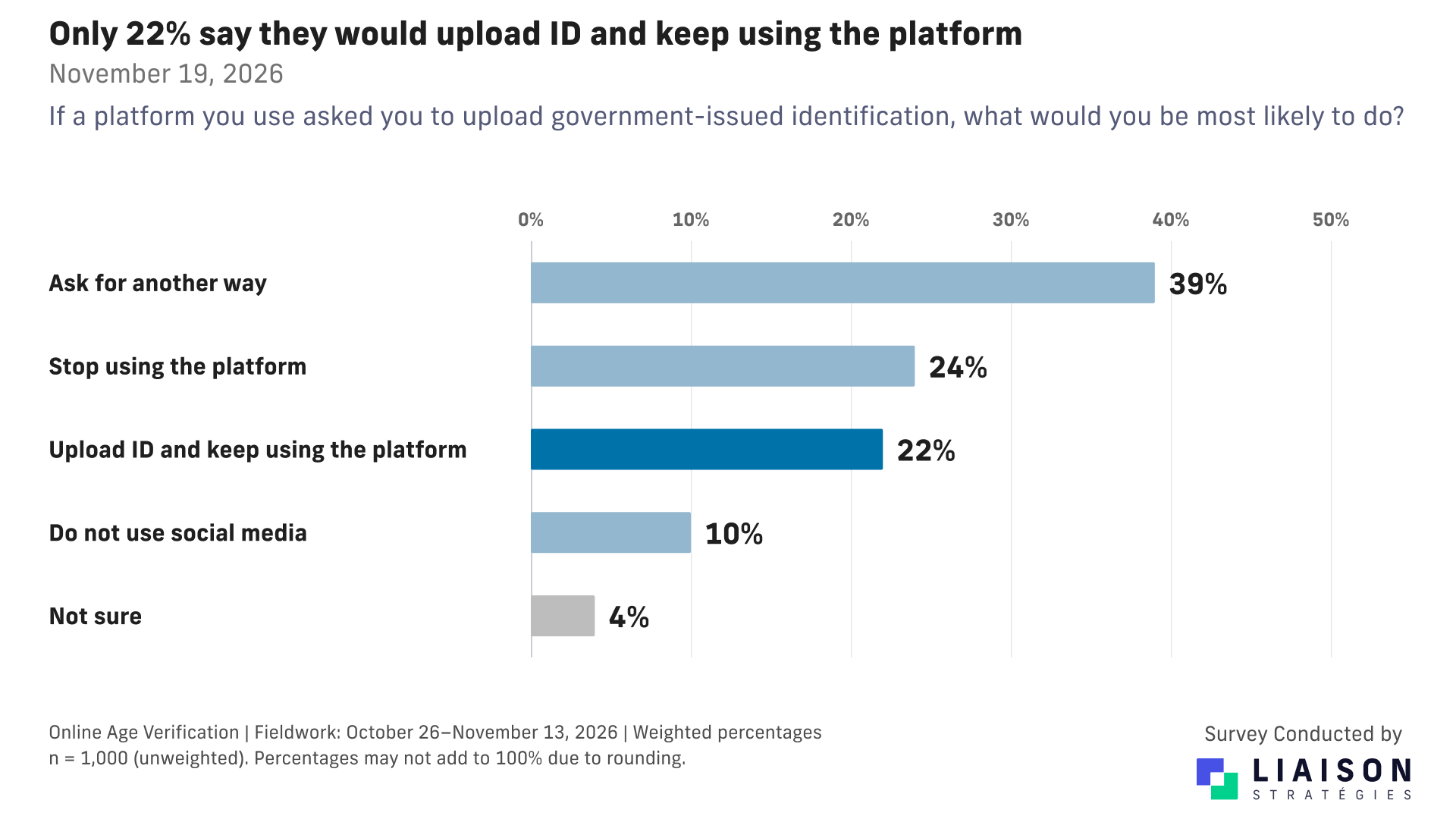
Only 22% say they would upload government-issued ID and keep using a platform that asked for it. Another 39% would ask for a different way to prove their age, and 24% say they would stop using the platform.
The national survey included 1,000 respondents and was conducted from October 26 to November 13, 2026. Liaison recruited survey participants by calling randomly selected cellphone and landline numbers. Participants completed the survey by phone or online. Results were weighted by age, gender and region. The full-sample margin of error is ±3.1 percentage points, 19 times out of 20, and is higher for smaller groups. Each version of the two split-sample questions was asked of 500 respondents.
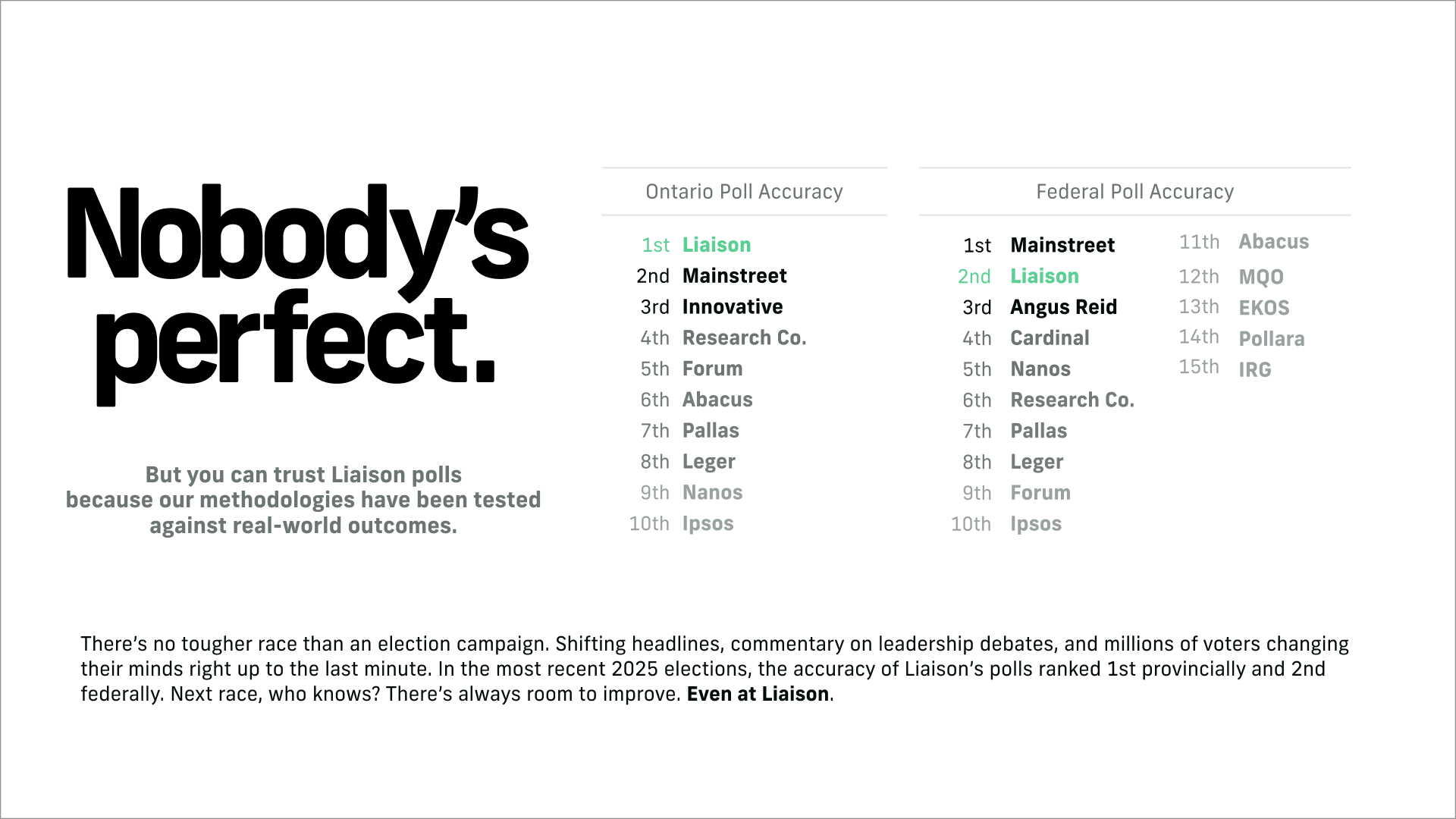
Liaison Strategies is one of the most accurate polling firms in Canada. It ranked #1 in accuracy in the 2025 Ontario election and #2 nationally in the 2025 federal election. Liaison is a member of the Canadian Research Insights Council.
David Valentin, Principal at Liaison Strategies, said:
“There’s broad agreement on the goal. Seventy-six per cent support a federal law keeping under-16s off certain social media platforms, including 77 per cent of Liberal voters and 74 per cent of Conservative voters. The agreement starts to break down when you spell out what every user would have to hand over. Strong support is 41 per cent with no method specified and 23 per cent when the platform gets ID or card details directly.”
“An ID requirement could cost platforms some users. Thirty per cent of adults under 35 say they’d leave a platform that asked them to upload government-issued ID, compared with 17 per cent of those 65 and older. That’s what people say they’d do, not a forecast of how many would actually quit.”
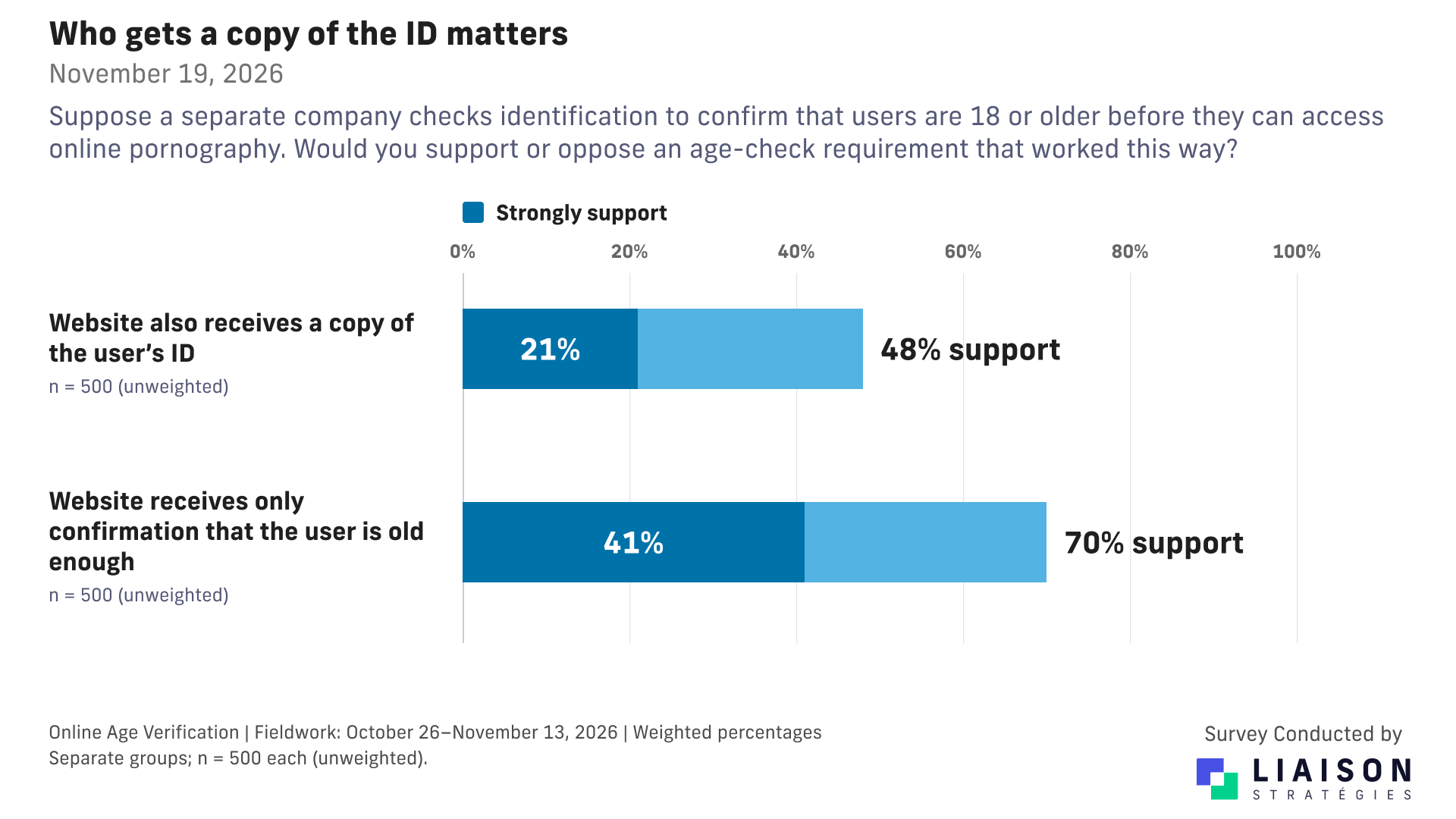
“We see another 22-point gap when we ask about access to online pornography. A separate company checks the ID in both scenarios. If the website gets only a yes or no on whether the user is old enough, 70 per cent support the requirement. If the website also gets a copy of the ID, support is 48 per cent.”
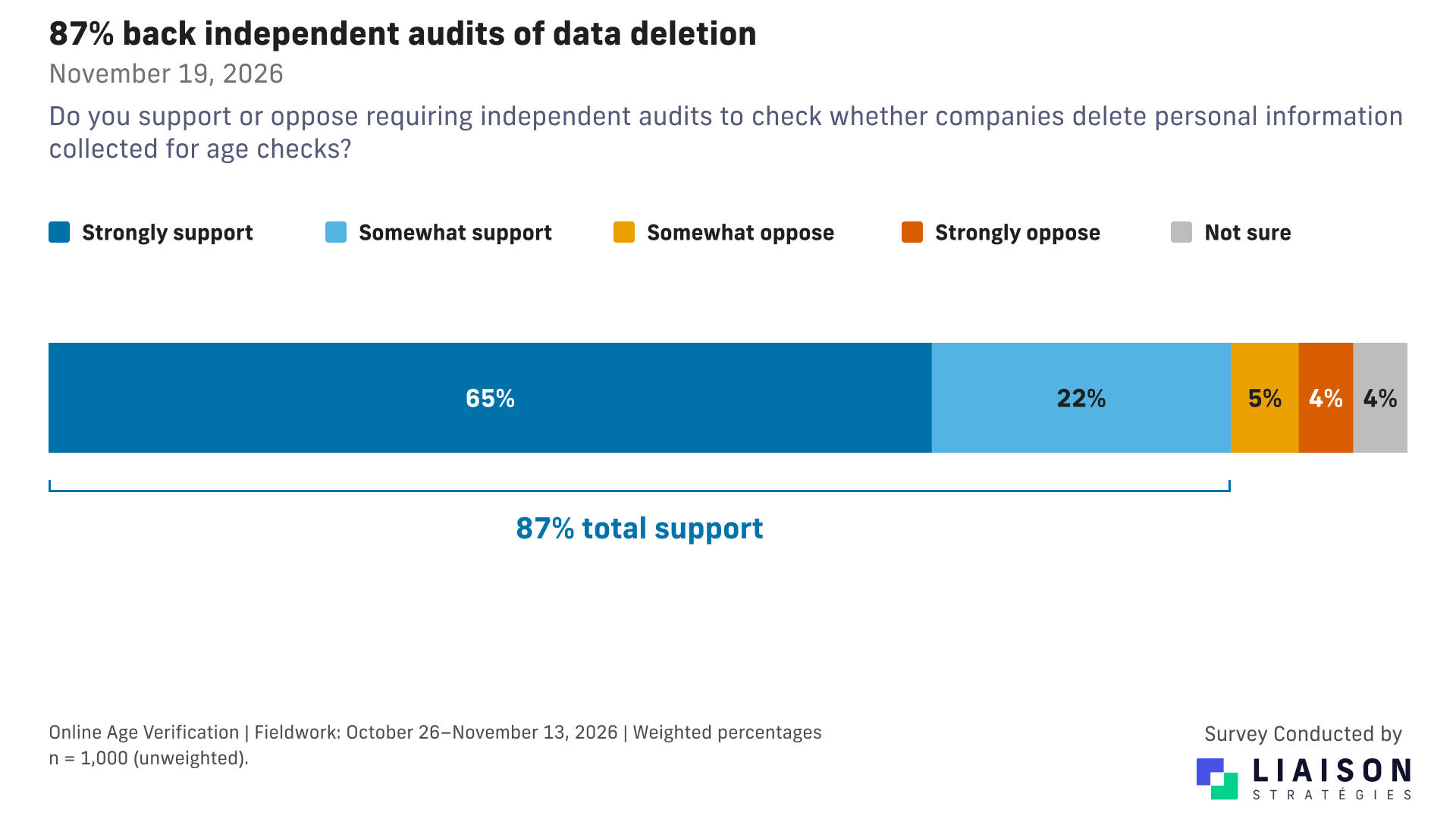
“People want someone checking what happens to their information after the age check. Eighty-seven per cent support independent audits to see whether companies delete the information they collect. That includes 84 per cent of adults under 35 and 86 per cent of those 65 and older. Misuse or exposure of personal information is the top concern nationally, at 39 per cent.”
“Canadians also want the checks to work. Just 40 per cent say they’re very or somewhat confident that age checks would substantially reduce the number of under-16s with social media accounts. In the scenarios we tested, support is 47 per cent for checks that prevent one in four underage accounts and 74 per cent for checks that prevent three in four.”
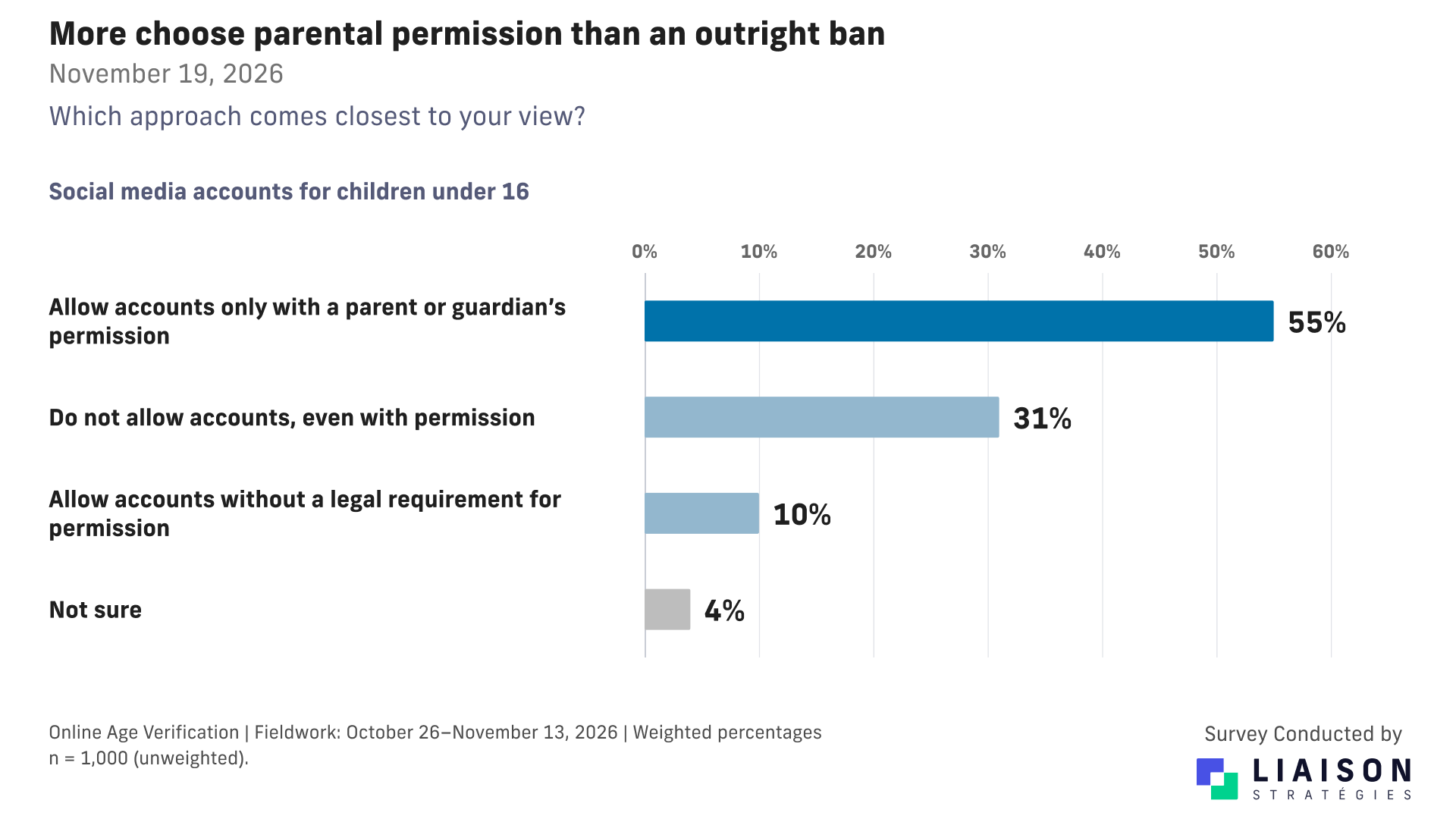
“When people can choose between a flat ban and letting parents decide whether their own children can have accounts, they lean toward permission. Fifty-five per cent say under-16s should be allowed accounts only with a parent or guardian’s permission, while 31 per cent would bar accounts even with permission. That 31 per cent is the same in households with and without children.”
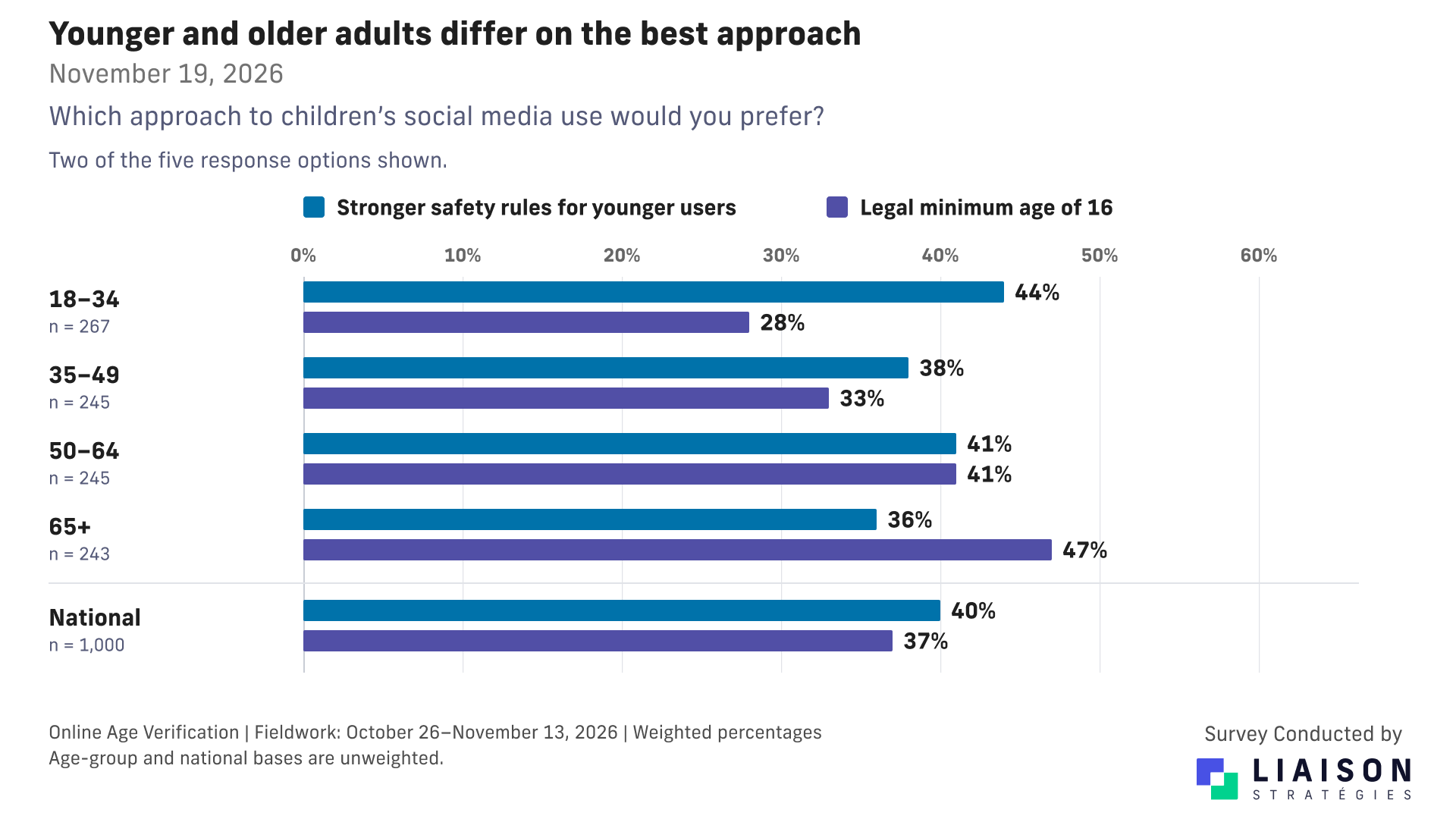
“Younger and older adults disagree on what the rule should be. Given a choice, 44 per cent of adults under 35 pick stronger safety rules for younger users and 28 per cent pick a legal minimum age of 16. Among those 65 and older, it’s the other way around: 47 per cent pick the age floor and 36 per cent pick stronger safety rules.”
-30-
Detailed Poll Report:
Detailed Crosstabs:
About Liaison Strategies
Liaison Strategies is a national public opinion research firm. With 13 years of experience in Canadian polling, David Valentin, principal, has fielded hundreds of projects at the municipal, provincial and federal levels and appeared across Canadian media to discuss insights. Liaison is a member of the Canadian Research Insights Council (CRIC), Canada's voice of the research, analytics, and insights profession both domestically and globally.