Federal Tracker: Conservatives Hit Tracking Low of 28%
Liberals lead 46% to 28% as Conservative support reaches its lowest level in Liaison tracking since March 2025. Carney approval returns to 66%.

October 5, 2026 (Toronto, ON) - The latest Liaison Strategies Weekly Federal Tracker shows the Conservatives at 28% among decided and leaning voters, their lowest support in the series dating back to March 2025. The Liberals hold at 46%, giving them an 18-point lead, while Mark Carney's approval returns to 66%.
Liaison surveyed a random sample of 1,526 Canadians from September 20 to October 3, 2026, using Interactive Voice Recording (IVR) technology. Participants were reached through random digit dialling (RDD) across both landline and cellular phone networks. The resulting data was weighted to match targets based on the 2021 Census. For the total sample, the margin of error is +/- 2.5 percentage points, 19 times out of 20, and is higher for subsamples. Results may not add to 100% due to rounding.
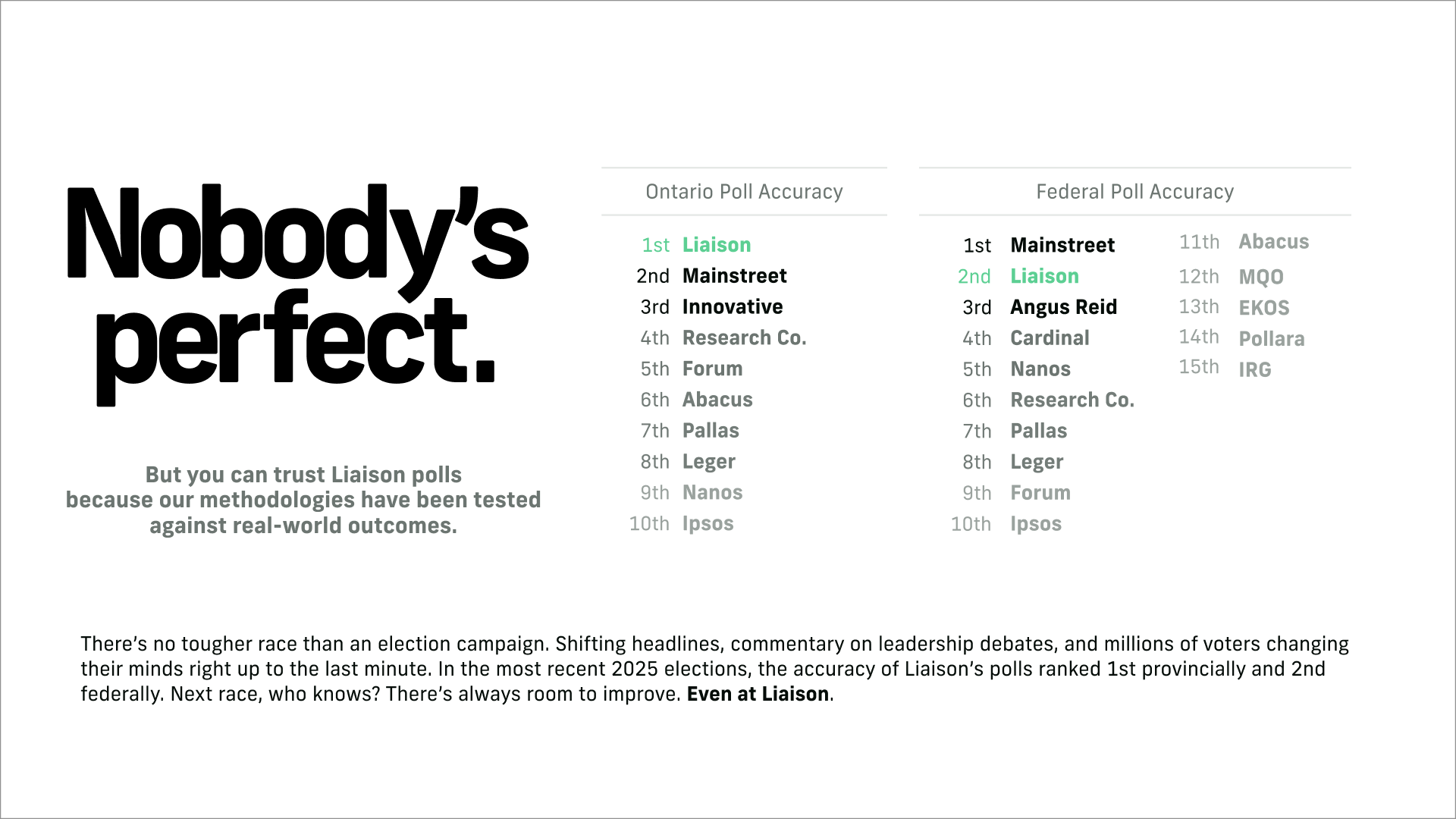
Liaison Strategies is one of the most accurate polling firms in Canada. It ranked #1 in accuracy in the 2025 Ontario election and #2 nationally in the 2025 federal election. Liaison is a member of the Canadian Research Insights Council.
David Valentin, Principal at Liaison Strategies, said:
"The Conservatives are entering October below their previous tracking low of 29%, recorded on August 31 and September 28. They have slipped from 32% to 28% over the past three weekly updates. The Liberals have not gained a point this week. They have gained room because the Conservatives have lost ground."
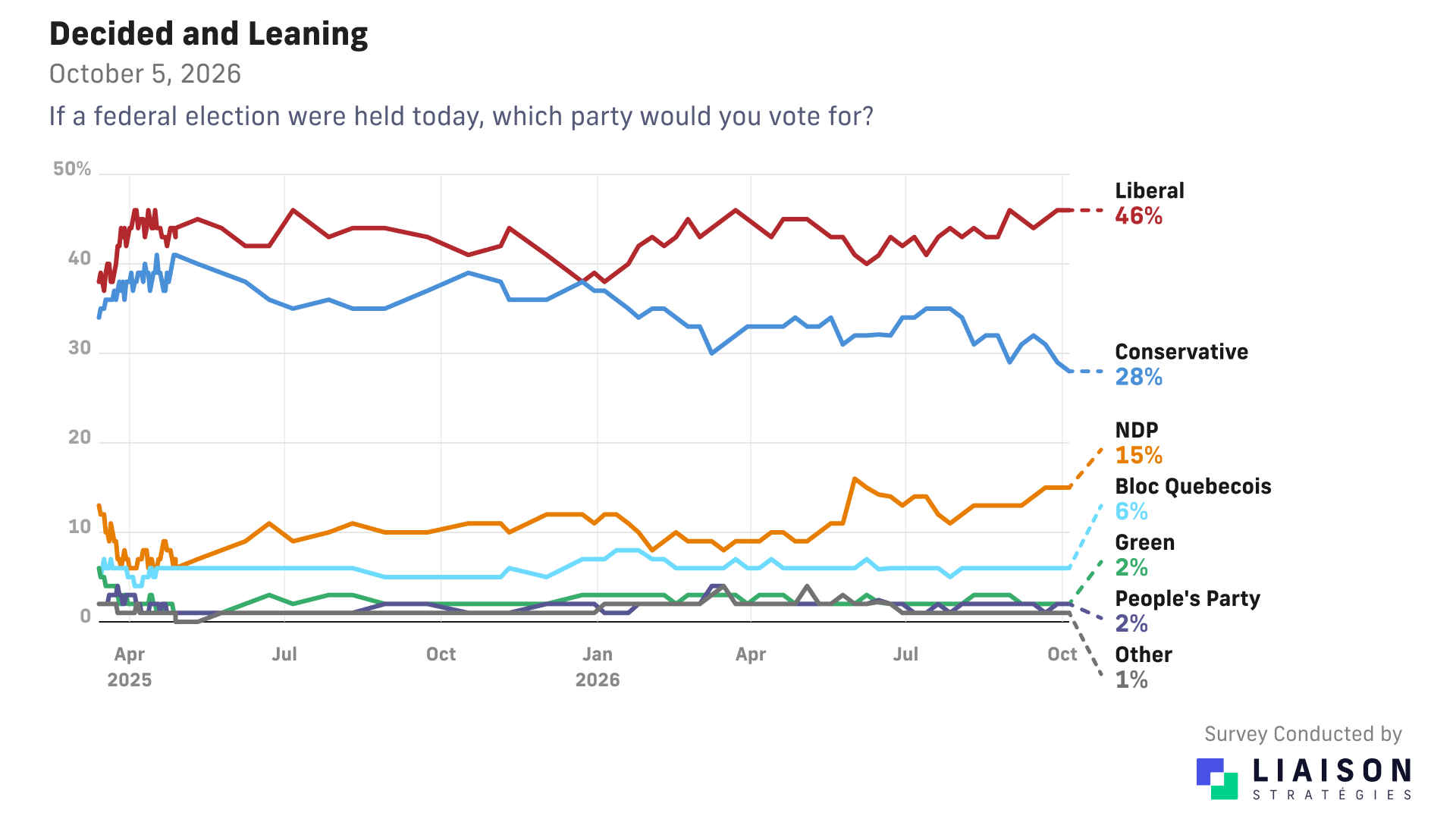
"The rest of the decided and leaning vote is largely unchanged: the NDP has 15%, the Bloc 6%, the Greens and the People's Party 2% each, and other parties 1%. On the initial ballot question, before leaners are included, the Liberals have 41%, the Conservatives 24%, and the NDP 13%, with 14% undecided. The Liberal advantage is substantial on either measure."
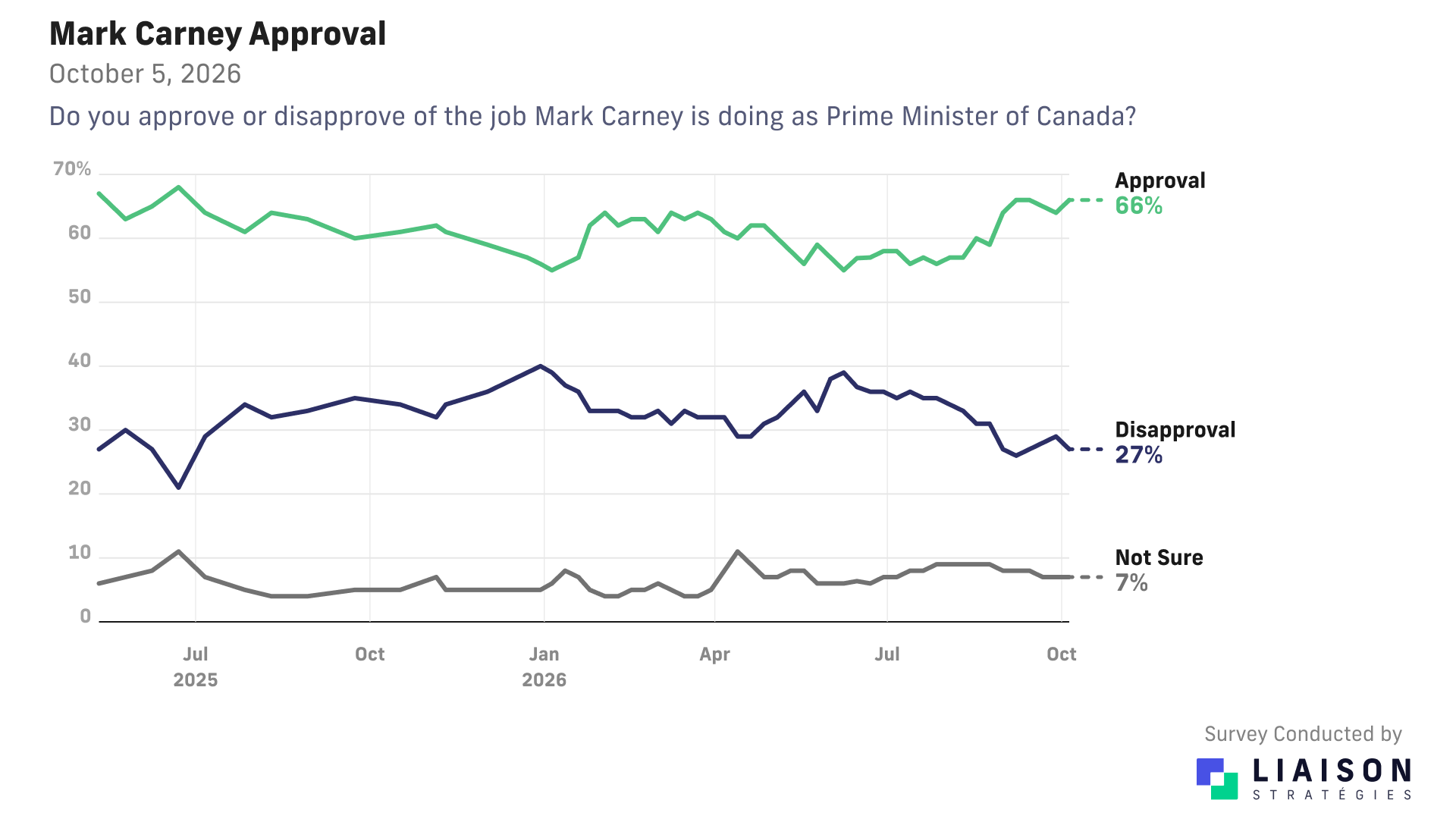
"Carney has reversed the modest decline in his approval over the previous two releases. Sixty-six per cent approve of his performance, up from 64%, while 27% disapprove, down from 29%, and 7% are unsure. That leaves him 39 points ahead on approval. The Liberals' lead is backed by a prime minister whom roughly two-thirds of Canadians currently approve of."
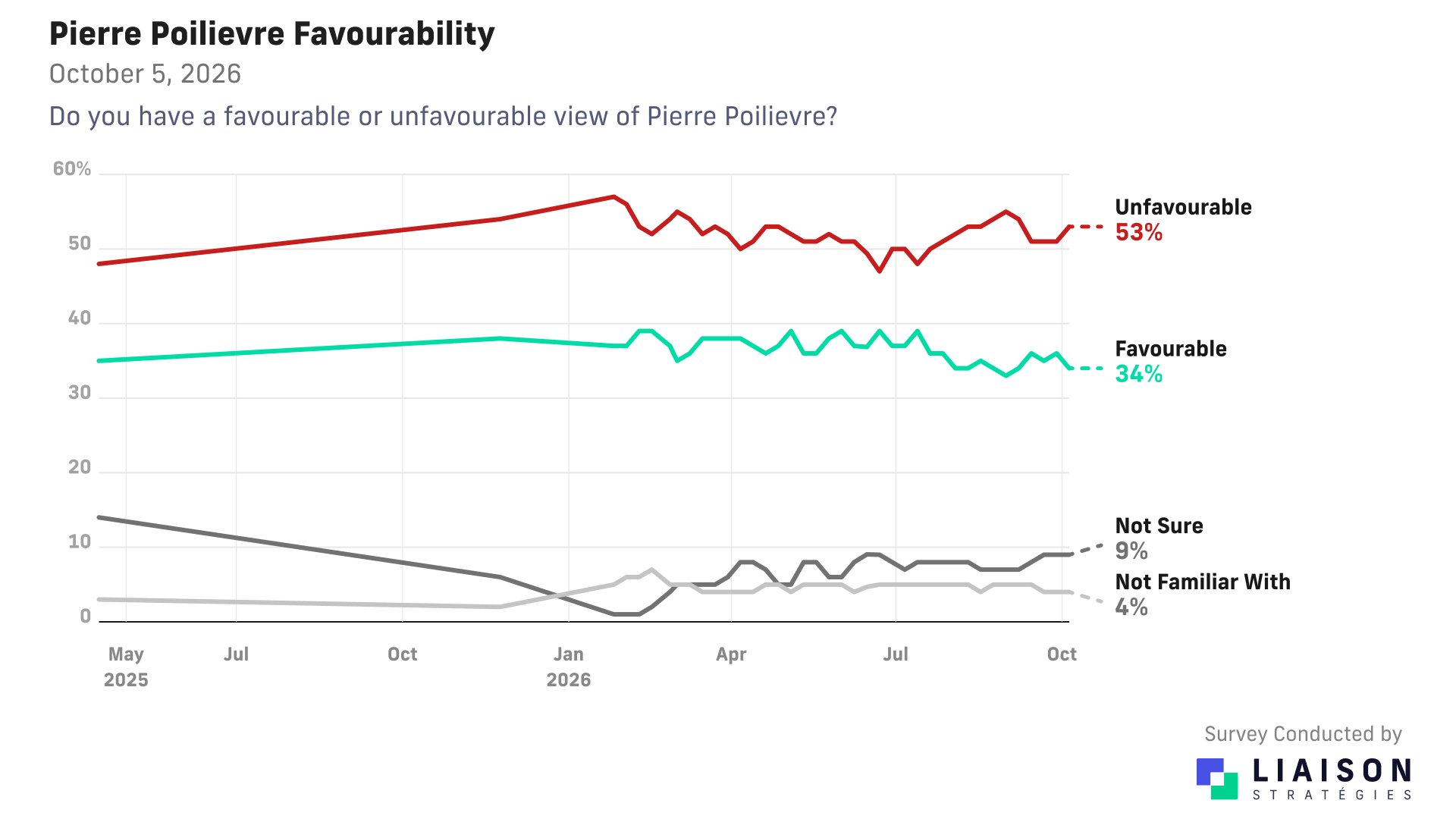
"Poilievre's numbers have moved in the opposite direction. His favourable rating is down two points to 34%, while his unfavourable rating is up two to 53%. Nine per cent are unsure and only 4% are unfamiliar with him. Most Canadians already have an opinion of Poilievre. His challenge is persuading them to reconsider it."
"In Ontario, 60% view Poilievre unfavourably and 32% favourably. That is difficult ground on which to rebuild a party's support. The Liberals have 50% of decided and leaning voters in the province, compared with 32% for the Conservatives. Quebec presents another obstacle: the Liberals are at 45%, the Bloc at 25%, and the Conservatives at 14%."
"Alberta remains the Conservatives' strongest region, with 46% to the Liberals' 35%. But Manitoba and Saskatchewan combined are much closer, at 41% Liberal and 37% Conservative. That small regional sample does not establish a clear Liberal lead. It does, however, caution against treating the West as a single, uniformly Conservative bloc. Regional results are more variable than the national total and are not seat projections."
"Lewis has a better personal result this week, but the NDP is still at 15%. His favourable rating has risen from 31% to 33%, while his unfavourable rating has fallen from 30% to 28%. Another 28% are unsure and 11% are unfamiliar with him. Improving impressions are useful. Turning them into additional votes is the next test."
"British Columbia shows both the opening and the limit for Lewis. Forty-six per cent view him favourably and 11% unfavourably, yet the NDP has 23% of decided and leaning voters. The Conservatives have 27% and the Liberals 44%. A favourable view of the NDP leader is not automatically a vote for his party."
"The Conservative deficit is not confined to women, although the Liberals' 52% to 23% lead among women is striking. Men also favour the Liberals, 43% to 34%. Among voters aged 18 to 34, the Conservatives are almost level with the NDP, at 25% and 24%, behind the Liberals at 37%. Getting back above 30% would be a start for the Conservatives. Becoming competitive with the Liberals requires a much broader recovery."
-30-
Detailed Poll Report:
Detailed Tables:
About Liaison Strategies
Liaison Strategies is a national public opinion research firm. With 13 years of experience in Canadian polling, David Valentin, principal, has fielded hundreds of projects at the municipal, provincial and federal levels and appeared across Canadian media to discuss insights. Liaison is a member of the Canadian Research Insights Council (CRIC), Canada's voice of the research, analytics, and insights profession both domestically and globally.