Canadians Divided on Hellebuyck's Next Step
Canadians split on a Hellebuyck return, trade or paid holdout. Hockey followers favour a trade or return over keeping him out on full pay; Winnipeg residents are divided.


October 22, 2026 (Toronto, ON) - Canadians are almost evenly divided over Connor Hellebuyck's future with the Winnipeg Jets: 31% favour letting him return while awaiting an acceptable trade, 30% favour a trade and 29% favour a paid holdout, a new Liaison Strategies survey finds.
Liaison surveyed 1,500 Canadians from October 19 to October 20, 2026, using Interactive Voice Recording (IVR), with random digit dialling to landline and cellular phones. The survey included an oversample in Manitoba, with 527 interviews across the province, including 350 in Winnipeg CMA.
Results were weighted by age, gender and region to match population targets based on the 2021 Census, with Manitoba weighted back to its national population share. The national margin of error is +/- 3.04 percentage points, 19 times out of 20, and is higher for subsamples. Results may not add to 100% due to rounding.
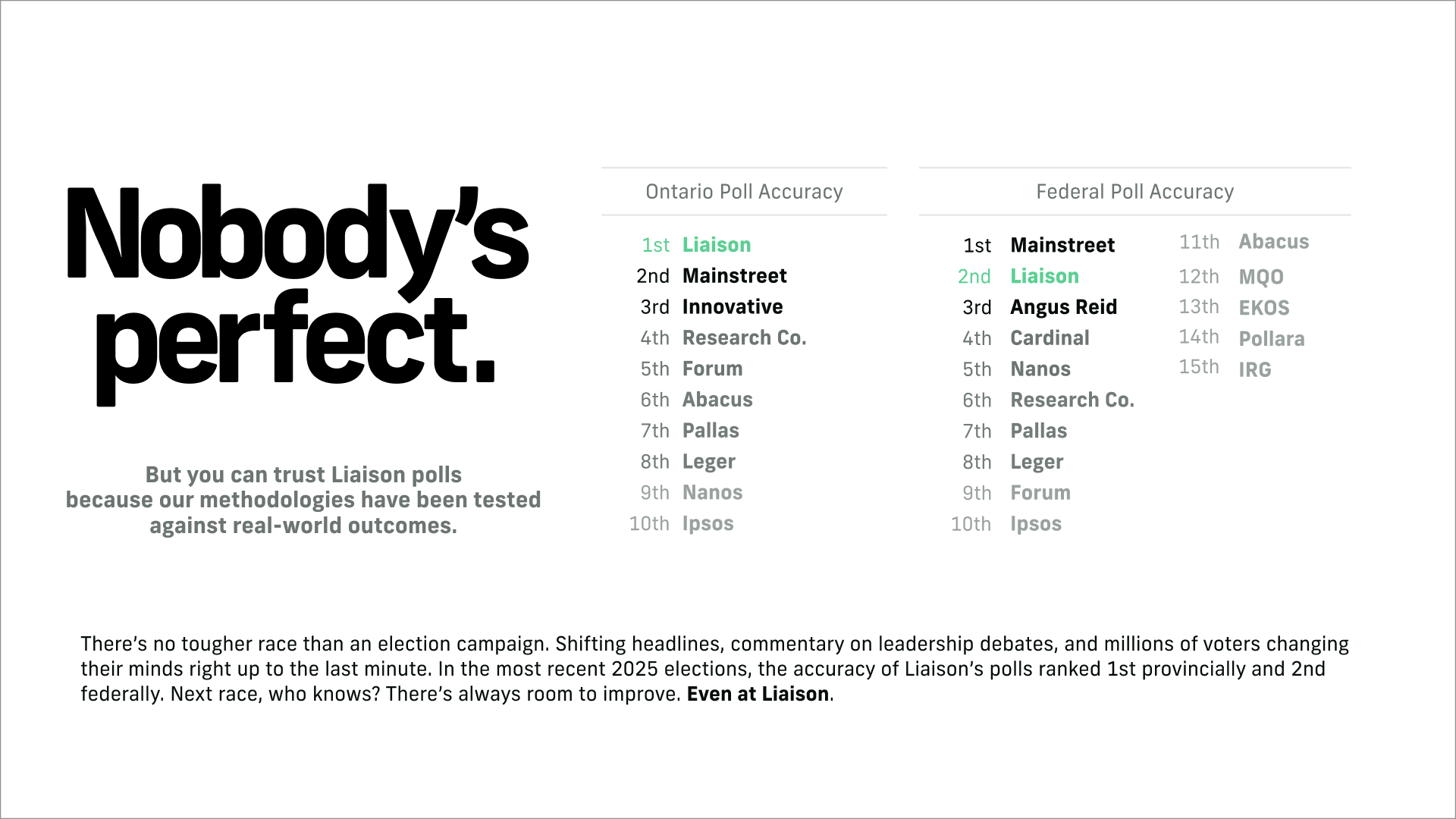
Liaison Strategies is one of the most accurate polling firms in Canada. It ranked #1 in accuracy in the 2025 Ontario election and #2 nationally in the 2025 federal election. Liaison is a member of the Canadian Research Insights Council.
David Valentin, Principal at Liaison Strategies, said:
"The Jets have more sympathy than Hellebuyck. But people disagree about whether he should play, be traded or sit out on full pay."
For the questions about Connor Hellebuyck and the Winnipeg Jets, respondents received a briefing covering his trade request, remaining contract, family explanation, suspension without pay, and reported willingness to return. The sympathy results reflect that information. Hockey followers are respondents who say they are very or somewhat interested in hockey; non-followers include all other interest responses, including unsure.
The return question assumes Hellebuyck is willing and eligible to play. It offers three choices: let him play while awaiting an acceptable trade; trade him for the best available offer, even below what the Jets consider fair value; or refuse a trade and keep him out for the rest of his contract while continuing to pay him.
"Among hockey followers, 39% favour a trade, 35% favour a return and 19% favour a paid holdout. More choose a trade or a return than keeping him out on full pay, but neither option has majority support."

"Hockey followers are more sympathetic to the Jets than to Hellebuyck, 49% to 16%. That tells us who they sympathize with, not what they want the team to do next."
"Take a return out of the question, and the choice becomes clearer: hockey followers prefer a trade to a paid holdout, 58% to 30%. That is not the same as choosing a trade over bringing him back."
Respondents were explicitly asked to assume the Jets would have to continue paying Hellebuyck if they refused a trade and kept him out. Among Canadians overall, 45% choose the trade option, 40% the hold-out option, and 15% are unsure.
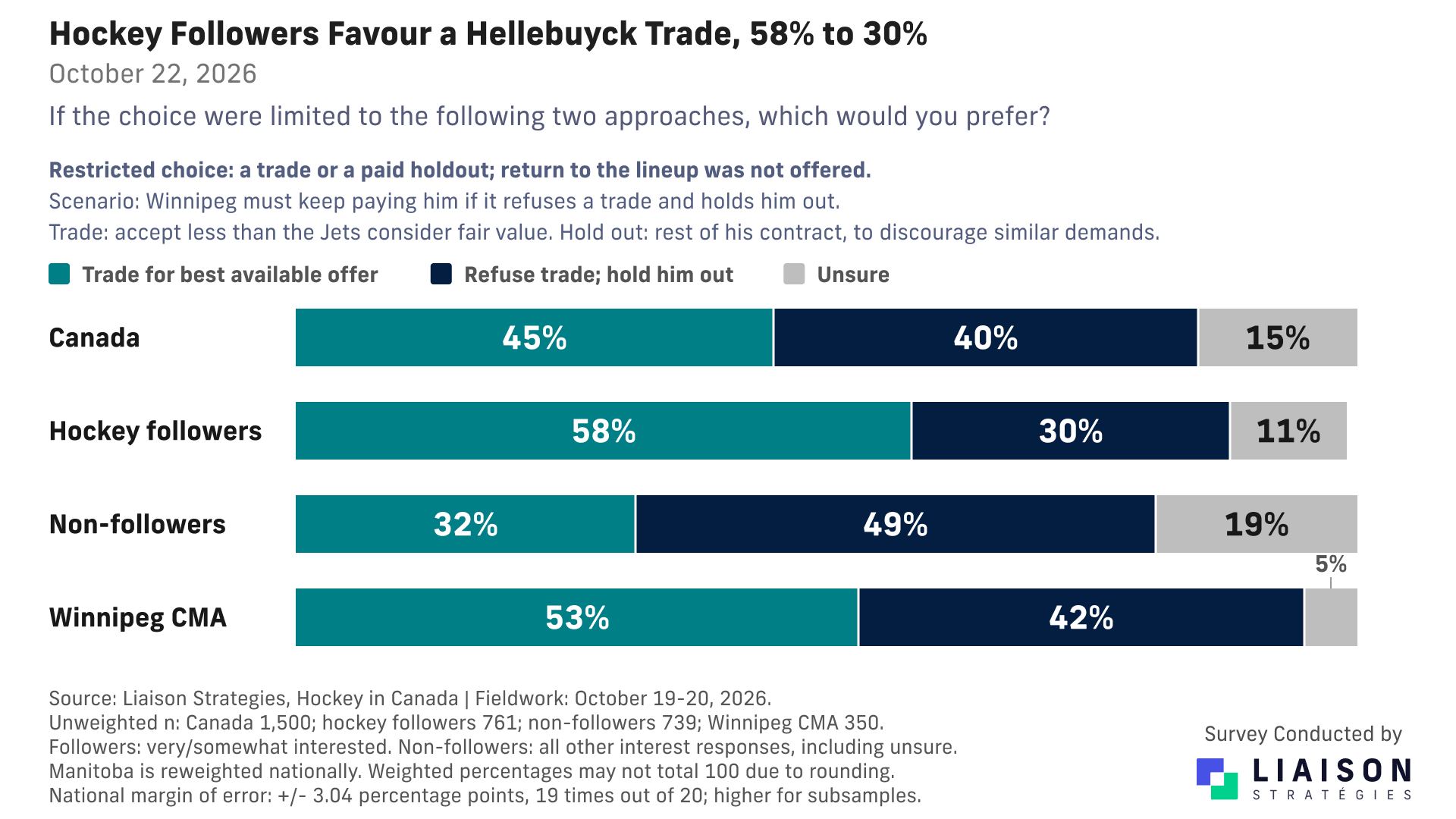
"The contrast with non-followers is substantial. They favour holding him out over trading him, 49% to 32%. The people interested in hockey are more willing to accept a trade under these conditions than those less interested in it."
"Hockey followers prioritize talent over willingness to stay, 57% to 29%. Non-followers lean the other way, preferring players who want to stay in Canada long term, 53% to 29%."
"People who follow the sport are more prepared to risk losing a player in exchange for having his talent on their team. Non-followers are more willing to pass on talent to get someone who wants to stay."
Winnipeg backs the Jets but is divided on what comes next
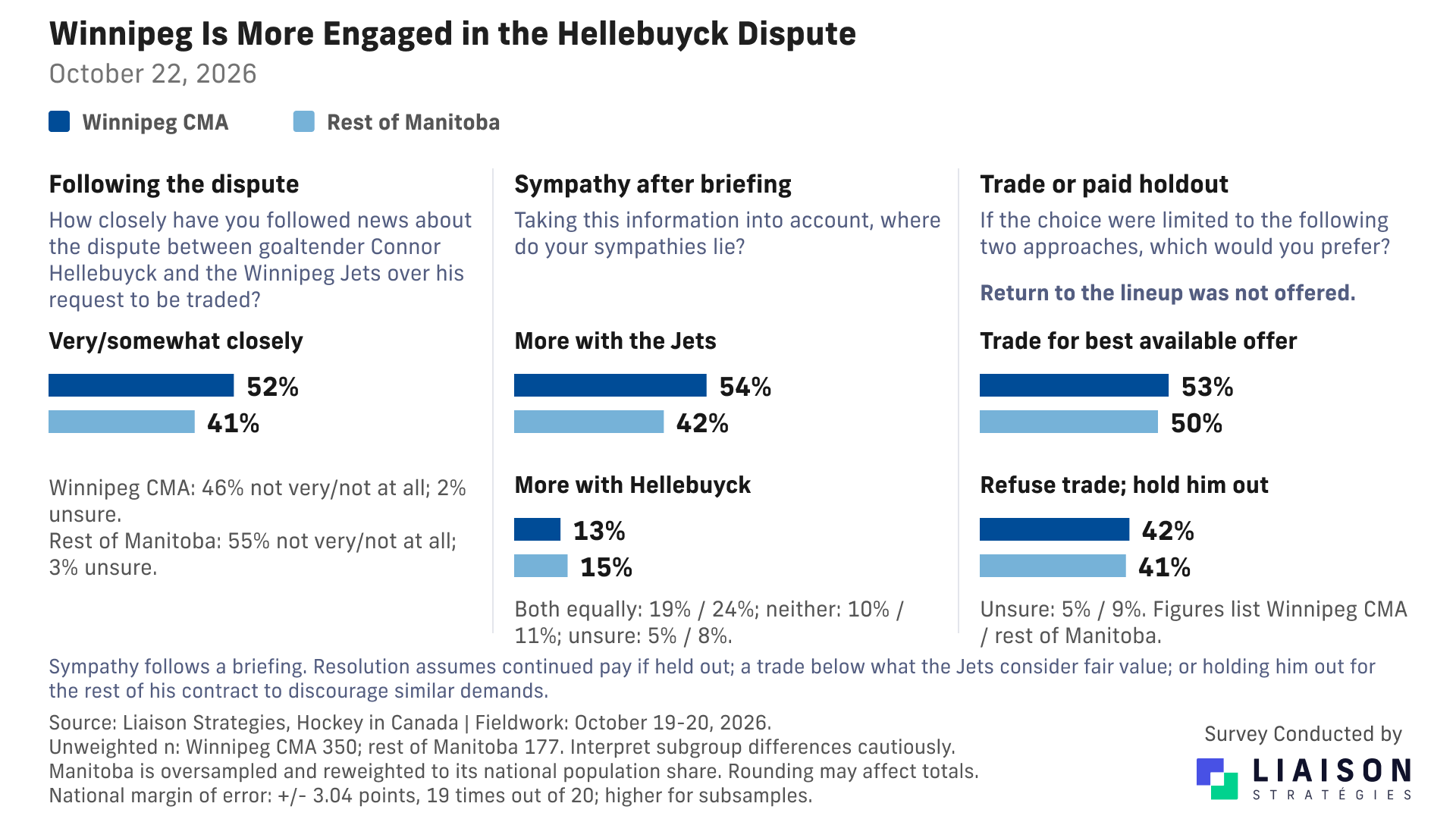
"This dispute has a much larger audience close to home. Fifty-two per cent of residents in Winnipeg CMA have followed it very or somewhat closely, compared with 41% elsewhere in Manitoba and 20% nationally. After receiving the briefing, Winnipeg residents are more sympathetic to the Jets than Hellebuyck, by 54% to 13%. Across Manitoba, those figures are 50% and 13%."
"With return included, Winnipeg CMA residents are divided: 31% favour letting Hellebuyck play while awaiting an acceptable trade, 31% favour a trade and 35% a paid holdout. Another 3% are unsure."
Here, a trade means accepting the best available offer even below what the Jets consider fair value. A paid holdout means refusing a trade and keeping him out for the rest of his contract while continuing to pay him.
"When return is not offered and a holdout means continued pay, 53% in Winnipeg CMA favour trading him for the best available offer, while 42% favour holding him out. Across Manitoba, the split is 52% to 42%. There is more sympathy for the team than the player, but a narrow majority still prefer a trade to the alternative we tested."
"Winnipeg is also almost evenly divided on talent versus willingness to stay: 47% prioritize talent and 46% prioritize players who want to remain in Canada long term. These are residents' views, not a survey limited to Jets fans."
Canadians back tax-adjusted salary caps
"Support for adjusting the salary cap is not confined to people who spend their evenings watching hockey. Sixty-six per cent of hockey followers support extra cap room for teams in higher-tax locations, as do 63% of non-followers. Nationally, 30% strongly support the proposal. After hearing the arguments for adjusted and uniform limits, Canadians favour making an allowance for income-tax differences."
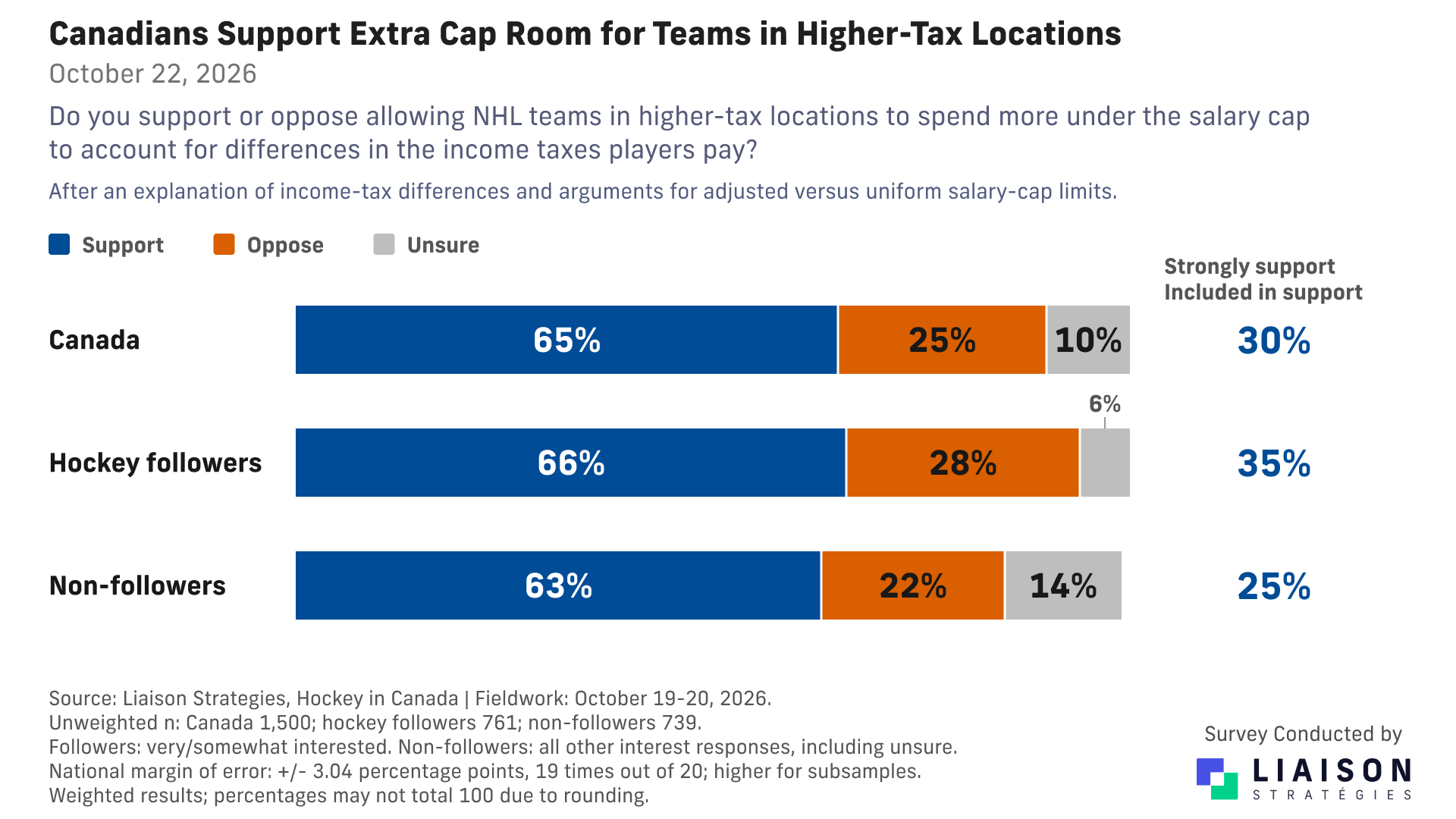
"This is a proposal to change what teams are allowed to spend, not to cut players' taxes. It would apply to higher-tax locations, not just Canadian teams. The survey measures support for that principle; it does not establish what a workable NHL formula would look like."
"Sixty per cent of Canadians are at least somewhat concerned about Canadian teams' ability to keep their best American players. Among hockey followers, that rises to 73%. There is an audience for this issue, but the intensity matters: 28% of Canadians are extremely or very concerned, with another 32% somewhat concerned."
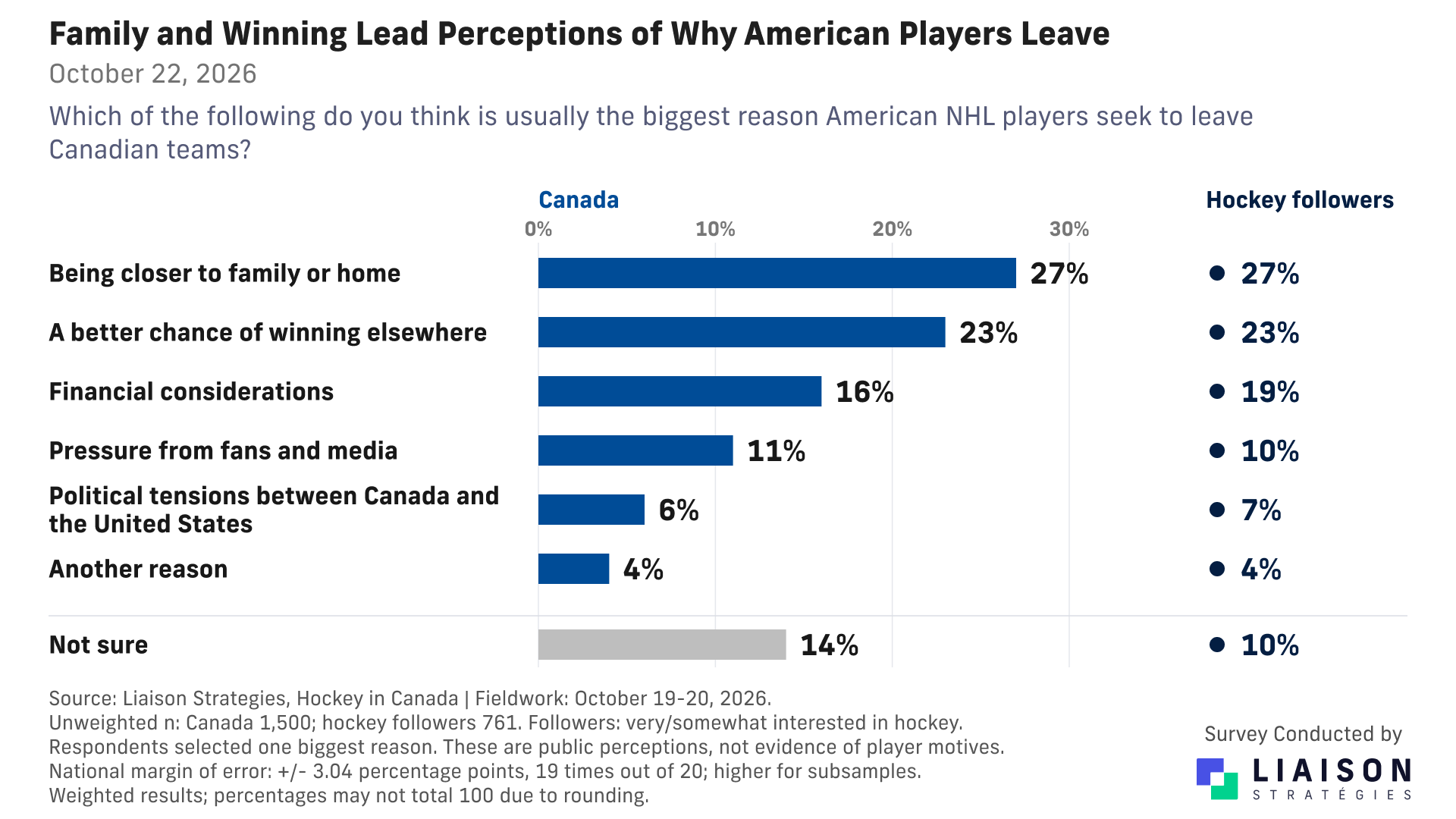
"Canadians most often point to family or home, at 27%, and a better chance of winning elsewhere, at 23%, when asked why American players seek to leave Canadian teams. Financial considerations receive 16%, fan and media pressure 11%, and political tensions 6%."
"These are perceptions, not proof of any player's motives. But politics is not the explanation most Canadians reach for."
"Thirty-six per cent say these departures mainly reflect a broader problem attracting and retaining American stars, while 24% say they mainly reflect individual circumstances. Another 32% say both matter equally. Canadians recognize a recruitment problem without assuming every player has the same reason for leaving."
-30-
Detailed Poll Report:
Detailed Tables:
About Liaison Strategies
Liaison Strategies is a national public opinion research firm. With 13 years of experience in Canadian polling, David Valentin, principal, has fielded hundreds of projects at the municipal, provincial and federal levels and appeared across Canadian media to discuss insights. Liaison is a member of the Canadian Research Insights Council (CRIC), Canada's voice of the research, analytics, and insights profession both domestically and globally.