Majority of Canadians Oppose U.S. Military Action in Venezuela

January 20 (Toronto, ON) – On the one-year anniversary of the second inauguration of U.S. President Donald Trump, a new national survey from Liaison Strategies reveals that a significant majority of Canadians are opposed to U.S. military intervention in Venezuela.
64% of respondents oppose the United States using military force to remove Nicolás Maduro from power, while only 32% support such action.
"As the world marks one year since President Trump’s return to the White House, Canadians are expressing a clear preference for diplomacy and aid over military force in Venezuela," said David Valentin, Principal at Liaison Strategies. "While there is a desire to help rebuild, there is deep skepticism regarding the legality and use of force to effect regime change."
Liaison surveyed a random sample of 1,000 Canadians from January 5 to January 17, 2026, using Interactive Voice Recording (IVR) technology. To ensure a representative sample, participants were reached through random digit dialing (RDD) across both landline and cellular phone networks. Each week, the rolling survey refreshes the sample by adding 500 participants and removing 500. The margin of error is ±3.1 percentage points, 19 times out of 20.
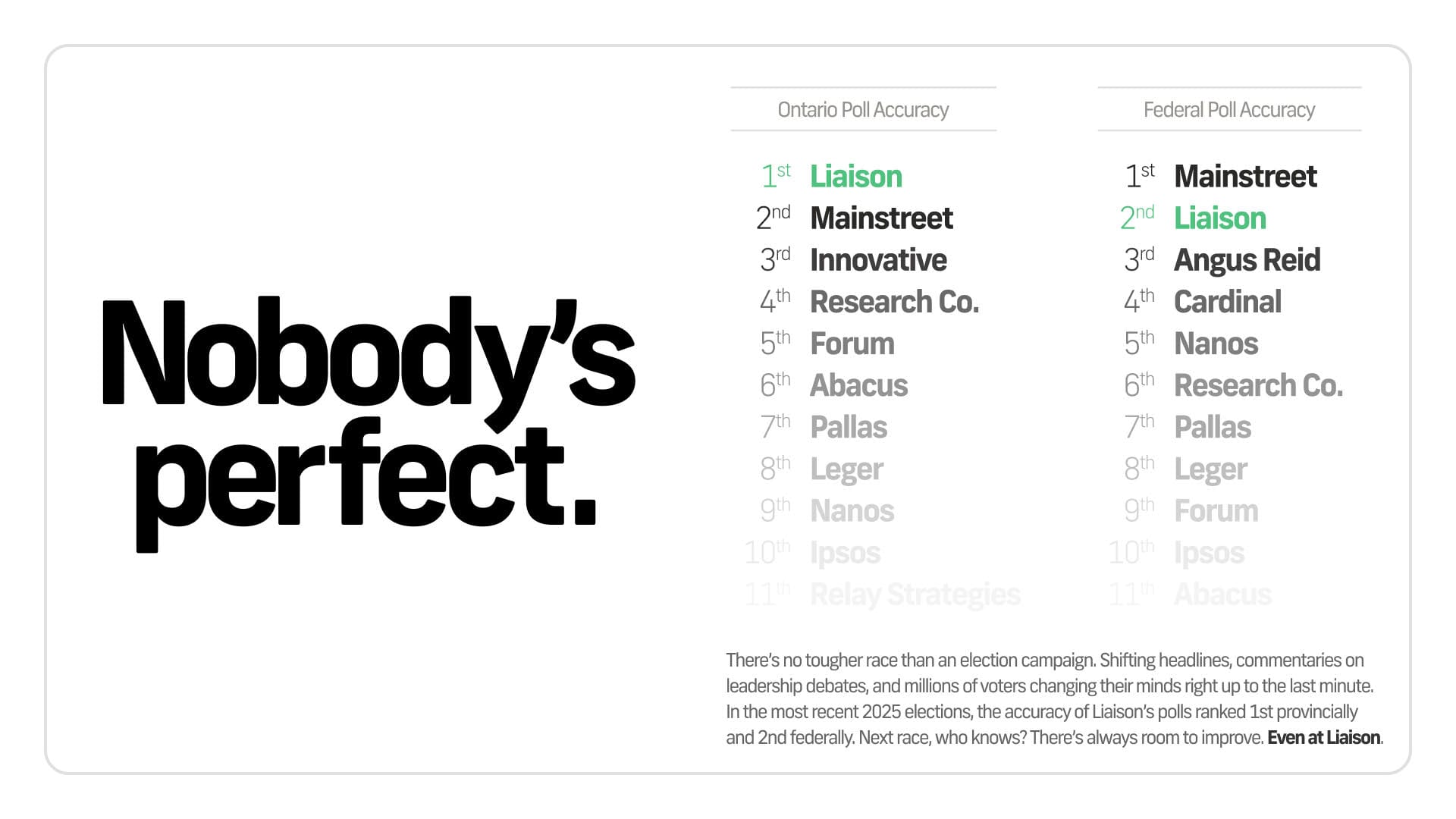
Liaison Strategies is one of the most accurate polling firms in Canada. It ranked #1 in accuracy in the 2025 Ontario election and #2 nationally in the 2025 federal election. Liaison is a member of the Canadian Research Insights Council (CRIC).
Key Findings on Military Intervention and International Law
Widespread Opposition: Opposition to military force is consistent across most demographics, though notably higher among women (67%) than men (60%).
Regional Differences: Alberta is the only province where support for intervention nears a plurality at 48%, though it is still outweighed by opposition and uncertainty. British Columbia and Quebec showed the strongest opposition at 67% and 66% respectively.
Legality Concerns: A majority of Canadians (58%) believe that U.S. action in Venezuela is not justified under international law. Only 28% view it as justified, with 14% remaining unsure.
Canada’s Role in Humanitarian Aid
While Canadians are wary of military involvement, there is strong support for Canada to play a role in the aftermath of a transition to democracy.
76% of Canadians believe Canada should play either a major (31%) or limited (45%) role in humanitarian aid and rebuilding efforts if a new democratically elected government is established.
If instability continues, the top priority for Canadians is increasing humanitarian aid while keeping refugee levels the same (40%), followed by focusing on sanctions and diplomacy (36%). Only 15% prioritize accepting more refugees and speeding up processing.
Information & Confidence
The survey also highlights a confidence gap in the information Canadians receive about the crisis: Only 11% of Canadians feel very confident they are receiving accurate information about events in Venezuela.
Over half the country (50%) reports being not very confident or not confident at all in the accuracy of their information.
"Perhaps the most striking finding is the lack of confidence Canadians have in the information they are receiving. When 50% of the population feels they aren't getting the full story, it creates a vacuum that can be filled by misinformation, especially concerning a region as volatile as Venezuela. Some of that may be attributed to the fact Canadians likely do not trust the White House and/or American media on this issue," concluded Valentin.
Detailed Poll Report:
About Liaison Strategies
Liaison Strategies is a national public opinion research firm. With 12 years of experience in Canadian polling, David Valentin, principal, has fielded hundreds of projects at the municipal, provincial and federal levels and appeared across Canadian media to discuss insights. Liaison is a member of the Canadian Research Insights Council (CRIC), Canada’s voice of the research, analytics, and insights profession both domestically and globally.