Canadians split on how hard to push Iran but say Ottawa’s first job is defending human rights

January 28, 2026 (Toronto, ON) – A new national survey of 1,000 Canadians finds the public pulling Canada in two directions at once: a strong appetite for a tougher stance on human-rights abuses in Iran, alongside a real caution about actions that could raise the risk of wider conflict.
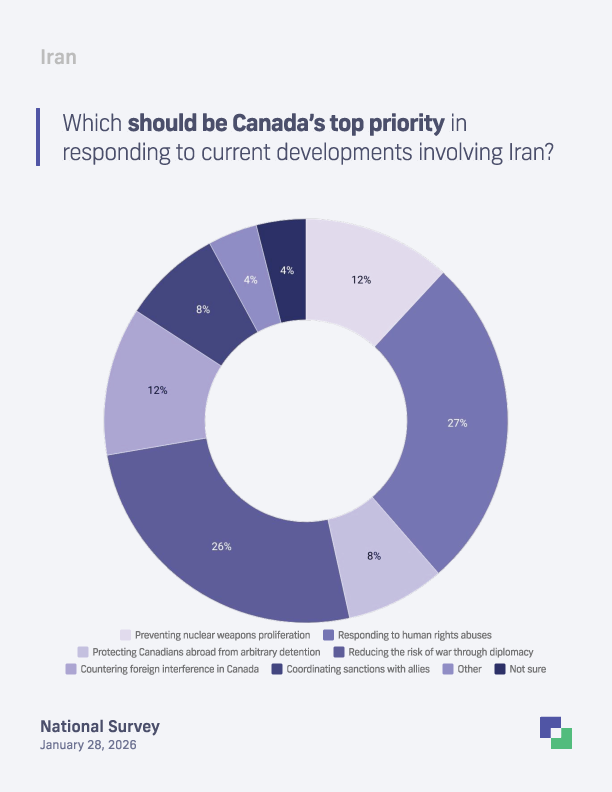
Asked what should be Canada’s top priority in responding to current developments involving Iran, Canadians most often choose responding to human rights abuses (27%) and reducing the risk of war through diplomacy (26%). Preventing nuclear weapons proliferation (12%) and countering foreign interference in Canada (12%) follow, with protecting Canadians abroad from arbitrary detention (8%) and coordinating sanctions with allies (8%) next.
Liaison surveyed a random sample of 1,000 Canadians from January 12 to January 24, 2026, using Interactive Voice Recording (IVR) technology. To ensure a representative sample, participants were reached through random digit dialing (RDD) across both landline and cellular phone networks. Each week, the rolling survey refreshes the sample by adding 500 participants and removing 500. The margin of error is ±3.1 percentage points, 19 times out of 20.
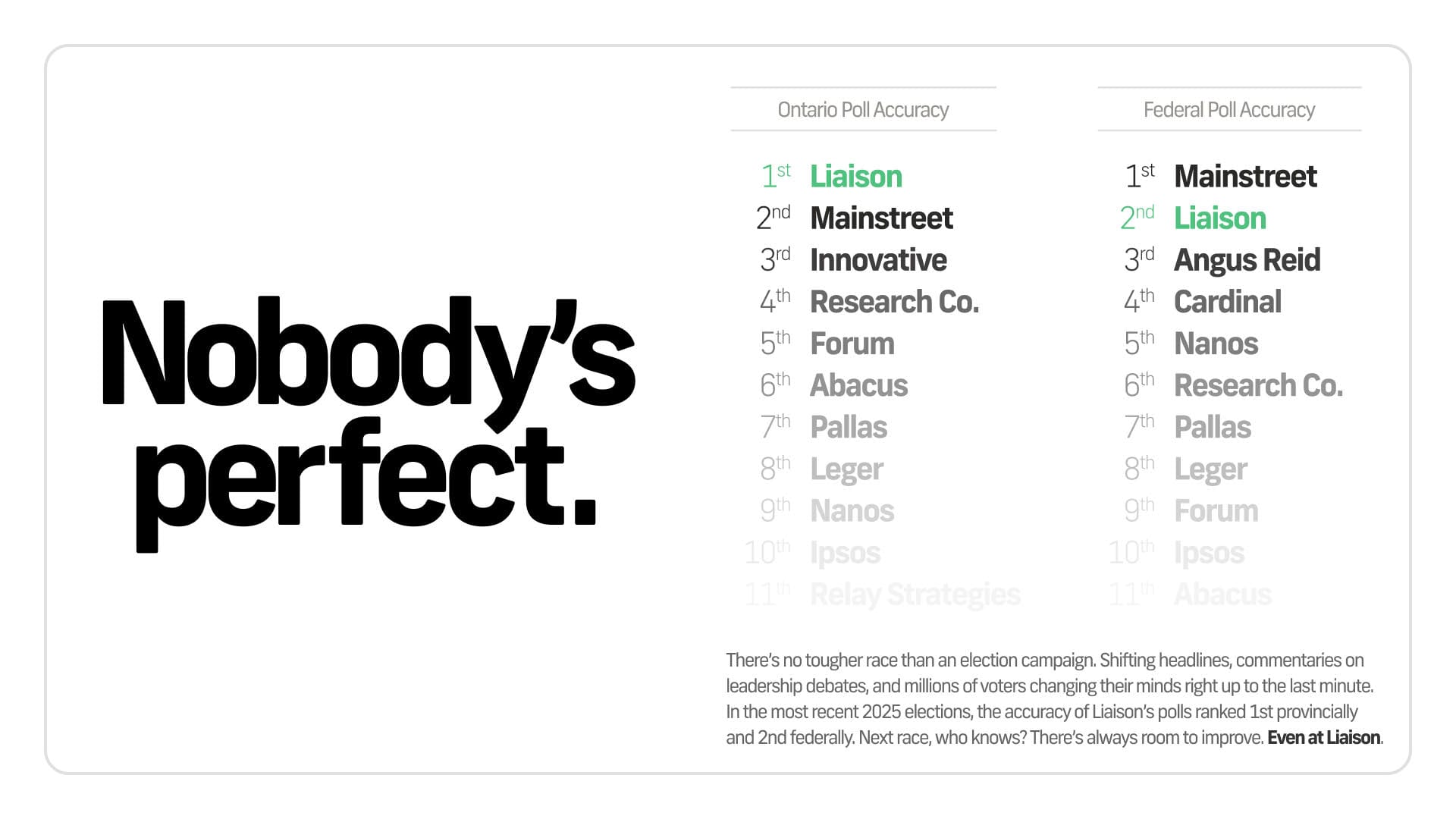
Liaison Strategies is one of the most accurate polling firms in Canada. It ranked #1 in accuracy in the 2025 Ontario election and #2 nationally in the 2025 federal election. Liaison is a member of the Canadian Research Insights Council (CRIC).
A majority of Canadians say they have followed reports of a severe crackdown on protests in Iran at least somewhat closely: 29% very closely and 30% somewhat closely.
David Valentin, Principal at Liaison Strategies, said the following:
“Canadians are not disengaged on this issue and are balancing two instincts at the same time. A lot of people want Canada to be tougher and clearer on human rights. At the same time, there is real caution about steps that could widen the conflict. It's worth keeping in mind that as a middle power there is only so much that Canada could do.”
A majority of Canadians say they have followed reports of a severe crackdown on protests in Iran at least somewhat closely: 29% very closely and 30% somewhat closely.
The country is divided on the right approach
When asked which approach Canada should take in responding to crackdowns inside Iran:
- 30% say Canada should speak out more forcefully and expand punitive measures
- 24% say maintain current levels of pressure and public statements
- 28% say be more cautious to avoid escalation and prioritize diplomacy
- 18% are not sure
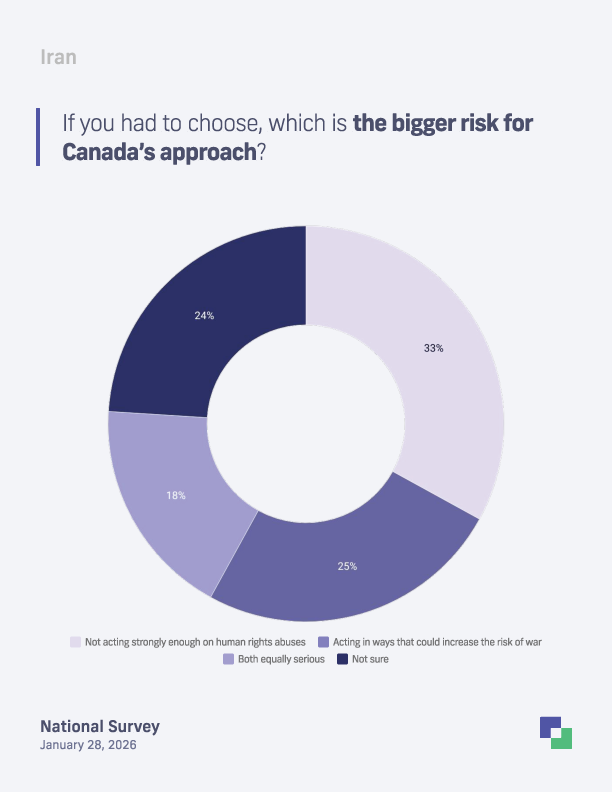
And when forced to choose the bigger risk for Canada’s approach:
- 33% say the bigger risk is not acting strongly enough on human rights abuses
- 25% say the bigger risk is acting in ways that could increase the risk of war
- 18% say both are equally serious
- 24% are not sure
Regional Divergence on Strategy
The survey highlights a sharp regional divide regarding the specific approach Canada should take toward the Iranian government:
- Forceful Action: Nationally, 30% of Canadians support speaking out more forcefully and expanding punitive measures. Support for this approach peaks in Alberta (58%) and Atlantic Canada (44%), while it is lowest in Quebec (13%).
- Diplomatic Caution: In contrast, 44% of Quebec residents believe Canada should be "more cautious to avoid escalation and prioritize diplomacy," nearly double the national average of 28%.
-30-
Detailed Poll Report:
About Liaison Strategies
Liaison Strategies is a national public opinion research firm. With 12 years of experience in Canadian polling, David Valentin, principal, has fielded hundreds of projects at the municipal, provincial and federal levels and appeared across Canadian media to discuss insights. Liaison is a member of the Canadian Research Insights Council (CRIC), Canada’s voice of the research, analytics, and insights profession both domestically and globally.